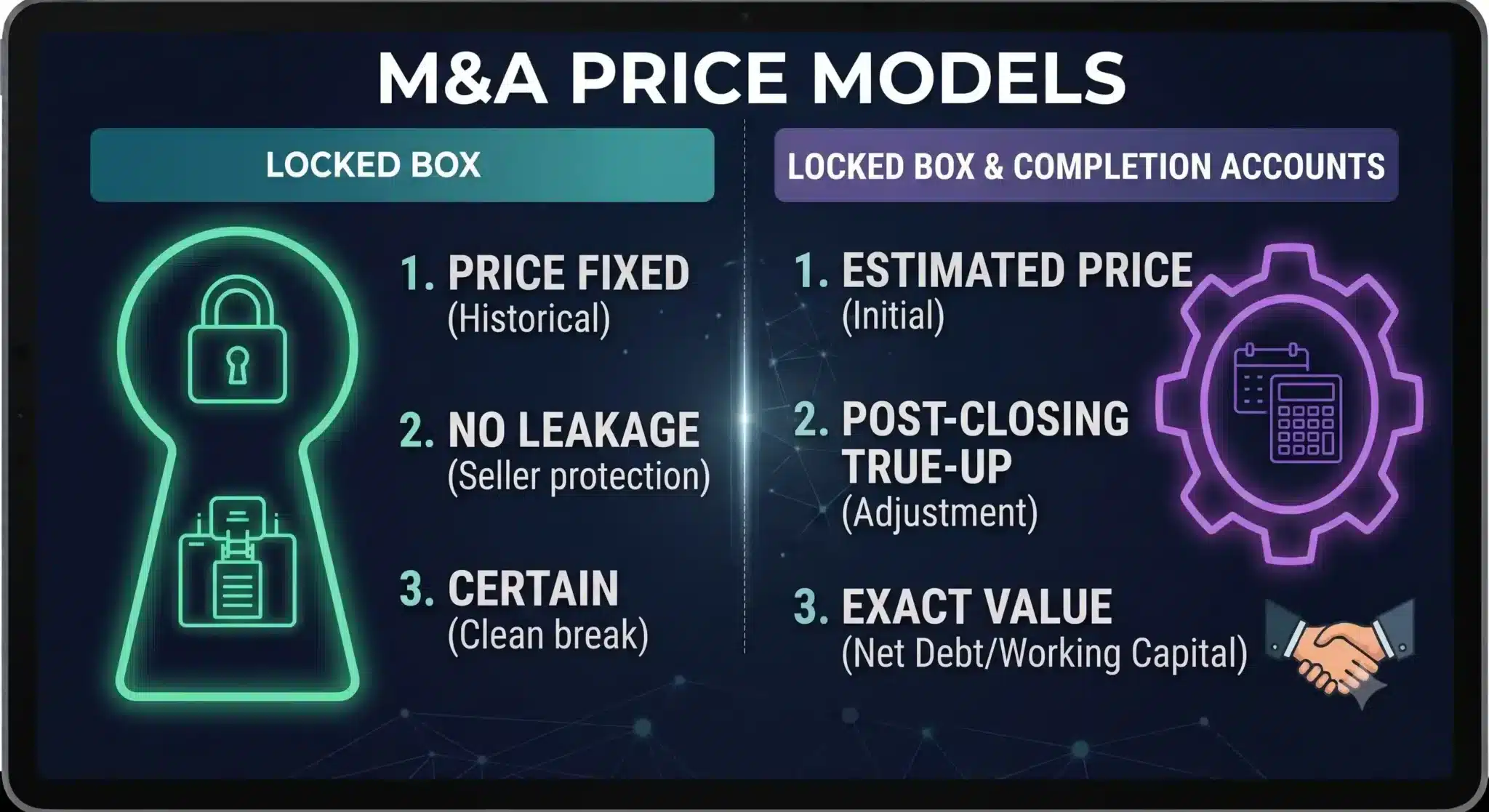
Locked Box vs Completion Accounts:
Imagine that, after years at the helm of your family business, you receive a purchase offer from an industrial competitor or an investment fund. The buyer puts a figure on the table: ten million euros. You can already picture yourself signing at the notary and cashing that cheque. And then, in the middle of due diligence, your advisor utters three words that change everything: “price adjustment.”
The reality is that, in the world of mergers and acquisitions, the headline price almost never matches what the seller ends up banking. Between the two there is a bridge full of technicalities, and the way to cross it is decided by a mechanism agreed in the sale and purchase agreement (the SPA): the price-closing mechanism. In Spain the match is almost always played between two contenders: the Locked Box and the Completion Accounts.
The question has, in our experience, a fairly clear answer for most owners selling for the first time: properly structured, the Locked Box better protects the seller. But it is worth understanding why, and also when that is not the case.
The origin of the conflict: the value bridge (Equity Bridge)
Before choosing a mechanism you have to understand where the problem comes from. When a buyer values your company, they do so assuming they receive it “debt-free, cash-free” and with a normalised level of working capital to operate smoothly. That is the Enterprise Value: the value of the operating business.
But you are not selling an abstract operating business: you are selling the shares of a specific company, with its real debt, cash and working capital. To move from one figure to the other, we advisors build the so-called value bridge:
EqV = EV - NFD +/- ΔWC
Where EqV is the Equity Value (what you actually receive for your shares); EV is the Enterprise Value agreed in the letter of intent; NFD is net financial debt (loans, credit lines, state-backed ICO facilities, leasing... less available cash); and ΔWC is the deviation of working capital from the normalised level the business needs to operate without strain (the so-called Working Capital Target or peg).
The question that decides everything is deceptively simple: at what moment do we measure the variables of that bridge?
- If we measure them on the closing day, we have Completion Accounts.
- If we fix them at a past date and “lock them with a key”, we have a Locked Box.
Everything else is a consequence of that choice.
Completion Accounts: the traditional post-closing price adjustment
The Completion Accounts mechanism is the one that has traditionally dominated industrial and strategic transactions in Spain. In the general M&A segment it remains very relevant: around a third of deals use it.
The logic is intuitive. The price paid on the day of signing before the notary is only provisional: it is calculated with an estimate of the net debt and working capital the company will have on that date. Once the buyer takes the helm, the real accounts are drawn up at the exact closing date and the value bridge is applied with audited figures. From this comes an adjustment (the true-up), which may favour one party or the other:
- Net cash adjustment: if real cash exceeds the estimate (or debt is lower), the buyer pays the difference. If the opposite occurs, the seller returns money.
- Working capital adjustment: real working capital is compared with the normalised target - usually an average of the previous twelve months, to neutralise seasonality. If real working capital falls below the target, the price drops in the buyer's favour.
Advantages and disadvantages for the seller
- In favour: it reflects the exact snapshot of the balance sheet on the day you transfer ownership. No one disputes that it is the system most “faithful” to the reality of the closing.
- Against: and here lies the problem: it generates uncertainty and shifts it to the future. You may receive a financial claim months after having sold. What is more, since the buyer already controls the company and is the one preparing the closing accounts, the information plays in their favour. That is why they usually also require a retention of part of the price in a guarantee account or escrow, which freezes your liquidity just when you thought the chapter was closed. And this is not a theoretical risk: industry studies point to closing accounts as the main source of disputes between buyer and seller after a deal, with a significant share ending up on the desk of an independent expert.
Locked Box: locking the price at a fixed past date
The Locked Box has gained enormous prominence in Spain, especially in the private equity world. In general M&A it was used in close to 50% of deals (versus 33% for completion accounts), and in the private equity segment penetration exceeds 90% - other industry sources, such as the IEB/EFPA analysis, place it at around 88% of fund exits. The market's direction is unequivocal.
The approach is different: the parties fix the price of the shares on a historical, audited balance sheet - for example, the close of the last financial year - the so-called Locked Box Date. From that date, cash, debt and working capital are contractually “locked with a key”. The price is calculated and fixed at the signing of the contract, and is not readjusted afterwards. You receive exactly what was agreed on the day of the deed. No post-closing audits, no deferred discussions.
The interim period and the risk of value extraction (Leakage)
Here arises the buyer's logical question: if I assume the risk and reward of the business from a past date, what stops the seller from emptying the cash before handing me the keys? The answer is the strict regulation of Leakage (unpermitted value outflows) during the interim period, which runs from the Locked Box Date to the actual closing:
- Leakage: any benefit the seller or related parties obtain that falls outside the ordinary course of business: unagreed dividends, exit bonuses to family directors, debt waivers to shareholders, fees of the deal's advisors or atypical contracts. If proven, the seller indemnifies euro for euro, and normally outside the general liability caps of the contract.
- Permitted Leakage: the outflows the parties agree in advance and leave outside penalty: the director's ordinary salary, the market-price rent of the premises owned by the family, or expressly authorised transaction costs. The key is to quantify them precisely in the SPA to avoid surprises.
How is the seller compensated for the value generated up to closing?
Under a Locked Box, the company keeps generating profits during the months up to closing, but those profits stay “inside the box”, to the buyer's benefit. To compensate for that loss, in Spain two routes are negotiated:
- Ticking fee (or equity ticker): a daily increase in the price, calculated as a theoretical interest on the Equity Value or as a fixed amount per day elapsed. Far from being a rarity, its use is growing: according to the 2025 market analysis, around 30% of Locked Box deals included an equity ticker, versus 20% the previous year. It is one of the levers where a good advisor makes a real difference to your pocket.
- Permitted dividend: agreeing that the seller withdraws a specific dividend before closing, reducing the base price by the same amount. It gives immediate liquidity without altering the economic balance.
Locked Box vs. Completion Accounts: a comparison at a glance
|
Criterion |
Locked Box | Completion Accounts |
| Price calculation date | Past historical reference date (Locked Box Date). |
Effective closing date before the notary (Closing). |
|
Price certainty at signing |
Absolute. The price is fixed and known from Signing. | Provisional. The final price is determined months later. |
| Post-closing price adjustments | None (except claims for unpermitted Leakage). |
Yes; euro-for-euro adjustment for changes in net debt and working capital. |
|
Price retention (Escrow) |
Generally none or limited to operational warranties. | Common and high, to cover the potential accounting adjustment. |
| Complexity after signing | Low. Enables a clean transition with no disputes. |
High. Requires preparing closing balance sheets and audits. |
|
Accounting-dispute risk |
Very low. | High; main source of post-closing conflict. |
| Typical buyer profile | Private Equity funds and competitive auctions. |
Local industrial and strategic buyers. |
A numeric example: the same business, two different endings
The theory is easier to grasp with figures. Take an industrial SME valued at a multiple of 8x on an EBITDA of EUR 6 million, i.e. an Enterprise Value of EUR 48 million. At the reference date, net financial debt is EUR 10 million, so the starting Equity Value - what the seller in principle receives - is around EUR 38 million. Normalised working capital (the target or peg) is set at EUR 2 million. Between signing and closing about five months elapse (150 days). The figures are illustrative, but the mechanics are real.
Scenario A - Locked Box
The share price is fixed at EUR 38 million at the Locked Box Date and is not touched. A ticking fee of 5% per year on the equity is agreed to compensate for the interim period: 38,000,000 × 5% × (150/365) ≈ EUR 0.78 million added to the price in the seller's favour. Unless there is unpermitted Leakage (which would be reimbursed euro for euro), the seller receives around EUR 38.78 million with total certainty on the closing day. No retentions, no true-up, no exposure to what happens in the business afterwards.
Scenario B - Completion Accounts
The buyer pays an estimated price of EUR 38 million and, at closing, prepares the real accounts. Two far-from-extraordinary deviations appear: real net debt turns out to be EUR 11 million (one million worse than estimated) and real working capital falls to EUR 1.5 million, half a million below the EUR 2 million target. The combined true-up is -EUR 1.5 million: the seller returns EUR 1.5 million. And that is the best case, because a dispute may still open over whether this or that item is “debt” or “working capital”, or over which accounting policy to apply - discussions that consume months and expert fees.
Same business, same starting valuation. The difference between banking ~EUR 38.78 million with peace of mind or returning EUR 1.5 million after weeks of tension is not in the headline price: it is in the closing mechanism. That is the point.
And what does Spanish law say?
A reasonable doubt: is it valid in Spain to set the price of a sale by a formula, or even to let a third party determine it? The answer is yes. The Civil Code allows the so-called determinable price: article 1447 permits referring the setting of the price to objective criteria or “to the discretion of a specified person”, and article 1449 sets the only relevant limit - that the price must never be left to the discretion of one of the parties alone. Both the Locked Box and Completion Accounts fit without problem, because both rest on criteria agreed in advance.
There is a technical nuance worth knowing. When the closing accounts end up in the hands of an independent expert, that expert acts under Spanish law as an arbitrador (integrating and completing the contract by fixing a figure), not as an árbitro (arbitrator) resolving a dispute under the Arbitration Act. The distinction, backed by classic Supreme Court case law (judgment of 10 March 1986 and later), has practical consequences: their decision binds the parties and the scope for challenge is narrow. Translated: if you enter a completion accounts mechanism, you expose yourself to a third party fixing a figure that is binding.
The battleground is the Spanish General Accounting Plan (Royal Decree 1514/2007). What counts as a “consistent” accounting policy, how inventory obsolescence or bad debt is provisioned, when revenue is recognised... are precisely the fronts triggered by a rigorous financial due diligence and the ones that generate the most litigation in closing accounts. The Locked Box, by fixing the price on an already-closed balance sheet, takes almost all that ammunition off the board.
A note for special situations: in distressed transactions or within insolvency proceedings, the logic changes. There the Consolidated Insolvency Act governs, with its rules on the sale of the productive unit, auction and pre-pack, and neither the Locked Box nor the Completion Accounts operate as in an ordinary transaction.
When does a Completion Accounts protect more?
Selling the Locked Box as the universal solution would not be entirely honest. There are contexts where completion accounts better protect the parties - including, sometimes, a well-advised seller:
- Highly seasonal or volatile businesses, where fixing a representative reference balance sheet is difficult and the interim-period risk is high.
- Complex carve-outs and segregations, where the company being sold does not yet have clean, audited historical accounts on which to “lock the box”.
- Long closing timelines due to regulatory or competition clearances, where the interim period stretches for months and the buyer demands measuring the real snapshot at the end.
- Companies with weak internal controls or heavy intragroup activity, where the buyer does not trust a reference balance sheet and prefers to audit the closing.
And an important warning about Spain: southern Europe has historically been a region of heavy use of post-closing adjustments. The Locked Box is gaining ground quickly, but it is unwise to assume that every local industrial buyer will accept it from the outset. General European statistics, moreover, have in recent years shown a certain pro-buyer bias; the weight of the Locked Box is especially solid in private equity and auctions, which is where the pro-seller thesis holds most strongly.
Maraz's conclusion: protect the seller, but with the homework done
For the owner of a family SME facing their first sale, the Locked Box offers, as a general rule, more protection and more peace of mind. By eliminating post-closing adjustments, it shuts the door on a sophisticated buyer using post-signing accounting to erode the price and claim a refund - what in the jargon is known as “the working capital trap”. And along the way it saves you months of technical discussion, audit costs and funds frozen in an escrow.
That said, for a Locked Box to be viable and safe, two non-negotiable conditions are needed:
- Impeccable accounts at the Locked Box Date. The reference balance sheet must be solid, transparent and, ideally, audited. Any accounting weakness will invalidate the method in the eyes of a serious buyer. Here a well-executed vendor due diligence is worth its weight in gold.
- Leakage definitions negotiated with an expert hand. Precisely delimiting which payments and incentives to your team are permitted during the interim period is what prevents accidental penalties. A poorly drafted nuance can cost a great deal of money.
At Maraz Corporate Finance we support you from the letter of intent onwards to design the optimal value bridge and defend the price mechanism that best shields your business family's wealth - whether a well-built Locked Box or, when the case calls for it, completion accounts with the appropriate safeguards. If you are considering the sale of your company, let's talk before opening the data room: the structure is won at the table, not in the subsequent audit.
Javier de Rojas Roca de Togores
Partner - Maraz Corporate Finance
FAQs on Locked Box vs. Completion Accounts
What is the essential difference between Locked Box and Completion Accounts?
The Locked Box fixes the share price on a historical balance sheet and does not readjust it after closing; the seller receives a certain amount. Completion Accounts pay a provisional price that is adjusted up or down when the real accounts are drawn up at the closing date. In short: certainty versus later adjustment.
Why is the Locked Box said to protect the seller more?
Because it eliminates the later price adjustment and, with it, the risk of the buyer claiming a refund months later using the closing accounting. The seller knows their cheque from signing, avoids escrow retentions and sidesteps the main source of post-closing disputes. It is especially advantageous in auction processes and private equity exits.
What is Leakage and why must I watch it?
It is any outflow of value from the company in favour of the seller or related parties during the interim period that does not correspond to the ordinary course of business: unagreed dividends, exit bonuses, waivers to shareholders, etc. If it occurs, the seller reimburses it euro for euro. That is why it is key to define permitted Leakage well (salaries, market-rate rents, authorised costs) in the SPA.
Does the seller lose the profit the company generates up to closing?
Not necessarily. Since under a Locked Box that profit stays “inside the box” in the buyer's favour, the seller is compensated with a ticking fee (a daily interest on the equity) or by agreeing a permitted dividend before closing. In the Spanish market the use of the equity ticker has grown strongly in recent years.
Is it valid in Spain to set the price with these mechanisms?
Yes. The Civil Code allows a price determinable by objective criteria (articles 1447 and 1449). The only limit is that the price must not be left to the discretion of one of the parties alone. When an independent expert intervenes in the closing accounts, they act as an arbitrador - integrating the contract by fixing a binding figure - not as an arbitrator.
So, should I always demand a Locked Box?
No. It is the best option in most SME sales with solid accounts, but Completion Accounts may fit better in highly seasonal businesses, complex carve-outs, long closings due to clearances or companies with weak controls. The decision must be made case by case, and that is where advice makes the difference