The Share Purchase Agreement (SPA) is the contract that completes the sale of a company's shares and, with them, control of the business. It is far more than a legal formality: it is the legal translation of the target's economic, tax and operational reality. The way it is drafted determines which party bears historical risk, how changes in value are allocated between signing and closing, and the conditions under which the sellers actually receive the agreed price.
The Spanish market has undergone a clear shift towards contractual sophistication. According to TTR Data's Iberian Market Annual Report 2025, deals worth EUR 103,085 million closed in Spain in 2025 — up 19.4% on the prior year — even as deal count fell to 3,336: fewer transactions, but larger and more technically demanding. In the middle market — Maraz's segment, with enterprise values between EUR 5 and 250 million — activity hit record highs, with an average ticket of around EUR 25 million. In that context, mastering the structure of the SPA is what separates a good valuation from a good deal.
The valuation bridge: from Enterprise Value to what the seller receives
The price agreed in the letter of intent is usually expressed as Enterprise Value (EV): the value of the operating business, assuming it is transferred debt-free with a normalised cash level. But the seller does not receive EV; the seller receives Equity Value, which is what remains after adjusting for debt, cash and working capital. The translation between the two — the equity bridge — must be defined in painstaking detail in the SPA. In simplified form:
Equity Value = Enterprise Value − Net financial debt + Cash − Working capital adjustment + Non-operating assets
Every term in that formula is negotiated, and this is where a rigorous business valuation becomes essential: without a sound starting point, the economic clauses of the SPA have no anchor. To fix the moment when risk passes from seller to buyer, the Spanish market uses two main mechanisms.
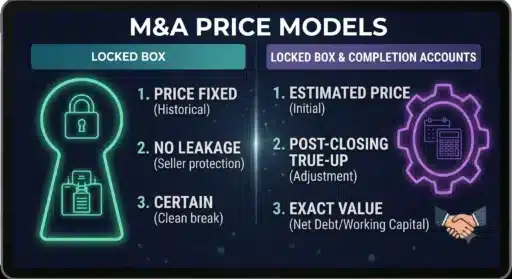
Locked-Box versus Completion Accounts
|
Locked-Box |
Completion Accounts |
|
|
Use in Spain (2025) |
~50% of deals; up to 88% in private equity exits. | ~33% overall; predominant (≈48%) in industrial/corporate deals. |
| Reference balance sheet | Historical date prior to signing (last audited accounts). |
Effective closing date and transfer of control. |
|
Risk transfer |
Retroactive to the locked-box date. | On the closing date. |
| Post-closing settlement | None, except claims for leakage. |
Euro-for-euro price adjustment after auditing the closing balance sheet. |
|
Seller compensation |
A daily interest charge (equity ticker) to closing is usually agreed. |
N/A: the seller enjoys the cash generated up to closing. |
Locked-Box. It provides certainty: the seller knows exactly what it will receive from signing, and post-closing balance-sheet disputes are eliminated. In return, since the buyer bears the risk of the business from the historical date, the SPA must protect two things: a prohibition on leakage — dividends, extraordinary bonuses, debt forgiveness, below-value asset sales — with a euro-for-euro clawback, and a definition of permitted leakage. An equity ticker is frequently added to compensate the seller for the cash the business generates until closing.
Completion Accounts. Preferred in the industrial world and in seasonal businesses or those with less institutionalised accounting, because the buyer pays for the exact financial picture on the closing date. The danger here lies in working capital: market studies show that almost all deals with an adjustment regulate net debt, but fewer than half include a specific working-capital adjustment. That omission is dangerous, because it gives the seller an incentive to strip the business before closing — delaying supplier payments or accelerating collections — inflating cash at the cost of handing over a company with no operating liquidity.
The fix: set a working capital target based on the trailing 12-month average and adjust deviations euro for euro. It is also advisable to address trapped cash and debt-like items (litigation provisions, accrued unpaid tax, pension commitments).
From due diligence to the SPA: managing contingencies
Financial, tax, legal and labour due diligence is the foundation on which the SPA is negotiated: each risk identified must have a concrete contractual response. In the Spanish market there are three main ways to handle contingencies:
- Direct price reduction: for probable, quantifiable contingencies (a final tax debt, an unpaid penalty), deducted directly from Enterprise Value in the valuation bridge.
- Escrow retention: for identified but uncertain risks, 10% to 15% of the price is locked in an escrow account for 18 to 36 months, released if the contingency does not materialise.
- Specific indemnity: for systemic or major risks (ongoing litigation, an open tax audit), a clause obliging the seller to hold the buyer harmless, operating independently of the general liability caps.
Representations & Warranties: why they replace the Civil Code
One of common law's contributions to Spanish practice is to displace the default statutory regime of the Civil Code with a self-contained contractual system of Representations & Warranties (R&W). The seller makes detailed written statements about the legal, financial and operational state of the target and undertakes to indemnify the buyer if they prove false.
Why is the law not enough? Because the hidden-defects regime of article 1484 of the Civil Code is wholly unsuited to a company sale: it allows just six months to claim, requires proving the defect was serious, pre-existing and hidden, and releases the seller if the buyer ought to have known of the problem through its own expertise. R&W clauses replace this with an objective regime: it is enough to prove that what was stated did not match reality on the closing date, with periods extended by agreement (typically 18-24 months for business warranties, and the statutory limitation period for tax and labour matters).
Negotiation focuses on the liability limits, which follow a clear pattern in Spain:
- Fundamental warranties (seller's capacity, title to the shares, absence of encumbrances): cap at 100% of the price, or uncapped. In 2025, most deals set the cap at the purchase price and a minority agreed unlimited liability.
- Business warranties (tax, contracts, intellectual property, licences): without W&I insurance, the cap typically sits in a 10% to 30% range of the price.
- Baskets and thresholds: minimum amounts below which no claims can be brought, to avoid low-value disputes that sour the post-closing relationship.
Warranty & Indemnity (W&I) insurance and the clean exit
The most disruptive trend has been the rise of Warranty & Indemnity (W&I) insurance, which has grown from covering roughly a third of deals in 2024 to close to 40% in 2025, spreading from large deals into the mid-market. Its appeal is that it enables a clean exit: the risk of breach of business warranties is transferred to an insurer, so the seller receives 100% of the price at closing with no retention or escrow, and the buyer pursues any claim against a solvent insurance company rather than an individual seller. For private equity funds it is almost standard, because it maximises IRR by allowing cash to be distributed immediately.
Conditions precedent and deferred closing
In Spain, signing and closing rarely coincide: in 2025, only around a third of deals were signed and closed in a single act. The rest included conditions precedent to be satisfied before closing:
- Regulatory approvals: merger control before the CNMC when legal thresholds are exceeded, foreign direct investment (FDI) clearance for non-EU buyers in strategic sectors, or sector regulators such as the DGSFP in insurance.
- Third-party consents (waivers): change-of-control clauses in financing or key customer contracts that require prior consent to the transfer, on pain of acceleration or termination.
- Pre-closing reorganisations (carve-out): where a unit embedded in a larger group is acquired, the SPA requires the seller to first isolate it in a company free of cross-group liabilities.
Earn-outs and post-closing covenants: where disputes arise
The earn-out (contingent payment tied to future results) holds at around 32% of deals, and is common in high-growth businesses or where buyer and seller cannot bridge the valuation gap. Its Achilles' heel is the conflict of incentives: once control passes, the buyer can run the business in ways that distort the EBITDA underlying the calculation. A well-drafted SPA neutralises this with surgical clauses:
- Separate management: an obligation to keep the business accounted for separately during the earn-out period, ensuring the metric is traceable.
- Cap on group costs: a prohibition on charging the subsidiary the buyer's corporate overheads (management fees, head-office costs) unrelated to day-to-day operations.
- Resource support: a commitment to provide the financial and commercial means historically required to deliver the business plan.
- Payment acceleration: the seller's right to collect 100% of the maximum contingent amount if the buyer resells the company or removes the founder without serious cause.
On top of this come non-compete and non-solicitation covenants, which in Spain must be limited in duration (two to five years, less in search fund deals), geographic scope (only the territory actually served) and sector (only the directly competing activity); overreaching on any of the three can render the clause void. In deals where the founder is key to the transition — common in the mid-market and in search fund acquisitions — the SPA is coordinated with a Transition Services Agreement (TSA) governing the founder's tenure (6 to 18 months), pay and division of authority.
Dispute resolution: arbitration versus ordinary courts
However carefully drafted, the valuation bridge, completion accounts or earn-out can give rise to disputes. The dispute-resolution clause decides timing, expertise and confidentiality. In Spain, the ordinary civil courts remain the majority choice (around 65%), even though a commercial dispute can take 3 to 5 years to reach a final judgment. Arbitration (around 35% and rising) offers awards in under 12 months, confidentiality and specialist arbitrators, with Madrid and Barcelona the usual seats. For purely technical disagreements — accounting criteria, the working-capital calculation or the earn-out EBITDA — practice imposes an escalation clause referring the matter to an independent accounting expert whose decision is binding, avoiding costly formal arbitration.
Conclusion
Success in a mid-market transaction does not end with agreeing Enterprise Value: it is won in the precise negotiation of each of the SPA's economic clauses. The choice between Locked-Box and Completion Accounts, the working-capital adjustment, the scope of the warranties, the use of W&I insurance or the design of the earn-out all determine how much the seller actually receives and what risk the buyer assumes. Given its level of detail and its legal, financial and tax implications, the SPA must be approached with expert advice from the start of the process, not in the final stretch.
At Maraz Corporate Finance we support mid-market business owners through every phase of the transaction, from preliminary analysis to signing the SPA. Explore our M&A and company sale advisory or contact our team.
Javier de Rojas Roca de Togores
Partner – Maraz Corporate Finance