Obstacles in an M&A Sale: A Seller's Guide
For most business owners, selling a company is the single most important financial decision of their professional life. And yet it is also one of the most likely to go wrong. There is a telling saying in the industry: to close a deal successfully, you first have to have fallen—or come close to falling—at several points along the way. The so-called deal breakers can surface unexpectedly at any stage.
For the owner of an SME facing a sale for the first—and probably only—time, knowing in advance where the obstacles lie can make the difference between closing the sale at a good price and not closing it at all. In this article we review, from the seller's perspective, the main pitfalls that can arise in an M&A sale process and, above all, how to anticipate and overcome them.
It is worth remembering that the market is active. The mid-market (middle market) and family-business segments are driving the recovery of M&A activity in Spain, underpinned by the stabilisation of the European Central Bank's interest rates, the abundant liquidity built up by private equity funds (dry powder) and the growing role of family offices. There is buyer appetite—particularly international—but also rising selectivity: deals are more discerning, and the market favours those who arrive prepared.
1. The valuation gap: unrealistic price expectations
This is probably the first and most frequent point of friction. Sellers tend to value their company by what it cost them to build, by the effort invested, or by what they have “heard” is paid in their sector (“my sector trades at 8 times EBITDA”). The buyer, by contrast, pays for the business's future capacity to generate cash and for the risk it perceives.
This difference in expectations—the so-called valuation gap—breaks many negotiations before they even begin. Relying solely on a generic sector multiple is a mistake: the multiple is the result of weighing risk against expectations, and it varies according to size, growth, revenue recurrence and the quality of the business.
How to anticipate it: carry out a professional, rigorous valuation before going to market, combining methodologies (discounted cash flow and comparable-transaction multiples) to build a defensible value range. At Maraz Corporate Finance we stress that a valuation cannot rest on a single lens, but on a coherent and robust financial narrative that supports the price in front of the buyer. When sellers come to the table with arguments—growth, profitability, debt levels, competitive position—rather than a multiple picked up by hearsay, they negotiate from a position of strength.
2. Due diligence: when contingencies surface
Due diligence (the buyer's exhaustive review of the company) is where everything beneath the income statement is examined in detail.
Most of the problems that surface are not fraud, but oversights accumulated over years. The most common findings that destroy value or stall deals are: unreliable accounting, or accounts that mix personal and company expenses; assets with unclear title (real estate, trademarks or machinery improperly registered); tax contingencies arising from poorly documented deductions; hidden labour liabilities (bogus self-employment, social security debts); and excessive dependence on a few clients or on the founder. Any of these findings can translate into a price reduction, into stronger warranties being demanded, or, outright, into the collapse of the deal.
Two areas account for much of the friction and are worth understanding in advance:
- Quality of Earnings. The buyer does not pay for the EBITDA shown in the accounts, but for normalised EBITDA: the figure that results from stripping out non-recurring items (extraordinary severance, one-off income or expenses), personal expenses charged to the company, or below-market salaries and rents in related-party transactions. Since the company's value is calculated by applying a multiple to that EBITDA, any downward adjustment that emerges in the buyer's review devalues the offer directly and, worse still, erodes trust.
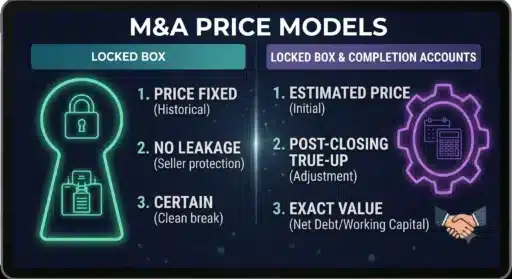
- Net financial debt and working capital. The price is first agreed as the value of the company (enterprise value) and then translated into what the seller actually receives (equity value) by subtracting net financial debt and adjusting for working capital. The problem is that the buyer's advisers tend to widen the perimeter of “debt” by including debt-like items: deferred tax liabilities, shareholder loans, litigation provisions or pending severance commitments. And if working capital at closing falls below the target level agreed in the contract, post-closing price adjustments unfavourable to the seller are triggered. These are technical details that translate into hundreds of thousands of euros.
How to anticipate it: with a vendor due diligence, commissioned by the seller before going to market. It allows problems to be identified and corrected before the other side discovers them, keeps control of the timetable, avoids surprises that erode trust and preserves negotiating power. It is best started six months to a year in advance, because remedying contingencies takes time. At Maraz Corporate Finance we pay particular attention to normalising EBITDA correctly and to anticipating the debate over net debt and working capital before going to market, because that is precisely where an ill-prepared seller loses value in the final stretch.
3. The company's lack of preparation
Closely related to the above: many owners go to market with financial information that is disorganised, incomplete or that “does not tell the same story” as the seller's pitch. This breeds mistrust, lengthens timetables and reduces room for manoeuvre.
A company with well-structured information can complete due diligence swiftly; one with scattered documentation and poorly cleaned-up accounts can drag it out for months and, along the way, lose the buyer.
How to anticipate it: prepare an orderly virtual data room (financial statements, contracts, corporate records, intellectual property, labour matters), normalise EBITDA by removing non-recurring items, clarify the corporate structure and carve out non-operating assets. A well-prepared company conveys professionalism, shortens timetables and reduces the buyer's scope to negotiate the price down.
4. Dependence on the owner and the team
Buyers want to acquire companies that run autonomously, not the owner's personal agenda. When the business depends too heavily on the owner—client relationships, strategic decisions, business know-how—the buyer perceives instability. The most immediate impact is a discount to the valuation.
There is a further dimension to key person risk: where ownership and management do not coincide, the management team can condition the deal. When key executives suspect that the sale threatens their job security, they may deliberately obstruct the supply of information to the data room, delaying or blocking the process.
How to anticipate it: professionalise management and build a competent second tier of leadership well in advance; document processes and systems; and keep the most trusted members of the team informed, aligned, protected in employment terms and incentivised for the deal, through clear communication plans and incentives linked to the success of the transaction (transaction bonuses). Lock-up or retention clauses (of two to five years), often tied to earn-out schemes, help retain key talent after closing.
5. Client or supplier concentration
A highly concentrated portfolio—a few clients accounting for a substantial share of turnover, or critical dependence on a single supplier—increases perceived risk and penalises the valuation. The buyer discounts that risk by reducing the multiple or the EBITDA to which it is applied.
How to anticipate it: diversify the client and supplier base before the sale, formalise multi-year contracts that bring recurrence and predictability of revenue, and document client loyalty. Recurrence is one of the factors that most raises a company's value.
6. Deterioration of trading during the process (current trading)
An M&A deal absorbs an enormous amount of time and management attention. A common mistake is for the owner to neglect day-to-day management, thinking the company is “as good as sold.” If sales or margins begin to contract during the process, the buyer will read it as the company losing traction and will be entitled to invoke material adverse change clauses or demand a reduction in the agreed price.
How to anticipate it: keep your focus on the business as if the sale were not going to happen, and delegate the running of the transaction to an external adviser who frees management from the burden of the process. When a third party coordinates the deal, the owner can keep hitting budget, which is precisely what underpins the price.
7. Negotiating the contract: earn-outs, warranties and escrow
Once the price is agreed, what remains is to negotiate how and when it is paid and what warranties the seller provides. Some of the most technical obstacles cluster here:
- Earn-out: part of the price is deferred and made conditional on meeting future targets (EBITDA, turnover). It is useful for bridging the valuation gap, but it demands very precise drafting: the running of the business during the period must be regulated, the metrics clearly defined, and provision made for what happens on a change of control. The recommended period is usually between 12 and 24 months.
- Representations & warranties: the seller's statements about the company's situation. The buyer will want to include as many as possible and protections that are as broad as possible; the seller needs certainty and to limit liability. To resolve that tension, limits are agreed: the cap (the maximum amount for which the seller is liable, usually a percentage of the price), the de minimis (the minimum threshold a single claim must exceed to be indemnifiable) and the basket or deductible (the aggregate amount claims must accumulate before the obligation to indemnify arises). Negotiating these limits well is as important as the price.
- Escrow: a portion of the price (typically between 10% and 20%) is deposited in an account controlled by a neutral third party to cover potential claims. In Spain this role is usually performed by a notary or a law firm.
- Warranty & indemnity insurance (W&I insurance): a policy, increasingly used in Spain, that transfers to an insurer the risk of a breach of warranties, allowing the escrow to be reduced or eliminated.
How to anticipate it: understand that these clauses are as important as the price itself. Accepting risky payment terms or unlimited warranties can cost as much as selling cheap. Here the support of an M&A adviser and specialist lawyers is decisive.
9. Tax and legal aspects: the structure of the deal
Taxation can turn the largest gain of an entrepreneur's life into an avoidable tax bill. Selling the shares directly as an individual makes the gain taxable in the savings base of personal income tax at high rates and immediately.
Structure matters, and a great deal: channelling the sale through a holding company that meets the legal requirements allows the participation exemption to be applied (generally 95% of the capital gain), leaving a very low effective tax burden at the corporate level and deferring the taxable event, which increases the liquidity available for reinvestment. The problem is that these decisions cannot be made on the day of signing: setting up the holding and contributing the shares requires advance planning to qualify for the tax-neutrality regime.
How to anticipate it: plan the tax and wealth structure well in advance, and do so without the prior reorganisations cooling the buyer's interest. A well-structured sale begins long before sitting down to negotiate.
10. Confidentiality and information leaks
A leak of the deal—among employees, clients, suppliers or competitors—can seriously damage the business and may even lead the seller, out of anger or as a defensive measure, to postpone or cancel the sale. Premature disclosure breeds uncertainty among staff, alerts competitors and can scare off buyers.
How to anticipate it: the non-disclosure agreement (NDA) is the gateway to the process: no serious buyer should receive detailed information without having signed one. It is also advisable to work with a blind profile (teaser) in the early stages, to control access to the data room and to disclose the most sensitive information only in the final phases. A generic NDA downloaded from the internet, or one of insufficient duration, is a route for leaks.
11. The seller's emotional factors
After years—sometimes decades—at the helm of the project, emotional attachment can sap objectivity: overvaluing the company, rejecting reasonable offers, resisting concessions in negotiation, or even withdrawing unilaterally at final signing out of pure second thoughts. The industry itself acknowledges that the main obstacle usually lies in the more psychological side of deals.
How to anticipate it: rely on an adviser who brings objectivity and acts as an intermediary, separating emotion from the financial decision. The adviser absorbs much of the negotiating tension and allows the owner to keep a cordial relationship with the buyer. Where the bond with the project runs deep, an orderly transition or a deferred exit over time helps to digest the change.
12. Timetables and loss of momentum
An M&A deal involving a Spanish SME usually closes within 6 to 12 months; the most complex—several shareholders, intricate groups, debt or real estate—can exceed 18. Time is the enemy of deals: the longer the process drags on, the greater the chance that circumstances change, the negotiation cools or new risks appear.
How to anticipate it: arrive with the documentation ready (vendor due diligence and data room), appoint a single experienced point of contact and, where possible, run a competitive process with several interested parties, which forces buyers to move swiftly.
13. The buyer's financing
Many deals depend on the buyer—particularly private equity funds that use leverage (leveraged buy-out)—securing financing. Lenders subject historical and projected cash flows to strict stress tests to verify ample debt-service capacity. If the sector is viewed unfavourably, if the projections fail that test, or if the rate environment makes credit more expensive, the deal can collapse at the last moment.
How to anticipate it: qualify buyers from the outset, verifying their solvency and real ability to close, and do not grant exclusivity without having checked the candidate's seriousness and financing. A well-prepared Independent Business Review brings analytical discipline and builds confidence among lenders' risk committees, easing financing.
14. Regulatory, competition and cultural-integration aspects
Depending on size and sector, a deal may require authorisations that lengthen timetables: merger control by the CNMC where certain market-share or turnover thresholds are exceeded, or the foreign-investment screening regime for non-resident investors in strategic sectors. It is worth identifying early whether the deal is subject to these filters and building them into the calendar as conditions precedent.
To this is added, particularly with international buyers, cultural and negotiating-style differences, which can block conversations or jeopardise the success of post-deal integration. For a seller retaining an earn-out or a lock-up period, this factor is also directly economic, so it is worth assessing cultural fit during the negotiation, and not only the numbers.
Preparation is everything: vendor due diligence and phased deals
Success in closing a deal is proportional to the anticipation applied in the preceding months. Two tools make the difference for the seller.
The vendor due diligence (VDD), commissioned by the shareholders themselves with an ideal horizon of 6 to 24 months, allows contingencies to be identified and remedied before the buyer examines them, value to be maximised by optimising cash generation and EBITDA normalisation, post-closing warranties to be tightened and the escrow reduced, and the process to be accelerated by raising the seller's credibility in front of competing buyers.
Phased deals offer an alternative to selling 100% “in a single act” where there are divergences over future value or where the founder's orderly continuity is key: an initial controlling stake is transferred (for example, 70%) and the remainder is reserved under cross put/call options exercisable over several years, linked to future performance. This route reduces the buyer's initial risk, aligns interests, professionalises the transition in family-succession contexts and allows the owner to capture the increase in value from the joint business plan.
Conclusion: obstacles are not insurmountable
An obstacle, by definition, is something that hinders an action—but nowhere does it say it cannot be overcome. The vast majority of the pitfalls we have reviewed—the valuation gap, due-diligence contingencies, dependence on the owner, contract clauses, taxation, information leaks—can be anticipated and mitigated with planning, preparation and experience.
The best recommendation for navigating almost all of them is the same: rely on a financial adviser specialised in M&A from the very start. A corporate finance boutique knows the terrain, brings methodology and objectivity, protects confidentiality, creates competition among buyers and negotiates in defence of the seller's interests.
Maraz Corporate Finance—specialised in M&A transactions and restructurings—accompanies owners through every phase of the process: valuation, design of the sale strategy, buyer identification, coordination of due diligence, negotiation of the contract, signing and closing. It does so with the methodological standards of investment banking and the closeness of a boutique, with direct partner involvement and a team of solid technical grounding.
If you are considering selling your company, speak to a specialist adviser before taking the first step: the difference between an orderly sale and a defensive negotiation begins long before sitting down at the table.
Javier de Rojas Roca de Togores
Partner – Maraz Corporate Finance
Frequently asked questions (FAQ) about obstacles in an M&A sale
How long does an M&A deal take?
The sale of a straightforward Spanish SME usually closes within 6 to 12 months from the start of the process to signing before a notary. Complex ones—several shareholders, groups, debt or real estate—can exceed 18. The factor that matters most is not the market, but the state of preparation with which the company arrives at the process.
What is due diligence?
It is the exhaustive review (financial, legal, tax, labour and commercial) that the buyer carries out on the company to verify that the information provided by the seller is true and complete, and to identify potential risks or contingencies. It is not a legal obligation, but no professional deal closes without it.
Why is a vendor due diligence an investment and not a cost?
Because it reverses the negotiating balance. In deals where the buyer leads the investigation exclusively, every contingency it detects becomes an argument to cut the price, demand more warranties or drag out the closing. By commissioning its own due diligence, the seller identifies and remedies those weaknesses internally and enters the negotiation with a clean, transparent company, maximising the final price and reducing the risk of a break-up.
Do I need an adviser to sell my company?
It is not mandatory, but attempting to sell without specialist advice is one of the most decisive mistakes an entrepreneur can make. It is also worth distinguishing between a generalist adviser and one specialised in transactions: many mid-market deals fail because due diligence is treated as a formality or because contractual clauses are poorly drafted. An M&A adviser values the company objectively, identifies qualified buyers, creates competition, negotiates on a level footing and coordinates due diligence and the contract.
How is a company valued, and why does the price exceed book value?
Book value is a historical snapshot (assets minus liabilities). The price a buyer pays looks to the future: the recurring capacity to generate cash, intangibles (brand, client base, talent) and synergies. That is why a multiple is applied to normalised EBITDA, which usually places the price well above book value. A rigorous valuation combines several methods—discounted cash flow and comparable multiples—to build a defensible range, not a single figure.
What is an earn-out?
It is a mechanism whereby part of the price is deferred and made conditional on the business meeting future targets (EBITDA, turnover, milestones). It serves to bring buyer and seller expectations closer when there is uncertainty, and usually extends over 12 to 24 months. It requires very careful contractual drafting.
Can I keep the deal secret?
To a large extent, yes, if it is managed with discipline: signing an NDA before sharing information, using a blind profile in the early stages, controlling the data room and disclosing the most sensitive information only at the end. There is, however, a tension: the more confidentiality you demand, the fewer buyers you reach and the slower the process.