M&A advisory in Spain: selling and buying companies
We sell companies with €10m to €300m in revenue through a competitive process among trade buyers and funds, with a partner in charge from start to finish. Tell us about your case and within 72 hours we give you an indicative valuation range, free of charge and in full confidence.
Or call +34 965 133 120

Maraz expert advisors for the sale and purchase of your company
At Maraz Corporate Finance, we are specialists in advising and managing M&A transactions for middle market companies, providing a comprehensive advisory service in all phases of the process, whether in the purchase or sale of companies. Our approach focuses on maximizing and optimizing the value of each transaction for our clients, with extensive experience in valuation of companies and transactions.

Who is our M&A service for?
Our M&A service is for anyone who has to decide on a sale, an acquisition or a merger and wants to do it with maximum value and minimum risk:
- Business owners who want to sell their company on the best terms.
- Investors and business groups looking for strategic acquisitions.
- Expanding companies growing through mergers or acquisitions.
- Business families and shareholders in succession or divestment processes.
If you are considering a transaction, tell us about your case: within 72 hours we give you an indicative valuation range, free of charge.
What is M&A advisory and why does it matter?
Selling a company is the most important financial transaction in a business owner’s life, and it usually happens only once. The M&A adviser prepares the company for sale, values it, finds and screens buyers, leads the negotiation and protects the seller in the contract until signing. The work has a measurable goal: that the deal closes, at the best price and with the least risk afterwards for the seller.
At Maraz we do it through a competitive process. Several buyers at once, trade and financial, with the same information and the same deadlines. It is the difference between negotiating with a single bidder who sets the pace and choosing between comparable offers, and the best way to avoid the most common mistakes when selling a business.

M&A services: selling and buying companies
We advise business owners, shareholders and investors on selling and buying companies, with a tailored strategy to maximise value and reduce risk.

Selling a company (sell-side)
On the sell side we start by understanding the business in depth: which variables support its value and which a buyer will challenge. With that we set a defensible valuation range, prepare the documentation and open a competitive process with the buyers that fit best, trade and financial, until we close with the one offering the best price and terms.
Partial sale
A partial sale transfers part of the ownership to a third party without giving up control. It fits two situations:
Shareholder exits. Enabling one or more shareholders to leave, because of strategic differences, personal needs or a wish for liquidity, including through an MBO in which the management team buys.
Funding growth. Raising resources for expansion, innovation or consolidation alongside a partner, trade or financial. It can also be the first step of a sale in stages.
Total sale
A total sale transfers control of the company to a new owner. It is the natural exit when there is no succession, when the owner wants to move on or when market timing allows value to be maximised. The buyer may be:
A trade buyer. A company in the sector understands the business and pays for the synergies of the acquisition: access to new markets, technology or operating capacity.
A financial investor. Private equity funds, family offices or search funds, which look for companies with growth potential and bring capital and, sometimes, management.

Buying a company (buy-side)
In an acquisition, what makes the difference is understanding why you are buying and how the synergies will create value for the buyer’s shareholders. Without that, you overpay or buy the wrong thing. See our guide to buying a company in Spain.
Corporates
We advise companies on inorganic growth: entering new markets, gaining scale through a buy-and-build strategy or acquiring technology and capabilities. We identify the opportunities that fit the strategy, lead or review the due diligence, quantify the synergies and negotiate the terms so that the integration works, avoiding the mistakes behind the high failure rate in M&A.
Financial investors
We advise private equity, family offices, venture capital and other financial investors on acquiring companies: identifying opportunities with growth potential, quantitative and qualitative analysis of the business and valuation. We also assist with structuring, financing and negotiating the deal, including cross-border transactions.
The process of selling a company
Selling a company takes nine to twelve months and goes through eight stages, with a Maraz partner in charge of every one. The earlier you prepare the company for the process, the better the outcome. See the stages of the sale process in detail.
1
Signing the sale mandate
2
Preliminary analysis and sale strategy
3
Preparing the documentation
- Blind profile of the company
- Financial analysis and valuation
- Information memorandum
- Draft non-disclosure agreement (NDA)
4
Searching for, selecting and contacting potential buyers (long list)
5
Negotiating with interested buyers (short list)
6
Buyer selection, letter of intent and due diligence
- Selection of the best potential buyer
- Negotiation and signing of the letter of intent (LOI)
- Negotiation of the scope of the due diligence
- Due diligence commissioned by the buyer
7
Due diligence by auditors, lawyers and consultants
- Control of the information provided throughout the due diligence
- Review of its findings and their impact on price and contract
8
Negotiation and closing
- Negotiation of the price, payment terms and closing mechanism (locked box or completion accounts)
- Negotiation of the share purchase agreement, including change of control clauses
- Signing before a notary
What our clients say
Genuine reviews posted on Google, in their original Spanish, by clients and business owners we have worked with.


Why choose Maraz to sell or buy your company
Because the person handling your deal has valued, negotiated and closed company sales and acquisitions, and has also sat on the other side of the table as a finance director. We know what a buyer looks at, where they try to push the price down and how to defend the valuation.

30 years in finance leadership and corporate finance

A partner leads your deal from start to finish

Fees tied to closing
Since 2013 we have valued, negotiated and sold numerous companies on behalf of their owners, acquired competitors for our clients and refinanced debt with banks and creditors. A partner leads each transaction personally, from the initial valuation to signing before the notary, and does not hand it over to a junior team. We take on a limited number of mandates at a time so that each receives the attention it demands.
Our fees are tied to closing: a small initial retainer and a success fee on the final price. If the company is not sold, we do not charge the success fee. It is how we align our interests with yours.
And we coordinate with your lawyers and tax advisers everything around the deal, from the contract to the taxes on selling a company in Spain.
Frequently asked questions about selling and buying companies
Selling or buying a company is a complex decision. We have gathered the most common questions; if you cannot find what you are looking for, tell us about your case and we will reply.
How does Maraz support me through the sale or acquisition?
From the outset until signing. We start with an objective valuation of the business and a sale or acquisition strategy that maximises the return; we prepare the commercial and financial documentation; we control the whole due diligence; and we negotiate the price and the clauses of the purchase agreement through to closing.
How does Maraz help negotiate the price and terms of the sale?
With experience in business valuation and transactions: we know how to defend the business plan and the valuation before the buyer and explain the business model with its numbers. And with competition: we identify the potential buyers and design the sale strategy that maximises the price and reduces the risks of the transaction for the seller.
How long does it take to sell a company?
Between nine and twelve months from signing the mandate to closing. Preparing the documentation and the valuation takes one or two months; contacting buyers and receiving offers, three or four; the due diligence and the negotiation of the contract, the rest. The better prepared the company is, the shorter the process.
How much does it cost to sell my company with Maraz?
An initial retainer that covers the preparation of the deal and a success fee on the sale price, charged only at closing. The percentage depends on the size and complexity of the transaction; we set it out at the first meeting, in writing and with no obligation.
How is confidentiality protected?
Buyers first receive a blind profile without the name of the company. Only those who sign a non-disclosure agreement and pass our screening gain access to the information memorandum. Your employees, customers and suppliers do not learn of the process until you decide to tell them, normally after signing.
What is my company worth?
It depends on its ability to generate cash, its growth and the risk the buyer perceives. For mid-sized companies the price is usually expressed as an EBITDA multiple, which varies by sector and size, and is cross-checked with a discounted cash flow. Net financial debt is then deducted from that enterprise value to arrive at the value of the shares. See also how to increase your company’s value before selling. Tell us about your case and within 72 hours we give you an indicative range, free of charge.
Who buys companies like mine?
There are three types of buyer: trade buyers in the sector, who pay for synergies; financial investors, such as private equity funds and family offices; and search funds or the management team itself. Which is best depends on the size of the company and on whether you want to exit completely or stay on as a shareholder. In a competitive process several are invited at once, and that is what raises the price. For context, see the M&A mid-market in Spain.
Do I have to stay in the company after selling it?
It depends on the buyer and on what you want. A transition period is usually agreed to hand over relationships with customers, suppliers and the team. A financial buyer normally asks the management team to stay; a trade buyer may need it less. These conditions, and any part of the price tied to future results (an earn-out), are negotiated in the letter of intent and in the contract.
Other Maraz services
In addition to M&A advisory, Maraz offers other services to strengthen the growth, solvency and profitability of your business.
Articles on selling companies and M&A
On the Maraz blog we share analysis and practical judgement on selling and buying companies: valuation, negotiation, contract and integration.

Change of Control Clauses: the silent impact in M&A

How to Buy a Company in Spain: a Step-by-Step M&A Guide

Importance of an Expert Advisor (M&A) to sell your company well

Cross-Border Transactions - expanding without borders
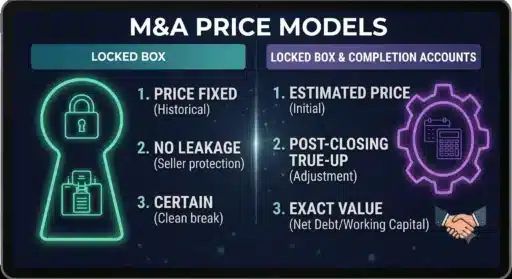
Locked Box vs. Completion Accounts: Which price-closing mechanism best protects the seller?

Obstacles in an M&A Sale: A Seller's Guide
All articles in this area
- Asset Deal vs. Share Deal in M&A transactions: How to choose the optimal structure
- Carve-Outs: Separating Part of the Business to Create Value
- Change of Control Clauses: the silent impact in M&A
- Cross-Border Transactions – expanding without borders
- Distressed M&A and Insolvency Proceedings in Spain
- Distressed M&A: How to Sell a Company in Crisis and Maximise Value
- Earn-out as a transaction closing tool
- Escrow: The mechanism that unlocks deals when trust Is missing
- Holding Company: Impact on Business Valuation and Sale
- How not to run an M&A deal: avoiding value destruction
- How to Buy a Company in Spain: a Step-by-Step M&A Guide
- How to increase your company’s value before selling
- How to prepare my company for sale
- How to prepare your company for an M&A process
- Importance of an Expert Advisor (M&A) to sell your company well
- Letter of Intent (LOI) in M&A transactions: a practical guide
- Locked Box vs. Completion Accounts: Which price-closing mechanism best protects the seller?
- M&A in Alicante as a growth strategy for local businesses
- Mistakes when selling a business and how to avoid them
- Obstacles in an M&A Sale: A Seller’s Guide
- Operating Leverage: Formula, Definition & Impact on Valuation
- Phasing deals: when it makes sense to sell a business in stages
- Private Equity: Corporate Transformation through LBOs and SPVs
- Reps & Warranties in M&A: key legal terms in business sale agreements
- Selling Your Company to a Search Fund
- Share Purchase Agreement (SPA): structuring and negotiation in Spanish M&A
- Shareholders’ Agreement: Key clauses and how to protect your position as a buyer
- SPV: What is it and How is it Used in Complex Financial Structures?
- Stages of the Business Sale Process
- Success and Failure in Mergers and Acquisitions
- Synergy Quantification in Mergers & Acquisitions
- Taxation on Business Transfers in Spain
- Taxes on Selling a Company in Spain
- The Information Memorandum (CIM)
- The key role of Management Team in M&A Transactions
- The mid-market of M&A in Spain: the silent engine of consolidation
- What an NDA (Confidentiality Agreement) Is and Its role in M&A transactions
- What is a Management Buy-Out (MBO) and how to structure It properly
Tell us about your case
Briefly describe your company’s situation. A partner will review it and tell you within 48 hours whether we can help and how. No cost, full confidentiality.
