EBITDA Multiples by Sector: 2026
There is a question that, sooner or later, every family business owner asks: how much is what I have built worth?
The answer is rarely the one you expect, and it is almost never a round number. In a mid-market M&A transaction, the starting point for answering it is almost always the same: a multiple applied to EBITDA. It is quick, it is intuitive and everyone understands it. But it is also where the most money is lost when it is used badly.
The 2026 market has an interesting asymmetry. While large transactions (above EUR 100 million) endure the scrutiny of a demanding macro environment, the segment of companies turning over between EUR 5 and 50 million remains very much alive, driven by private capital and by industrial buyers consolidating sectors through growth and build-up strategies. For a profitable, well-prepared SME, it is a good time to sell.
The problem is that applying a sector multiple mechanically - take the table, multiply and done - is a mistake that can cost millions. The multiple is not a constant: it is shorthand for expressing risk. It summarises the sector's barriers to entry, how dependent the business is on its owner, how spread out the client base is and what proportion of revenue is recurring. In this guide we review the multiples being paid in 2026, sector by sector, with particular attention to the clusters that drive the economy of the Valencian Community and Murcia. And, above all, we explain what lies behind each figure.
From EBITDA to money at the notary: the value bridge
Before looking at any table, it is worth understanding something that surprises many owners the first time: the multiple is not applied to the profit shown in their accounts, and the result of that multiplication is not what they will receive either. There are two adjustments in between, and both are decisive.
First: normalise the EBITDA
Normalising means reconstructing the EBITDA so that it reflects what the company would earn if it were run by an independent third party, without the particularities of the owning family. It is the figure the buyer really cares about. The three most common adjustments we work on are:
- The salary of the managing shareholders. If the director is paid above (or below) what a professional executive in that role would cost, it is adjusted to market price.
- Related-party rents. It is very common for the unit where the business operates to belong to a family asset-holding company. If the rent is not at market price, it is corrected.
- Personal and extraordinary expenses. Private vehicles, trips that are not for the business, a closed lawsuit, a one-off provision for obsolete inventory... anything non-recurring is stripped out.
In a Spanish SME, the difference between accounting EBITDA and normalised EBITDA usually ranges from 15% to 25%. Put another way: that adjustment can change the final valuation more than the multiple itself. It is the part of the work that generates the most value and the one that is most neglected. We develop it in depth in how to increase your company's value before selling.
Second: the equity bridge, or why Enterprise Value is not what you receive
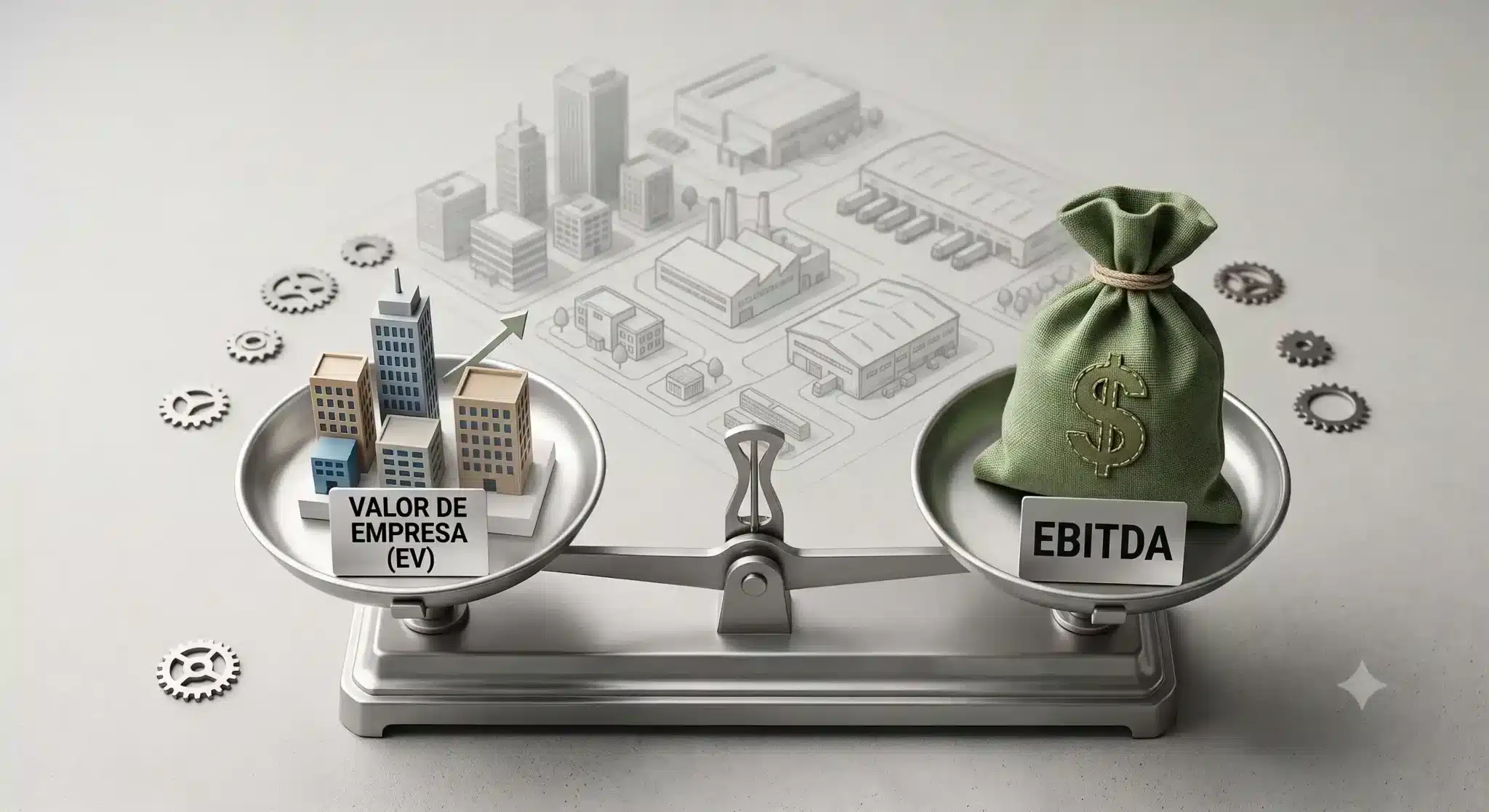
When we multiply the normalised EBITDA by the sector multiple, we obtain the Enterprise Value (EV): the value of the operating business. But what the seller receives at the notary is the Equity Value (the value of the shares), and to get there you have to cross the so-called value bridge:
Equity Value = EV - (Financial debt - Cash) +/- Working capital adjustment
From the value of the business you subtract gross financial debt (banks, state-backed ICO loans, credit lines, leasing), add available cash, and adjust for the deviation of working capital from what the business needs to operate without strain - the working capital target, usually set as a historical average. That last adjustment, the working capital one, is where many sellers lose money for not having prepared it: it is one of the classic traps of the SPA. Whoever understands this bridge well before sitting down to negotiate starts with an advantage.
EBITDA multiples by sector in the Mediterranean Arc: Valencia, Alicante, Castellon and Murcia
National tables are useful for orientation, but the business fabric of the Levante has a personality of its own that a local advisor knows and a generic one ignores. Here brand, exports and family structure carry particular weight. These are the normalised-EBITDA ranges being paid in real transactions across the region in 2026, with the context that explains why.
Agri-food and fruit & vegetables
It is the great transactional engine of Murcia and the province of Alicante, and a magnet for funds executing horizontal integrations. Here the range is enormous depending on where each company sits in the value chain:
- Producers with their own brand and national or international distribution: 7.5x - 11x. These are paid the best: they have pricing power, shelf presence and a consumer who seeks them out by name.
- Premium specialities, frozen goods and niche preserves: 8x - 13x. Healthy or organic food, or high-value ready meals. The premium reflects gross margins above 40% and real barriers to entry.
- Manufacturing for third parties (private label, co-packing): 4.5x - 6.5x. Dependence on the large retail chains compresses the margin and raises risk, and the buyer discounts that.
- Fruit & vegetable handling, packing and marketing: 3.5x - 5.5x. Narrow margins, seasonal campaigns and climate risk. Here working capital management and campaign financing are what determine whether the deal works.
In these campaign-driven businesses, when treasury strain bites ahead of a transaction, it pays to have the financial structure in order: this is the terrain of debt restructuring and refinancing, which can make the difference between closing the sale on good terms or doing so in a hurry.
Ceramics and tiles (Castellon) and auxiliary industry
The Castellon cluster concentrates around 94% of national tile production, according to ASCER. Having absorbed the blow of the energy crisis and emission rights, the sector is reorganising towards consolidation and efficiency. And there is an important nuance: the chemical part of the cluster is paid better than the tile itself.
- Manufacturers of large-format or premium tiles and flooring: 6x - 8.5x. Design patents, low-consumption kilns and diversified export markets are rewarded.
- Auxiliary industry (frits, glazes, colours, machinery): 6.5x - 9x. This is the most technologically advanced segment. Chemical patents and digital printing give these SMEs stable margins and the highest multiples in the cluster.
Footwear, textiles and clothing (Elche, Elda, Alcoy, Ontinyent)
The fashion and footwear of the Vinalopo and the textiles of l'Alcoia are living the twin transition of nearshoring and channel digitalisation. The value gap between those who control their brand and those who manufacture for others is vast:
- Brands with a direct-to-consumer channel (D2C, integrated e-commerce): 5.5x - 8.5x. The buyer values omnichannel presence, low dependence on wholesalers and, increasingly, control of the customer's own data.
- Manufacturers and component suppliers (OEM): 3.5x - 5x. Lower multiples owing to capital intensity, cost pressure and the lack of control over the final brand.
Chemicals, plastics, packaging and toys (Ibi, Foia de Castalla, Ribera Alta)
The old toy-making district of Ibi has reinvented itself as a cluster of plastic injection moulding and precision die-making, closely tied to packaging and cosmetics. Sustainability has become a real value lever here:
- Technical packaging (corrugated cardboard, bio-oriented plastics): 5.5x - 8x. Very active in consolidation, driven by ESG recyclability requirements.
- Custom plastic injection and die-making (B2B): 4.5x - 6.5x. Conditioned by dependence on industrial clients and energy cost. Those who automate with robotics move into the upper band.
Cold-chain logistics, distribution and transport
The Mediterranean Corridor needs a cold chain that does not break from the fields of Murcia and Almeria to northern Europe. That has turned temperature-controlled logistics into a strategic sector:
- Integrated 3PL logistics operators (cold storage, stock, picking): 7x - 9.5x. Long-term contracts with large exporters give cash visibility that the buyer values highly.
- Road transport fleets (refrigerated or ADR): 4x - 6x. Very CapEx-intensive in fleet renewal, sensitive to fuel, and with the chronic problem of finding drivers.
Services, hospitality, leisure and tourism (Costa Blanca and Costa Calida)
Premium tourism and services energise Alicante, Valencia and Murcia, with one peculiarity: when there is owned real estate, the valuation splits in two.
- Hotel chains with owned real estate: 6.5x - 10x (operating company). The bricks and mortar are valued separately, at their asset value (NAV with a RICS appraisal); the hotel management goes by EBITDA multiple.
- Organised catering and branded leisure: 6x - 8.5x. Chains with a scalable model and centralised purchasing earn a clear premium over the independent outlet, which stays at 4x - 5.5x.
EBITDA multiples by sector at national level (2026)
To place the Levante clusters against the market as a whole, these are the national ranges of the most representative sectors in 2026:
|
Sector / activity |
EBITDA multiple 2026 | Trend |
| Vertical B2B SaaS (niche software) | 10x - 15x |
Stable / selective |
|
Horizontal B2B SaaS |
8x - 12x | Consolidation |
| IT services, cybersecurity and cloud | 6x - 9x |
Rising |
|
Medical devices and laboratories |
8x - 12x | Defensive / strong |
| Dental and specialty clinics | 6x - 10x |
Intense build-up |
|
Renewable energy and efficiency (O&M) |
8x - 14x | Rising |
| Waste management and ESG infrastructure | 7.5x - 10x |
Rising (regulatory) |
|
Recurring B2B services (facility mgmt.) |
5.5x - 7.5x | Active (search funds) |
| Engineering with multi-year contracts | 6x - 9x |
Rising in critical niches |
|
Specialised industrial distribution |
6x - 9x | Stable, niche |
| General consumer distribution / retail | 4x - 6x |
Tight margins |
|
General industry and manufacturing |
5x - 8x | Stable, CapEx-sensitive |
| Private education and e-learning | 4x - 6.7x |
Stable |
|
Technical construction and refurbishment |
4x - 6x | PERTE / Next Gen boost |
| Real estate holding (patrimonial) | Asset value (NAV) |
Valued by asset, not EBITDA |
Note: ranges on normalised EBITDA and referring to Enterprise Value. In SaaS, the EBITDA multiple coexists with the multiple on recurring revenue (ARR); an isolated multiple never replaces a full valuation.
Three national trends worth watching closely
Beyond the ranges, there are three underlying movements shaping 2026 valuations that affect many Levante companies even if they do not appear in the classic clusters.
- Renewable energy and efficiency push valuations up. The maintenance of solar parks (O&M), energy efficiency and services tied to the green transition are paid at 8x-14x, driven by demand from ESG-mandated funds and by the revenue visibility that long-term operating contracts provide. It is one of the few sectors where a mid-sized SME can aspire to double-digit multiples without being a technology company.
- Engineering with multi-year contracts breaks its ceiling. An engineering firm invoicing one-off projects is valued modestly; but if it holds recurring maintenance contracts in critical sectors - energy, infrastructure, pharmaceuticals - it jumps to the upper end of its range (6x-9x) or beyond. Recurrence is, as always, the great multiplier.
- General industry lives on CapEx and working capital. Manufacturing sits at 5x-8x, but within that range everything is decided by the state of the machinery and the health of working capital. A plant with up-to-date investment and well-managed working capital is paid well above another with the same EBITDA but deferred CapEx. And real estate holding is a case apart: it is valued not by EBITDA but by the value of its assets, with an independent appraisal.
And a warning we always repeat: these are not the multiples of listed companies. Transposing without adjustment the multiple of a large listed company to a family SME is one of the costliest mistakes made, because listed companies are larger, more diversified and liquid, and are paid with premiums that do not apply to a mid-sized company. We explain the comparison between valuing by multiples and by discounted cash flow in EBITDA multiples vs. DCF, the EV/EBITDA multiple in detail in how to interpret EV/EBITDA in M&A, and the full landscape of methodologies in business valuation methods.
What raises and lowers the valuation in due diligence
Two companies in Alicante or Murcia with the same turnover and the same normalised EBITDA can receive radically different offers. The difference is decided in due diligence, when the buyer detects what it rewards and what it penalises.
What raises the multiple (from +0.5x to +2.5x)
Recurring revenue under contract (retainers or subscriptions); a spread-out client base where no single client accounts for more than 10%; a management team that functions without the owner; clean financial data structured in an auditable ERP; and margins sustainably above the sector average.
What reduces it (from -0.5x to -2x)
High dependence on the founder - the key-man risk, especially in commercial relationships; client concentration, when a single one exceeds 25%-30% of turnover; deferred maintenance CapEx, with obsolete machinery, fleets or facilities; accounting with no margin analytics by product or channel; and labour disputes, high turnover or open litigation.
It is worth noting a pattern: the two factors that most penalise the Levante family business are almost always the same - dependence on the founder and client concentration. And they are, precisely, the ones that can most be improved with time.
The role of the fractional CFO before selling
The most common mistake of the family SME is coming to market without having prepared the balance sheet. At Maraz we act as a fractional CFO in the phase prior to the transaction, precisely to reach due diligence with no weak flanks. In practice, that means:
- Setting up cost-accounting analytics that break down profitability by product, channel and client, so the buyer cannot demand discounts on the grounds of a lack of visibility.
- Optimising working capital - cleaning up inventory and ordering collections and payments - to set a working capital target favourable to the seller and dodge the trap of the final adjustment.
And reducing key-man risk by shifting decisions to a management committee, so as to demonstrate that the company will keep generating cash without its owner. All of this is delivered through our financial advisory and fractional CFO service.
The adjustment almost every table skips: size
There is a trap many owners fall into when reading a multiples table: assuming that their sector's range applies to their company just as it does to a large one. It does not. A company turning over EUR 10 million is not valued at the same multiple as another in the same sector turning over EUR 500 million, even if they do exactly the same thing. Size is, in itself, a risk factor, and the buyer discounts it.
The reason is common sense: a small company depends on fewer clients, fewer key people and fewer markets; it is more fragile in the face of the unexpected and, moreover, its shares are far less liquid - there is no market where they can be sold with a click. That is why several adjustments are applied to the reference sector multiple that are worth knowing before getting your hopes up over a figure.
Size discount
It is the most important and the most surprising. The sector multiples in circulation are usually built by looking at mid-sized companies or listed comparables, which are larger. Transposing them to an SME requires reducing them: the size discount usually ranges between 15% and 30%, and can reach 40% in the smallest companies. And there is a critical threshold: below around EUR 200,000 of EBITDA, the company enters micro-enterprise territory, where the discounts sharpen and the universe of buyers shrinks drastically. The smaller the company, the further it sits from the upper end of its sector's range. We develop this in our guide on business valuation by multiples.
Illiquidity discount
The shares of a listed company sell in seconds; the shares of a family business do not. Finding a buyer, negotiating and closing takes months and does not always succeed. That lack of liquidity has a price, and the buyer builds it into the multiple. It is a discount the company cannot eliminate entirely, but it can soften by presenting itself as an attractive, easy-to-buy asset: clear accounts, orderly processes and a convincing investment story.
The Spain discount and the type of buyer
Two nuances that complete the picture.
- First, geography: multiples in Spain are between 10% and 20% lower than those in the United Kingdom, France or Germany for equivalent companies, because the Spanish M&A market is smaller and there are fewer buyers competing for each deal.
- Second, who is buying: a pure financial fund tends to sit at the lower end of the range, whereas an industrial or strategic buyer may pay above it if the acquisition brings synergies - access to a market, a brand or a technology that saves it years. Part of the advisor's job is precisely to identify and attract the buyer for whom your company is worth more.
The practical conclusion is clear: the table multiple is the theoretical ceiling of a sector, not the price of your company. Between that number and the real offer there is a chain of adjustments - normalisation, size, illiquidity, geography, buyer type and the due diligence risk factors - that is only handled well with preparation and with someone who knows the market from the inside.
How to prepare for a successful sale
Selling the company is, for most owners, a once-in-a-lifetime transaction. Leaving the valuation in the hands of a rough calculation, or accepting the first offer from a local competitor, usually means leaving a lot of money on the table.
The real value of a business does not come from a generic table. It comes from the quality of its normalised historical data, the financial narrative built around it and the firmness with which the advisors defend the value bridge in the negotiation. The Levante clusters - from the footwear of Elche to the ceramics of Castellon, from Murcian agri-food to the plastics of Ibi - have their own dynamics that are only harnessed well with knowledge of the ground.
At Maraz Corporate Finance, based in Alicante with clients in Valencia and Murcia, we support family businesses across the whole cycle of the transaction: from the professional valuation of the company and the prior preparation as fractional CFO, through to comprehensive advice on the sale and M&A transactions and the due diligence. If you are thinking of selling, of generational succession or simply want a value diagnosis to decide with judgement, let's talk with no commitment.
Javier de Rojas Roca de Togores
Partner - Maraz Corporate Finance
FAQs on EBITDA multiples by sector in the Spanish mid-market
How much is an SME in Spain worth in 2026?
It is calculated by multiplying its normalised EBITDA by a reference multiple for its sector, which in the mid-market runs approximately from 4 to 15 times (with higher peaks in software). That result is the value of the business; to know what the seller receives you have to subtract net debt and adjust working capital.
Which sectors have the highest multiples?
Niche SaaS software (10x-15x) tops the list, followed by medical devices, the auxiliary chemical industry of the ceramics cluster and premium agri-food with its own brand.
Why is my accounting EBITDA not valid for valuation?
Because it includes items a buyer would adjust: the owner's salary if it is not at market price, related-party rents, personal or extraordinary expenses. Normalised EBITDA strips all that out and usually differs from the accounting figure by 15% to 30%.
What is the equity bridge?
It is the bridge that goes from the value of the business (Enterprise Value) to the price of the shares (Equity Value): financial debt is subtracted, cash is added and the deviation of working capital from what the business needs is adjusted. It is where many sellers lose value if they have not prepared it.
Is my company worth the same as a large one in my sector?
No. Size is a risk factor in itself: a small company depends on fewer clients and key people, and its shares are less liquid. A size discount is applied to the sector multiple, usually ranging from 15% to 30% - and up to 40% in the smallest. Below around EUR 200,000 of EBITDA, moreover, you enter micro-enterprise territory, with larger discounts and fewer potential buyers.
Are the multiples of listed companies useful for my SME?
Only as a methodological reference, never directly. Listed companies are paid with size and liquidity premiums that do not apply to a family business. Using their multiple without adjustment is one of the most frequent valuation mistakes.