Why an expert advisor (M&A) matters when selling a company
Selling a company is, for the vast majority of business owners, the most important financial decision of their lives. And yet almost everyone approaches it at a structural disadvantage that is rarely admitted out loud: across the table sits a professional buyer —a private equity fund, a search fund or a large corporation— that closes dozens of deals a year, while the owner sits down to that table for the first and, almost always, only time in their life. That asymmetry is no small detail. It is, frequently, the difference between closing an excellent deal and leaving several million euros on the table.
The good news is that this disadvantage is not a fate. A well-designed sale process led by an experienced advisor rebalances the forces: it generates real competition among buyers, protects the value of the company and orders a transition that, in the family business, is as much financial as it is emotional. This article explains how that mechanism works, what a good M&A advisor actually does and why —with the data in hand— their fees are usually one of the most profitable investments the seller will make.
The starting point: a market of demanding buyers
It is worth beginning with the context, because it frames everything else. The M&A market in Spain is going through a phase that could be summed up as “fewer deals, more value”. According to TTR Data, around 3,336 transactions closed in 2025 for an aggregate amount of some €103 billion: a fall in number versus the prior year but a jump of almost 20% in value. The trend continued into the first half of 2026, with about 1,485 transactions and a volume that held virtually flat despite the drop in number. Spain remains the fourth-largest M&A market in Europe, behind only the United Kingdom, Germany and France.
For the owner, the message has two sides. On one hand, there is liquidity and buyer appetite: private equity in the middle market segment (deals of €10m to €100m of equity) moved some €3 billion across 114 transactions in 2025, up 36% on the prior year, according to SpainCap. And Spain is Europe's leading country for search funds, those vehicles in which a manager buys a single company to run it —a route for generational handover that keeps growing.
On the other hand, those buyers are increasingly selective and sophisticated. In a market like this, preparation and professional execution of the process are not a luxury: they are what separates a deal closed on good terms from a process that cools off, collapses or ends with the price eroded.
The root of the problem: the asymmetry of the negotiation
The sale of a company is not played out in a symmetrical market. The professional buyer masters technical due diligence, risk analysis and complex contractual structuring. The seller, however good an entrepreneur, is a debutant. When an owner decides to negotiate alone against the first offer that arrives —usually an “unsolicited” offer that feels like a compliment— they are exposed to three dynamics that destroy value silently:
- The lack of competitive tension. Without a process that forces several buyers to compete at once, the single bidder has no incentive to put forward its best price or to speed up timelines. It knows it is alone in the room, and behaves accordingly.
- The dilution of EBITDA for want of adjustments. Buyers value the business on its future ability to generate cash. If the seller does not present a properly normalised EBITDA, the inefficiencies typical of family-business accounting undervalue the business from the outset. In Spanish SMEs, the gap between reported and normalised EBITDA typically runs from 15% to 30%: a great deal of money at stake once it is multiplied.
- Operational and emotional wear. An M&A process absorbs hundreds of hours. If the owner takes on the technical interlocution and the buyer's pressure personally, they neglect the day-to-day running of the business precisely when the company is under the spotlight of the audit. And a drop in results at that moment is an invitation to cut the price.
The result of negotiating at a disadvantage is rarely an obviously bad deal. It is something subtler and more expensive: a good business closed at a mediocre price, without the seller ever knowing how much they let slip away.
The antidote: the power of the restricted auction
The difference between a successful transaction and an inefficient liquidation lies in the methodology. A senior M&A advisor does not “find a buyer”: they design a restricted competitive process —a private, confidential auction— that organises a selected group of qualified buyers around a single calendar. Everyone advances at once, everyone knows there are others on the far side, and that simple certainty changes the behaviour of them all.
A process like this typically unfolds over a horizon of 6 to 12 months (sometimes a little more in complex deals), divided into four phases with well-defined deliverables and milestones:
|
Phase |
Duration | Key deliverables | Strategic objective |
| I. Preparation and valuation | 1–2 months | Information memorandum (Infomemo), blind teaser, financial projections model. |
Set the Enterprise Value range and normalise operating profitability. |
|
II. Launch and market |
2–3 months | Signing of NDAs, distribution of the blind profile, receipt of indications of interest. | Generate maximum competitive tension among the shortlist of candidates. |
| III. Due diligence and confirmation | 3–4 months | Opening of the virtual data room (VDR), Vendor Due Diligence. |
Validate the information and mitigate contingencies before the buyer can use them. |
|
IV. Closing and SPA |
1–2 months | Share Purchase Agreement (SPA), shareholders' agreement, escrow accounts. |
Structure warranties, fix the net price and formalise the transfer of control. |
That other counterparties are analysing the business in parallel acts as a powerful catalyst, both psychological and financial. It forces buyers to put forward more aggressive multiples, limits attempts at downward renegotiation during due diligence and materially speeds up the time to signing. This is not a hunch: the academic evidence on sale methods shows that auctions that fail to generate real competition —those that end in a negotiation with a single buyer— close at premiums of around 9 to 10 percentage points below genuinely competitive auctions. The lesson is twofold: it is not enough to open a process, you must attract authentic competition; and doing so is, precisely, the advisor's craft.
The three functions of an expert advisor in M&A
A corporate finance advisory team acts as the guarantor of the deal's viability by playing, at the same time, three very different roles.
1. The technical and financial designer
The basis of any sound negotiation is the correct determination of the company's financial variables. The advisor cleans up the historical accounts through the normalisation of EBITDA: isolating the business's real, recurring cash-generating capacity by adjusting whatever will not reflect operations under a new owner —owners' personal expenses, extraordinary items, atypical income that will not recur, or the salary of owner-managers brought to market value. Every euro of normalised EBITDA will later be multiplied by the multiple, so this work, done rigorously and documented, is among the things that move price the most. We develop it in detail in our guides to valuation by comparable multiples and to how to interpret EV/EBITDA.
The advisor also builds the value bridge: the passage from the value of the business (Enterprise Value) to the value of the shares the seller actually banks at the notary (Equity Value). That bridge is crossed by subtracting net financial debt and adjusting the deviation of working capital from the level the business needs to operate. It looks like a technicality, but it is where many sellers lose money for not having prepared it: the multiple is not what you take home. It is worth understanding well the difference between Enterprise Value and Equity Value before sitting down to negotiate.
2. The emotional shield (the “bad cop”)
The sale of a family business carries an enormous personal charge: identity, legacy, a life's work. Professional buyers use hard negotiating techniques that can damage the relationship between the founder and the future management team. The advisor acts as a buffer: absorbing the technical friction and defending the valuation with intransigence, allowing the owner to keep a cordial and constructive relationship with the buyer.
This is critical when the seller must keep collaborating during an agreed transition or when part of the price is tied to future targets —earn-outs. Having the advisor, rather than the owner, be the one to say “no” preserves a capital that does not appear on the balance sheet but is worth a great deal: the trust between the parties.
3. The orchestra conductor
A successful deal requires aligning tax advisers, commercial lawyers, auditors and technical due diligence teams. The M&A advisor coordinates that whole ecosystem: managing the flow of information with strict control of the data room, anticipating the objections that will surface in the buyer's audit and leading the structuring of the financial clauses of the Share Purchase Agreement (SPA). Without that baton, each specialist optimises their own patch and no one protects the deal as a whole —which is where value is really won or lost. It is one of the reasons a specialised advisor is decisive when it comes to preparing your company for sale.
Pre-sale preparation (12 to 24 months): the defensive shield
Value is not improvised in the final stretch of the negotiation; it is planned in advance. Arriving at the market prepared protects the seller's position. In practice, there are three fronts worth working on in the 12 to 24 months before launch —the timeframe we develop in our analysis of how to prepare your company for sale:
- Professionalise management and reduce dependence on the owner. An institutional buyer penalises with a risk discount —which in the build-up of the cost of capital can be worth several points— any company overly dependent on its founder (the dreaded key-man dependency). Delegating decisions to a solid middle-management team and documenting the key processes before going to market is one of the most direct value levers there is.
- Stabilise the operating metrics. Avoid sharp falls in sales or margin in the quarters before launch. A stable, predictable EBITDA dispels uncertainty and sustains high multiples; a rollercoaster of results invites the buyer to discount risk.
- Commission a Vendor Due Diligence (VDD). This is a thorough review the seller itself commissions on its own company before opening the process, to detect and correct in time any financial, tax, employment or legal contingency. It neutralises price chipping —those buyer attempts to unilaterally cut the price on “discovering” problems in its audit— because the problems have already been surfaced and resolved, or presented with the right context.
This last point deserves emphasis, because it is counter-intuitive: paying to audit yourself before selling looks like an expense, but it is one of the most profitable investments in the process. We explain it in detail in the advantages of Vendor Due Diligence. The VDD does three things at once: it gives foresight over problems, it supports the value arguments and —by letting all buyers work from the same information base at the same time— it reinforces the competitive tension of the process.
Structuring the deal: why the headline price deceives
The price that appears in a headline is almost never the money the seller takes home. The nominal figure is irrelevant unless analysed together with the payment structure and the warranties retained. And this is where the differences in expectations between buyer and seller —the valuation gap— are resolved with instruments the advisor must negotiate and monitor with technical precision:
- Earn-outs (deferred, performance-based payments). These tie part of the price to meeting future sales or EBITDA targets. They are increasingly common: in 2025 they appeared in around 27% of European deals, a record high according to the CMS European M&A Study 2026, and in more than half of cases the deferred portion weighed between 10% and 20% of the price. The advisor ensures the metrics are so well defined in the contract that the buyer cannot “manufacture” an accounting shortfall.
- Staged sales (phasing deals). The founder does not transfer 100% from the start: they retain a minority stake through a transition phase, securing an orderly exit and capturing part of the future upside under the new majority partner. It is a structure especially useful in the family business; we analyse it in when it makes sense to sell in stages.
- Escrow accounts and reps & warranties. Deposits retained with a third party to cover unforeseen contingencies under the representations and warranties. The advisor negotiates the liability limits (caps) and the minimum claim thresholds (baskets) to prevent unjustified claims. As a European reference, more than half of deals set the cap below 50% of the price.
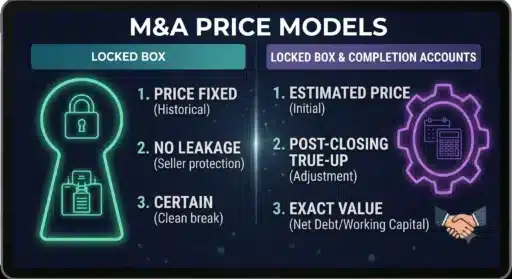
To all of this we add the price-setting mechanism (the classic debate between locked box and completion accounts), the payment structure —today the norm is 70–80% in cash with the rest deferred— and the legal-tax optimisation, which can substantially change the seller's net proceeds. On that last point, I recommend reviewing well in advance the taxes on selling a company in Spain, because the prior corporate reorganisations —which take months— can make a big difference to what finally stays in your pocket.
How much does an expert advisor cost, and why does it pay off?
There is a very widespread misperception: seeing the advisor's fees as a cost to avoid rather than an investment. The usual structure combines a retainer (an initial amount covering the preparation phase, normally creditable against the final commission) and a success fee aligned with the closing value. That percentage decreases with the size of the deal: in the core middle market it usually runs around 3% to 5%, and falls in larger deals.
Does it pay off? The evidence says yes, and emphatically. The most relevant academic study on the sell side —Agrawal, Cooper, Lian and Wang (2023), on 3,281 private-company deals— found that sellers who retained an advisor obtained premiums 6% to 25% higher than sellers who went alone, a result statistically robust across all deal sizes. Put another way: in a mid-sized company, the premium a good process generates comfortably exceeds the advisor's fees.
It is no coincidence that the data on the EBITDA multiples paid by sector show how one and the same company, with identical revenue and profitability, can close at very different multiples depending on how the process is run: from around 5 times EBITDA in an isolated, inexperienced negotiation to 7 times or more under a well-executed competitive scheme. The difference is not in the asset; it is in the process.
The backdrop: generational handover and legacy
None of this is only financial. 89% of Spanish companies are family businesses; they generate close to 57% of private-sector GDP and 67% of private employment. Yet only around 29% successfully survive a generational handover, and barely just over 1% reach the third generation (data from the Instituto de la Empresa Familiar). Behind each of those statistics is an entrepreneur who, at some point, faces the question of what to do with a life's work when there is no clear internal successor.
In that context, an orderly, advised and competitive sale —to a strategic buyer, a fund or a search fund— stops being a “failure” and becomes what it really is: a strategic route to preserve the legacy, keep the jobs and ensure the continuity of the project on the best possible terms. Before getting there, it is worth knowing the most common reasons M&A deals succeed or fail and how a discounted cash flow valuation underpins a defensible price range —because arriving informed is the first way to rebalance the scales.
Ultimately, hiring an expert advisor is not only the way to maximise the patrimonial value accumulated over decades of effort: it is the safeguard that ensures the founder's legacy continues under the best possible operational and legal conditions. If you are thinking of selling in the next year or two, the best time to start preparing is now. At Maraz Corporate Finance we support the entrepreneur across the entire arc of the deal, from the prior preparation to the signing before a notary, with a single objective: that the price you receive truly reflects what your company is worth.
Javier de Rojas Roca de Togores
Partner – Maraz Corporate Finance
FAQs on the M&A expert advisor and the sale of your company
How much does it cost to hire an expert M&A advisor, and how are the fees structured?
The usual structure combines two elements: an initial retainer —a fixed amount covering the preparation and valuation phase, normally creditable against the final commission— and a success fee, a percentage of the closing price that is only charged if the deal completes. That percentage decreases with size: in the core middle market it usually runs between 3% and 5%, and falls in larger deals. What matters is not the percentage in isolation but the return: the academic evidence (Agrawal et al., 2023, on 3,281 private deals) shows that advised sellers obtain premiums 6% to 25% higher than those who negotiate alone. In a mid-sized company, that premium comfortably exceeds the fees.
Why is a competitive process better than accepting a direct offer I already have on the table?
Because a single offer, however attractive it seems, has been formed without competition. A buyer that knows it is the only one in the room has no incentive to put forward its best price or to close quickly, and tends to hold back ammunition to negotiate down during due diligence. A restricted competitive process —a private auction with several qualified buyers advancing in parallel— changes that behaviour: it forces more aggressive multiples, limits downward renegotiation and speeds up timelines. The evidence shows that deals which fail to generate real competition close at premiums 9 to 10 percentage points below genuinely competitive ones.
What is normalising EBITDA and why does it influence the price so much?
Normalising EBITDA means cleaning the accounts of everything that does not reflect the recurring capacity of the business under a new owner: owners' personal expenses, extraordinary items, atypical income that will not recur, or owner-manager salaries adjusted to market level. In Spanish family SMEs, the gap between reported and normalised EBITDA is usually 15% to 30%. Because the buyer applies the valuation multiple to that figure, every euro of well-documented normalised EBITDA can be worth several euros of final price. Doing this work proactively, before going to market, prevents the buyer from imposing its own version during the audit.
How long does it take to sell a company, and how far in advance should I start preparing?
A well-structured sale process in the middle market usually takes between 6 and 12 months from launch to signing, split into four phases: preparation and valuation, launch and market, due diligence and confirmation, and closing. But the prior preparation should start much earlier: between 12 and 24 months. That margin allows you to normalise and optimise EBITDA, professionalise reporting, reduce dependence on the founder and commission a Vendor Due Diligence. Early preparation is one of the factors that most influences the final price; improvising in the final stretch almost always proves expensive.
What is Vendor Due Diligence and why should I, the seller, pay for it?
Vendor Due Diligence (VDD) is a thorough review —financial, tax, employment and legal— that the seller itself commissions on its own company before opening the process. Although paying to audit yourself may seem a contradiction, it is one of the most profitable investments: it lets you detect and correct contingencies before the buyer discovers them and uses them to cut the price (so-called price chipping). It also orders the information in a data room, speeds up the buyer's audit and reinforces competitive tension by letting all candidates work from the same base. Fewer surprises mean fewer reductions and less retained warranty: getting paid more, and sooner.
I have received a very good unsolicited offer. Do I still need an advisor?
In that case more than ever. An unsolicited offer is usually good news wrapped in a trap: the buyer has chosen the moment, knows the market better than you and wants to close before competition appears. Accepting exclusively and without a benchmark gives up precisely the lever that generates the most value. An advisor can validate whether the offer is really good, benchmark it against the market and —if it makes sense— turn that interest into the starting point of a discreet competitive process that puts the price to the test. It is not about rejecting the buyer, but about making sure its offer is the best possible one.