Search Fund : A different kind of buyer
When a business owner decides to sell their company, they typically imagine, on the other side of the table, a private equity fund with a team of analysts, a strategic competitor with financial muscle, or a family office. Few anticipate finding themselves across from a search fund.
In recent years, however, this acquisition vehicle has gained a notable presence in the Spanish and European market for lower-mid-market transactions —the segment with EBITDA of between €500,000 and €3 million, with the bulk of deals concentrated between €0.5 and €2 million—, historically the most difficult to divest from due to the lack of active institutional buyers. The search fund has come to fill precisely that gap.
For an owner contemplating an exit or a generational transfer, understanding how this type of buyer operates, what its economic logic is, and what the implications of negotiating with one are is as important as knowing the value of their own company. Doing so without that understanding is the equivalent of sitting down to negotiate without having read the rules of the game.
This article is a practical guide for owners and management teams who find themselves —or may find themselves— facing a proposal of this kind. It addresses the structure of the vehicle, the buyer profile, the particularities of the negotiation, the most common mistakes, and the contractual elements that determine the real price the seller receives.
What a Search Fund is: Structure and economic logic
A search fund is an investment vehicle created by one or two entrepreneurs —typically with a top-tier MBA and between five and ten years of professional experience— with the exclusive purpose of identifying, acquiring, and managing a single company over a five-to-seven-year horizon.
The model originated at Stanford University in the 1980s and has been systematized and studied with academic rigor by Harvard Business School, which periodically publishes return statistics on the model. The historical data is consistently attractive: the average return on invested capital exceeds that of most mid-market buyout strategies. That profitability is no accident; it is a direct consequence of the alignment of incentives between the entrepreneur-manager and their investors.
The two phases of the model
- Search phase: The searcher raises capital from a syndicate of investors —usually between 15 and 30 individuals or institutions with experience in private equity, transactions, or industry— to fund 18 to 24 months of active search. The typical amount of this first round ranges between €400,000 and €600,000 and covers the team's fees, operating expenses, travel, and preliminary due diligence costs.
In exchange, search-phase investors obtain a preferential right to participate in the acquisition under favorable economic terms: typically a 20–30% discount on the price at which new investors enter in the acquisition round, and in some models, an additional stake in the searcher's carry.
- Acquisition and management phase: Once the target company has been identified and negotiated, the searcher returns to the market —including their search investors— to raise the acquisition capital. The financing structure usually combines equity (60–70%) and bank debt (30–40%), although in higher-leverage environments that proportion may be inverted. The searcher then takes over the running of the company as CEO and principal executive.
The holding horizon is five to seven years, after which a sale takes place —to a larger fund, to a strategic buyer, or to another search fund— that crystallizes the return on the transaction.
The structural difference from traditional private equity
What distinguishes a search fund from a conventional private equity fund is not only the size of the transaction, but the nature of the buyer. In classic private equity, the fund manager is an investment professional whose career is built on asset turnover and portfolio management. The CEO who will run the acquired company is a subsequent hire.
In a search fund, the searcher is the future managing director of your company. They do not buy to resell quickly; they buy to run. Their incentives are aligned with the long-term operational performance of the company, not with the speed of capital turnover.
This difference has concrete practical implications for the seller: the searcher will place particular value on the transfer of knowledge, the stability of the management team, and the quality of relationships with customers and suppliers. And they will be willing to invest real time in understanding the business before closing the transaction.
Traditional Search Fund vs. Self-Funded Search
Not all searchers operate under the same model, and the difference is relevant for the seller. In the traditional search fund, the entrepreneur raises institutional capital —funds of funds specialized in search funds and professional investors— from day one, both to fund the search and to back the subsequent acquisition. In the self-funded model, by contrast, the entrepreneur finances the search with their own resources and does not seek investors until they have a specific company on the table.
The self-funded model has grown very significantly in recent years, including in Spain. Why it matters to the seller: the traditional searcher has consolidated institutional backing from the outset, which lends solidity to the process and greater certainty of closing. The self-funded searcher tends to rely to a greater extent on bank debt and local investors brought in at the last minute, which can substantially alter the capital structure of the transaction and the real execution risk. It is advisable to ask from the outset which model the buyer operates under and what degree of capital commitment they have effectively secured.
Why Search Funds are looking at your company
The profile of company that attracts a search fund is not arbitrary; it responds to a well-defined investment thesis that combines criteria of risk, improvement potential, and leverage capacity. Understanding those criteria allows the seller to anticipate interest and, more importantly, to identify the points on which the buyer will focus their attention during due diligence.
Common selection criteria
- Revenue between €2 and €20 million, with EBITDA of between €500,000 and €3 million, stable or trending positively over the last three financial years.
- Business models with predictable revenues: multi-year contracts, recurring subscription or maintenance billing, high customer retention rates. Recurrence reduces leverage risk and makes the debt easier to service.
- A defensible competitive position in a niche: a high-growth sector is not required; a sustainable advantage —relationships, technical know-how, local reputation— that a new competitor cannot easily replicate is enough.
- A diversified customer base: no single customer should represent more than 20–25% of revenues. Customer concentration is one of the main factors driving valuation discounts.
- A consolidated second-tier team: the searcher cannot run the company alone from day one. They need a capable team that continues operating while they learn the business.
- Manageable founder dependency: a certain degree of dependency is inevitable, but it must be transferable within a reasonable period. Companies where 80% of the knowledge lives exclusively in the owner's head are difficult to finance.
- A visible improvement opportunity: the searcher builds their return thesis on the ability to extract operational value —margin improvement, organic growth, digitalization, geographic or product expansion— once at the helm.
What the searcher is not looking for
Equally important is understanding what drives a search fund away from a deal:
- Companies in sectors with high regulatory risk or rapid technological disruption.
- Business models based on one-off projects with no recurrence.
- Structures with excess existing debt.
- Companies with material open litigation or irregular tax or labor compliance.
The searcher and their investors carry out rigorous due diligence; any hidden risk will eventually surface and, if it does so after signing, will generate contractual disputes.
Key differences in the negotiation
The speed of decision is not what it appears
The searcher acts with subjective urgency —they have been searching for one to two years, their capital is consumed month by month, and the pressure from their investors is real—. This urgency may lead the seller to believe they have a buyer with rapid decision-making capacity. This is a common mistake.
Approval of a transaction requires validation by the investor syndicate. There is no centralized investment committee with executive power; there are between 15 and 30 individuals —with their own agendas, analyses, and timelines— who must review the deal, ask questions and, in most models, give their explicit approval before the searcher can commit capital. This process can delay closing by weeks or months beyond what was expected.
Practical implication: Establish clear contractual milestones in the Letter of Intent: a deadline for completing due diligence, a deadline for signing the SPA, and an estimated closing date. Include penalty or break clauses if the process drags on without justified cause.
The financial structure and its implications for the seller
Search funds do not have unlimited capital. The transaction is financed with a combination of equity raised from investors and bank debt, the proportion of which depends on the company's profile, the level of EBITDA, and credit market conditions at the time of closing. In current transactions in the Spanish market, bank leverage typically ranges between 2.5x and 4x EBITDA.
This structure has direct implications for the seller.
- The available price has a ceiling determined by the debt service capacity, which limits the achievable multiples.
- If the bank does not grant financing on the anticipated terms, the transaction may collapse or require renegotiation.
- Part of the price may be deferred over time —deferred consideration— or made contingent on future results —earn-out—, reducing certainty of payment.
- A fourth element, frequently overlooked but very common in these transactions, is the vendor loan. The buyer often requests that the seller themselves finance a portion of the price —typically between 10% and 20%— through a loan subordinated to the bank debt. For the buyer and the banks, the seller keeping "skin in the game" is a signal of confidence in the future viability of the business and facilitates the granting of senior credit. For the seller, however, it means assuming credit risk on a portion of the price and accepting that its collection ranks behind the bank's. It is not a clause to reject outright, but one to negotiate carefully: interest rate, repayment schedule, guarantees, and acceleration events.
The earn-out is a legitimate tool when used to bridge a valuation gap between buyer and seller; it is an abusive mechanism when designed so that the seller has little prospect of collecting it. The difference between the two scenarios lies in the contractual details, not in the agreed nominal amount.
Valuation: Where the real tension is concentrated
Search funds apply standard M&A valuation methodologies: multiples on adjusted EBITDA (the most common in this segment), discounted cash flow, and comparable transaction analysis. Typical multiples in lower-mid-market transactions in Spain currently range between 4x and 7x EBITDA, with significant variation depending on sector, recurrence, growth, and the quality of the team.
The tension is usually not in the multiple stated in the Letter of Intent, but in how the calculation base is defined.Adjustments to EBITDA —owner's compensation above or below market, personal expenses booked as corporate, non-recurring investments, restructuring costs— can move adjusted EBITDA by between 15% and 30% relative to accounting EBITDA. That difference, multiplied by the agreed multiple, is price.
A seller who accepts the multiple without negotiating the calculation base may be leaving between €300,000 and €800,000 on the table in a mid-market transaction. The work of adjusting EBITDA is as important as the negotiation of the multiple.
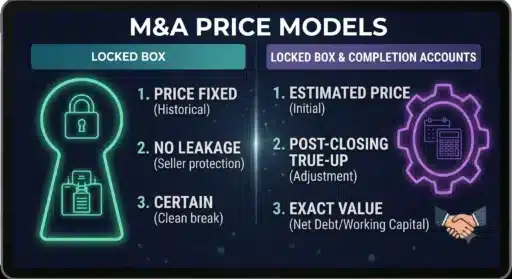
It is also worth recalling a distinction that gives rise to much of the post-LOI conflict: the multiple is applied to the Enterprise Value, but what the seller actually takes to the bank is the Equity Value, which results from adding cash and subtracting financial debt. In the SME segment, the greatest source of tension is usually not the multiple, but the definition of Net Cash / Net Debt and, above all, of Normalized Working Capital.
Many transactions stall because the seller does not understand why part of the price is withheld to guarantee a "normal" level of operating working capital at the time of closing. Negotiating, at the level of each accounting line item, which items are debt, which are cash, and what the reference working capital is, is as decisive for the effective price as the multiple itself.
The Transition Period: An operational variable, not a formality
In a transaction with a search fund, the founder's stay-on period is not a formality; it is a structural condition of the investment thesis. The searcher needs to absorb the institutional knowledge, the relationships with strategic customers, the internal culture, and the technical know-how. Without that transfer, post-closing operational risk is unacceptable for the investors.
What the seller must demand is that this period be well defined contractually. Ambiguity on this point invariably generates conflicts: what is the founder's real role vis-à-vis the new CEO? Do they have authority over the team? Can they make operational decisions? What is their compensation? What happens if there is disagreement with the new manager about the direction of the business? A well-drafted Transition Services Agreement (TSA) avoids these frictions.
The most common mistakes when selling to a Search Fund
1) Disclosing sensitive information without contractual protection
A searcher who makes contact, visits facilities, and requests financial documentation has not made a binding offer. They have initiated an evaluation. Many owners, faced with the searcher's enthusiasm and the implicit pressure of a process that is moving forward, share margins by customer, cost structure, and key contracts before having a solid confidentiality agreement signed and, above all, before receiving a Letter of Intent setting out the basic economic terms.
Information shared before the LOI is information that, if the deal does not close, has been transferred free of charge to someone who can use that knowledge in multiple ways. This is especially relevant in niche markets where the base of competitors or alternative buyers is small.
2) Negotiating without independent financial advice
The searcher has spent 18 to 24 months preparing for this negotiation. They know precisely the sector's valuation metrics, the usual deal structures, the clauses that are typically conceded and those that are not, and the arguments that will weaken the seller's position. The owner who has run their company for decades —and who is probably facing the only M&A transaction of their life— starts from a structural disadvantage if they do not have specialized advice.
An M&A financial advisor not only helps to maximize the price; they structure the process so that the seller negotiates from a position of strength, manage the timeline to prevent the seller from becoming trapped in long exclusivity periods, identify hidden risks before the buyer uses them, and ensure that what is agreed verbally is reflected in the contract. In cost-benefit terms, it is the investment with the highest return in any sale process.
3) Not preparing the company sufficiently in advance
The companies that obtain the best terms in a sale process are those that began their preparation 12 to 24 months before the process started. That preparation includes: organizing the corporate and tax structure, normalizing the owner's compensation to market levels, documenting key operational processes, reducing customer concentration where possible, resolving latent contingent liabilities, and demonstrating a sustained growth trajectory over recent financial years.
A disorganized company not only receives lower offers; it receives offers with more negative EBITDA adjustments, more aggressive warranty clauses, and more conditions precedent. Prior order is, in practice, price.
4) Underestimating the Investor syndicate's due diligence
Not all search funds are alike. The solidity of the investor syndicate backing the searcher —their sector experience, their track record of completed deals, their ability to add operational value to the new manager— largely determines the real probability that the transaction reaches closing and that the company performs well afterward.
Before signing an exclusivity agreement or a binding LOI, the seller should request active references: speak with owners who have sold to that searcher or to deals managed by their investor network. The information exists; it must be sought out.
5) Accepting an Earn-Out without negotiating its protection mechanisms
The earn-out is the clause that generates the most conflict in M&A transactions with search funds. A poorly designed earn-out turns part of the price into an option that the buyer has the power not to exercise. The seller's protection mechanisms —a closed accounting definition, limits on the new manager's discretion during the measurement period, audit rights, acceleration of the earn-out in the event of an early sale— are not abusive demands; they are basic conditions of a balanced deal.
The role of the financial advisor in a transaction with a Search Fund
In a transaction of this nature, the financial advisor specialized in M&A plays a role that goes well beyond preparing a valuation report. Their functions span the entire transaction cycle:
Preparation and positioning
Rigorous analysis of EBITDA adjustments and construction of the value narrative the seller will present to the buyer and their investors. Preparation of the Information Memorandum with the level of detail and depth required by an audience of professional investors accustomed to analyzing private equity transactions.
Management of the competitive process
If the seller has the capacity to generate more than one offer —whether from other search funds, strategic buyers, or private equity funds—, the advisor manages the competitive process so that offers can be compared on equal terms and so that the existence of alternatives strengthens the seller's negotiating position.
Technical negotiation
Direct liaison with the searcher's team and their financial and legal advisors, defense of the EBITDA adjustments, structuring of the offer, and negotiation of the economic terms of the SPA. The advisor acts as the seller's technical shield, allowing them to maintain a constructive personal relationship with the buyer while the difficult aspects of the negotiation are handled at a technical level.
Financial review of the SPA
Analysis of the SPA from an economic and financial perspective: the impact of the price adjustment clauses, the economic scope of the representations and warranties, the design of the earn-out mechanisms, and coordination with the legal advisor on all aspects with economic implications.
Post-Closing support
In transactions with an earn-out, the advisor's role may extend through to the final settlement of the price, overseeing the calculation of the agreed indicators and representing the seller's interests vis-à-vis the new manager in the event of a discrepancy.
Conclusion: Preparation defines the outcome
Search funds represent a real and growing opportunity for owners of medium-sized companies seeking a buyer committed to the long term, with a genuine willingness to grow the business and the capacity to execute transactions in a market segment where traditional institutional buyers are rarely present.
But opportunities do not automatically translate into good deals. The difference between a transaction that maximizes value for the seller and one that erodes it does not lie in the type of buyer: it lies in the quality of the preparation, in the solidity of the advice, and in a deep understanding of the mechanisms that determine the real price.
A well-financed searcher, backed by experienced investors and with a clear value thesis, is an excellent buyer. An owner who comes to that negotiation prepared, advised, and with a rigorous analysis of the value of their company is the only one who can guarantee that the deal is as good for them as it is for the buyer.
To all the technical analysis, it is worth adding a factor that appears in no valuation model but proves decisive: the chemistry with the searcher. Unlike a traditional fund, this buyer is going to sit in the founder's office and live alongside their employees, their customers and, very often, the seller themselves during the transition period. The owner is not only handing over a company: they are handing over the keys to a project to which they have probably dedicated a good part of their life.
Assessing the human and managerial quality of the searcher —their maturity, their capacity to listen, their fit with the company's culture— is not an emotional luxury, but a critical success factor that conditions the transition, the continuity of the team and, in transactions with an earn-out, the very collection of the deferred price.
At Maraz Corporate Finance, we have extensive experience defending the interests of owners against institutional buyers and structuring optimal transactions. If you have been approached by a Search Fund or are planning the handover of your company, contact us for a preliminary valuation session with no obligation.
Analyst – Maraz Corporate Finance
Frequently asked questions about selling your company to a search fund
What is a search fund and how does it differ from a private equity fund?
A search fund is a vehicle created by one or two entrepreneurs (the searchers) who, backed by a group of investors, spend around two years looking for a single company to buy and run personally. Unlike a private equity fund, which manages a portfolio and delegates management to the existing team, the searcher becomes the new CEO and gets involved in the day-to-day. It is a formula designed for profitable, stable SMEs, not for crisis situations or large groups.
What type of company does a search fund look for?
Companies with EBITDA usually between €1 and €5 million, recurring revenue, stable margins, low cyclicality, little technological dependence and an owner who wants to retire or step back. Family businesses with no clear generational successor are especially attractive. The searcher is looking for a business that works well and can keep working with a new manager at the helm, so the quality of the middle management and the documentation of processes weigh heavily in their decision.
How is the price structured in a sale to a search fund?
Search funds usually finance the purchase with a combination of their investors' equity and bank debt, so the price is negotiated on a multiple of normalised EBITDA, typically between 4x and 7x depending on sector and size. They frequently include a deferred payment or an earn-out linked to results, and sometimes a vendor loan. It is worth having a professional valuation before negotiating in order to defend the price with technical arguments.
What are the advantages of selling to a search fund rather than to a competitor or a fund?
For an owner who cares about the continuity of the business, the search fund offers a buyer who wants to preserve the company, its brand, its workforce and its culture, rather than integrating or restructuring it. The process is usually more personal and the transition more orderly, with the seller supporting the searcher for a few months. The trade-off is that the price may be somewhat lower than that of a strategic buyer with synergies, and that the deal depends on the searcher closing their financing.
How do I prepare my company for a sale to a search fund?
The same as for any other sale: normalise EBITDA, reduce owner dependence, document processes and relationships with key customers, and organise the financial, tax and employment information. An M&A adviser can also benchmark the searcher against other potential buyers to create competitive tension, and it pays to know the stages of the sale process well before signing a letter of intent.