The mergers and acquisitions market in Spain is enjoying a period of maturity without precedent. With the macroeconomic variables stabilising and the European Central Bank on a rate-easing path, the corporate transaction has established itself as the preferred lever to create value, internationalise and reshape entire sectors. And within that ecosystem there is one protagonist that rarely makes the headlines yet sustains the real activity: the mid-market. It is the silent engine of Spanish consolidation.
It is worth beginning by defining the term, because the Anglo-Saxon label is misleading. In southern Europe, and certainly in Spain, the mid-market is defined more pragmatically: transactions with an Enterprise Value of between €10 and €100 million, which usually correspond to companies with revenues of between €1 and €50 million. They are not giants, but nor are they micro-enterprises: they set the pulse of their industries. This article covers their real dimension, the catalysts that are driving activity, and — above all — the fine mechanics of valuation and deal structure, which is where a seller wins or loses a substantial part of the price.
The real dimension of the mid-market of M&A in Spain
The 2025 figures help explain why this segment deserves attention, although they should be read with care because each source measures something different. Announced M&A in Spain reached a high of €121,374 million (+38.6%), driven above all by large cross-border deals, according to Cuatrecasas. If instead one looks at the closed transactional market, TTR Data (with A&O Shearman) records €103,085 million across 3,336 deals (+19.4% in value, −8% in number). These are two legitimate ways of measuring the same thing: the first includes what has been announced even if not yet closed; the second, what has actually been completed. The divergence between the two illustrates how far the headlines depend on a handful of megadeals.
But the structural backbone of the market is not those large headlines; it is the mid segment. The Spanish mid-market (deals with an EV between €5 and €250 million) closed 742 transactions in 2025 (+10%, an all-time high) for around €18,900 million, with an average ticket of €25.5 million, according to Blue Mountain. It is a deep, recurring market and far less volatile than that of the large deals.
The dynamism rests on exceptional liquidity in private capital. According to SpainCap, private equity and venture capital invested a record €7,015 million in 2025 across 1,041 investments, of which €3,039 million went specifically to the mid-market (deals of €10–100 million of equity), 37% more than the previous year. Added to that is dry powder of around €8,000 million in the hands of domestic private managers waiting to be deployed. In other words: there is more than enough ammunition to sustain the buying momentum throughout the 2025-2026 biennium.
Anatomy of the Spanish SME
In Spain, SMEs are 99.8% of the business fabric, contribute around 60% of the corporate Gross Value Added (Eurostat) and sustain roughly two thirds of employment. That fragmentation, so characteristic of our economy — the average size of the Spanish company is 4.8 employees against 5.9 in the EU — exposes companies to three tensions that inorganic consolidation helps to resolve.
The first is the need for scale. Fragmentation leaves many SMEs without the muscle to undertake the investments that are unavoidable today: digitalisation, artificial intelligence, sustainable transition. Gaining critical mass by integrating competitors — the build-up or buy-and-build strategies — makes it possible to dilute fixed costs, optimise the supply chain and compete abroad with solvency.
The second is the attraction of external capital. The mid-sized SME is highly attractive to private equity, search funds or industrial operators, which bring not only financing but management capabilities: they professionalise reporting, processes and the commercial strategy, accompanying the transition from family SME to well-ordered corporation.
The third is more cultural than financial: the historical bias towards organic growth. The Spanish entrepreneur has tended to distrust the inorganic route because of its apparent legal complexity. A good adviser reverses that perception by demonstrating that selective acquisition captures market share, clients and talent far faster than linear expansion. Anyone who wishes to explore what separates a good deal from a bad one will find the full framework in our analysis of the keys to success and failure in mergers and acquisitions.
The catalysts of the transaction
The maturity wall of the ICO loans
During the pandemic, many SMEs turned to the state-backed ICO credit lines to sustain their liquidity — in total, €140,700 million was mobilised across more than 1.19 million operations. Today, with the grace periods exhausted and amortisation under way, the remaining outstanding balance is around €24,100 million, and the Bank of Spain estimates that roughly a third of that balance shows signs of doubtfulness or special monitoring.
The bulk of the hard-to-collect loans mature from 2026 onwards, which points to a wave of refinancings in 2026-2027. That situation acts as a catalyst for defensive M&A: sound companies exploit the asymmetry to acquire over-leveraged competitors at attractive valuations. When financial stress bites, the border with debt restructuring and refinancing becomes very thin, and it is wise to act before the problem becomes one of solvency.
Non-dilutive financing: ENISA and CDTI
To grow or finance acquisitions without ceding too much capital, structured public financing is a very useful and often underused piece. ENISA manages participating loans of between €25,000 and €1.5 million with no personal guarantee or collateral — in 2025 it granted 514 loans for €86.2 million, and since that year it has unified its lines into the FEPYME fund with a permanent, year-round call. The CDTI, for its part, grants loans for technological development with a non-repayable tranche of between 20% and 33% of the budget. Well combined with bank and alternative financing, they fit naturally into the capital structure of a deal.
Generational handover and founder dependency
The family business is the backbone of the Spanish mid-market, and with it comes one of the risks buyers watch most closely: founder dependency. When technical knowledge, commercial relationships and day-to-day decisions reside in a single person, the value of the business can erode silently the moment that person leaves. That is why preparing the company for sale should begin 12 to 24 months in advance: professionalising middle management, structuring retention agreements and designing deferred-payment mechanisms that transfer goodwill in an orderly way.
Valuation and deal structure
Price and its structure are the heart of the negotiation. In Spain, the private SME is usually valued by multiples of normalised EBITDA. As a reference, the average multiple of the Spanish mid-market stood at around 7.8x EV/EBITDA in 2025, although the real range is wide: from 4x-6x in the lower middle market and mature sectors, up to 8x-10x (and beyond) in technology, healthcare or recurring-revenue businesses.
The Argos Index, the European mid-market benchmark, closed 2025 at 8.3x, its lowest level since 2014, a sign of a market that has corrected after the excesses of 2021. That valuation by multiples should always be cross-checked with a discounted cash flow (DCF): multiples are the snapshot of the market; the DCF, the film of future cash potential. For a detailed sector breakdown, we refer you to our guide to EBITDA multiples by sector.
Normalised EBITDA as the foundation
Applying a multiple to the accounting EBITDA filed at the Commercial Registry is a mistake that almost always penalises the seller. In the Spanish family business, the gap between accounting EBITDA and normalised EBITDA (the true recurring figure) usually ranges between 15% and 30%. Normalising requires surgical adjustments: bringing the salaries of shareholders and family members to market cost, cleaning up personal expenses charged to the company, regularising related-party transactions (rents on properties owned by the shareholders that are outside market range) and adding back extraordinary, non-recurring costs. Whoever neglects this phase usually leaves money on the table.
The rise of earn-outs
Uncertainty and the usual gap in expectations between buyer and seller have entrenched deferred-payment structures. In European private equity transactions, the use of the earn-out has held consistently at around 32% of deals (CMS European Private Equity Study), and the general trend is upward in a buyer-friendly market. The dominant practice pays 65%-75% in cash at the signing before a notary and defers the remaining 25%-35% over 12-24 months, tied to future EBITDA or to specific milestones. Well designed, the earn-out bridges the valuation gap; badly designed, it is an inexhaustible source of post-closing litigation.
How the price is set: locked-box versus completion accounts
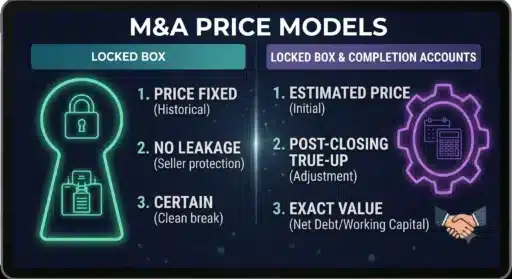
One of the most strategic decisions, taken before signing the letter of intent (LOI), is the price-setting mechanism. It determines, quite simply, when the economic risk of the business is transferred to the buyer. This is the essential comparison:
|
Dimension |
Locked-Box |
Completion Accounts |
|
Use in PE deals |
Preferred: around 85% of private equity transactions. | Minority in PE; more frequent in southern Europe and non-PE deals. |
| Risk transfer | Retroactive to a historical date (locked-box date). |
On the effective closing date. |
|
Post-closing adjustments |
None; only unagreed leakage is claimed. | Euro-for-euro adjustment after auditing the closing balance sheet. |
| Advantage for the seller | Price certainty from signing. |
Retains the cash the business generates up to closing. |
|
When it fits |
Predictable flows, audited accounts, low seasonality. |
High seasonality, carve-outs, informal accounting. |
In the mid-market the choice is not trivial: the smaller the deal, the more it tends towards completion accounts, because many SMEs do not have audited monthly closings and carry strong working-capital seasonality, which forces the balance sheet to be adjusted afterwards to protect the buyer from a decapitalisation.
The valuation bridge (equity bridge) and the balance-sheet traps
The move from the operating value of the company (Enterprise Value) to the liquid value of the shares (Equity Value) — the actual amount of the cheque — is instrumented in the SPA through the equity bridge. In essence: to the Enterprise Value you add cash, subtract gross financial debt and debt-like liabilities, and adjust for the deviation of working capital from its normalised level.
The formula is simple to state; the devil is in the balance-sheet traps the adviser must scrutinise:
- The working capital peg: a historical average level of working capital is agreed in order to deliver the company with the operating liquidity it needs. If the real figure at closing falls below it, the price is reduced euro for euro, preventing the seller from having accelerated collections or delayed payments to inflate cash before selling.
- Off-balance-sheet operations (factoring and confirming): in non-recourse factoring, client balances leave the assets and inject “artificial” liquidity; a sophisticated buyer will treat those drawn lines as debt-like. Confirming used to covertly finance payment terms will also be classified as financial debt.
- Public and non-bank liabilities: provisions for litigation, deferrals with the Tax Authority or Social Security, leases capitalised under IFRS 16 or debts with ENISA and CDTI must be subtracted as net financial debt in the bridge.
Who buys and what the seller looks for in the mid-market
The success of a divestment is measured not only by the figure, but by the fit between the structure of the deal and the founder’s life expectations.
The industrial buyer
It is the ideal buyer for someone close to retirement who wants to step away quickly and completely. Because it has pre-existing synergies — distribution networks, structural savings, centralised purchasing — it usually captures more immediate value and can pay a higher entry valuation, paying 100% at closing (a clean exit backed by W&I insurance).
The financial investor (private equity and search funds)
It is the better alternative if the founder retains an active professional horizon of four to six years, wants to internationalise the brand and needs growth capital and governance. The entry valuation may be lower than that of an industrial buyer, but by retaining a minority stake (rollover equity) the entrepreneur participates in the “second sale cycle”.
With professionalised management and consolidated acquisitions, exit multiples usually expand, and it is not uncommon for the local partner to triple or quadruple the value of their remaining stake in five years. Before accepting either of the two profiles, it is wise to be aware of the usual obstacles in a sale and, above all, how not to carry out an M&A transaction, so as not to repeat the mistakes that destroy value.
Conclusion: the discipline of advisory
Selling or bringing in a partner into a mid-market company is a technically demanding process that ordinarily runs between 6 and 18 months. Attempting it alone exposes the entrepreneur to a severe information asymmetry against professional buyers who negotiate daily with dedicated teams. It is no minor matter: the academic evidence (Agrawal et al., Quarterly Journal of Finance, 2023, on 3,281 transactions) shows that sellers with an adviser obtain premiums of between 6% and 25% higher than unrepresented sellers.
The adviser’s role goes far beyond intermediation. It lies in the normalisation of EBITDA, in the defence of the equity bridge against unjustified price retrogressions, in the orderly management of the data room, in the arrangement of W&I insurance that shields the seller’s liability after closing, and in the design of the legal and tax structure that turns the gross agreed price into real net liquidity for the family.
If you are considering selling, buying or bringing in a partner into your mid-market company, at Maraz Corporate Finance we support the transaction from start to finish. Contact our team for a confidential, no-obligation conversation.
Javier de Rojas Roca de Togores
Partner – Maraz Corporate Finance
FAQs on the mid-market of M&A in Spain
What is considered mid-market in Spain?
In Spanish and southern-European practice, the mid-market groups transactions with an Enterprise Value of between €10 and €100 million, usually of companies with revenues of between €1 and €50 million. It is a more pragmatic definition than the Anglo-Saxon one, which handles far higher ranges. Below it lies the lower middle market (EV of €5 to €15 million), where the dynamics of buyers and multiples differ.
At what multiple are SMEs sold in the mid-market?
The average of the Spanish mid-market stood at around 7.8x normalised EBITDA in 2025, but the range is wide: from 4x-6x in the lower middle market and mature sectors (distribution, B2B services) up to 8x-10x or more in technology, healthcare and recurring revenue. The multiple is always applied to normalised EBITDA, not to the accounting figure: the difference between the two is usually 15% to 30% in the family business.
What is the equity bridge in an M&A transaction?
It is the bridge that converts Enterprise Value (the agreed operating value) into Equity Value (the amount the seller actually receives). You add cash, subtract financial debt and debt-like liabilities, and adjust for the deviation of working capital from its normalised level. What is negotiated most is which items count as “debt” and the working-capital adjustment.
What is the difference between locked-box and completion accounts?
They are the two price-setting mechanisms. In the locked-box, the price is fixed on a historical balance sheet and the economic risk is transferred to the buyer retroactively to that date, with no subsequent adjustments (other than unagreed leakage): it gives certainty from signing. In completion accounts, the price is adjusted euro for euro after auditing the balance sheet on the closing date. Private equity prefers the locked-box (around 85% of its deals); in southern Europe and in SMEs with less formal accounting, completion accounts predominate.
What is an earn-out and when is it advisable?
An earn-out is a portion of the price contingent on meeting future objectives (EBITDA, sales, milestones). It is advisable when buyer and seller disagree on the projections: it allows the valuation gap to be bridged by deferring part of the payment. In European private equity, around 32% of deals incorporate one. The key lies in precisely defining the metric, the period (usually 12-24 months) and the governance of the business during that time, to avoid litigation.
Why is the Spanish mid-market so active now?
Several catalysts converge: private capital with record liquidity (€7,015 million invested in 2025 according to SpainCap and around €8,000 million of domestic dry powder); the maturity wall of the pandemic-era ICO loans, which is driving defensive and consolidation M&A from 2026; the generational handover in the family business; and the need for scale to face digitalisation and AI. The ECB’s rate cuts have also reactivated acquisition financing.
Is an industrial buyer or a private equity fund preferable?
It depends on the founder’s life plan. The industrial buyer usually pays more in cash and allows a clean exit, ideal for those who want to step away soon. The fund may offer a somewhat lower entry, but with rollover equity the entrepreneur participates in a second sale cycle that, with professionalised management, can multiply the value of their remaining stake in five years. There is no single answer: the optimal structure depends on age, objectives and the desired future involvement.
Why hire an adviser to sell a mid-market company?
Because the academic evidence (Agrawal et al., Quarterly Journal of Finance, 2023) shows that sellers with an adviser obtain premiums of between 6% and 25% higher than those who negotiate without representation. The adviser provides EBITDA normalisation, defence of the equity bridge, data-room management, W&I insurance and the legal-tax structure that maximises the seller’s net liquidity, as well as balancing the asymmetry against professional buyers who negotiate daily.