How to Buy a Company:
For many business owners and family groups, buying a company is the fastest route to scale, to enter a new market or to acquire capabilities that would take years to build, and it is also one of the operations in which the most value is destroyed when the process is improvised. The Spanish market offers real opportunities: according to TTR Data, 3,336 M&A transactions worth €103,085 million were recorded in Spain in 2025, and 2,261 had been recorded by September 2026, 15% fewer, in a more selective market.
This guide walks through, from the buy-side adviser's point of view, the steps to acquiring a company in the Spanish middle market, with tickets of between €2 million and €50 million: from the acquisition thesis to the first hundred days after closing.
1. Why buy a company instead of growing organically
Organic growth looks cheaper, but it is slow and uncertain. An acquisition buys time: loyal customers, a team that already works, licences, territorial presence or proprietary technology. In fragmented sectors it is also the natural tool for consolidation through build-ups.
The decisive test is not whether the target is a "good" company, but whether its value to this particular buyer exceeds the total cost of acquiring and integrating it. It makes sense when there is strategic logic beyond size, the capacity to integrate, and a price that leaves room even if synergies arrive late.
The supply of companies is also growing because of generational succession in family businesses. According to the Spanish Family Business Institute's report "La Empresa Familiar en España 2025", family firms account for 92.4% of Spanish companies, but only 29.3% have survived a generational handover and barely 1.2% are in the third generation or beyond.
Many founders have no successor, and a sale to a competitor, an industrial group, a family office or the management team itself is an increasingly common exit: solid companies that have never been on the market, with sellers for whom the business is far more than an asset, which weighs on price, timing and terms.
2. Define the acquisition thesis and criteria
An acquisition should not be a reactive response to a passing opportunity, but the consequence of a written thesis approved by management or the board. The thesis sets sector, size, geography, strategic fit, realistic synergies and investment capacity, in quantifiable variables.
Quantifying synergies demands discipline. Cost synergies are relatively predictable; financial synergies are usually modest; revenue synergies —cross-selling, pricing, access to new channels— are the most overestimated: McKinsey's classic study "Where mergers go wrong" found that almost 70% of deals failed to achieve their forecast revenue synergies.
Each synergy should be quantified with four data points —annual amount, cost to achieve, timing and probability— and netted against negative synergies, such as customers lost through the change of ownership or managers who leave. The result is the value of the company to the buyer (standalone value plus net synergies minus integration costs), and the maximum price must stay below it.
If a manufacturer expects to save €600,000 a year by buying a regional competitor, but needs €1.5 million of integration investment and will lose part of the acquired customer base, those figures must feed into the valuation and a sensitivity scenario. The practical rule: do not pay the seller for synergies that only the buyer can generate.
Financial capacity is measured by the debt the combined group could carry in a downside scenario, and the deal only creates value if the return on invested capital (ROIC) comfortably exceeds the buyer's cost of capital (WACC). And one criterion that is often forgotten: who will run the acquired company. If the answer is "the founder, who stays two years", the thesis needs a management succession plan and a defined post-acquisition governance model.
3. Sourcing and identifying targets
Once the thesis is defined, the market mapping begins. The adviser builds a long list —typically 30 to 100 companies— and filters it on financial, strategic and ownership criteria down to a short list of five to ten targets, checking in the Companies Registry and the Register of Beneficial Owners who really stands behind each company.
The best companies are rarely formally for sale. In its report "Tendencias de mercado en M&A en España 2025", the law firm Cuatrecasas analysed almost seventy acquisitions of Spanish companies: 71% were negotiated bilaterally and only 29% through an auction. The proprietary route —approaching companies that have not considered selling— avoids the competition of an auction and allows tailor-made structures; the intermediated process offers organised information, but pushes up multiples and compresses timetables.
In the SME segment, a discreet approach is decisive: a clumsy first contact closes doors that never reopen. The M&A adviser provides a neutral intermediary who protects the buyer's identity, an approach that the family business owner perceives as an opportunity rather than a threat, and strict confidentiality.
4. First contact, NDA and indicative valuation
Once the owner agrees to explore the conversation, a non-disclosure agreement (NDA) is signed covering non-solicitation of employees and customers and penalties for leaks. In an organised process the buyer receives an anonymous teaser and, after the NDA, an information memorandum; in a bilateral approach the information must be requested methodically.
How an SME is valued in Spain
The reference is the EV/EBITDA multiple applied to normalised EBITDA, cross-checked with a discounted cash flow (DCF) that tests whether the price is consistent with future cash generation. If the multiple and the DCF diverge, they are not averaged: the assumption behind the gap is investigated.
According to Dealsuite's European monitor, the average lower-mid-market multiple in Southern Europe was 5.4x EBITDA in the first half of 2026, and size matters: a company with €200,000 of EBITDA was valued on average at 4.3x, against 7.5x for one with €10 million.
Normalising EBITDA is where the price is won or lost. In family businesses the accounts tend to reflect tax or structural decisions: off-market partner remuneration, rents paid to related companies, personal expenses or non-recurring income. Every adjustment must be documented, because the seller will tend to present as "non-recurring" anything that reduces profit.
Enterprise value versus equity value
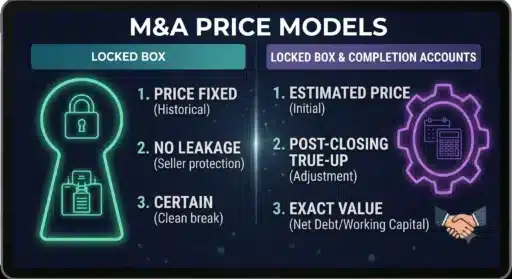
The multiple gives enterprise value (EV), free of debt and cash. The price of the shares (equity value) results from deducting net financial debt and debt-like items (pending dividends, deferred taxes, committed severance payments, deferred maintenance capex) and adjusting for the difference between actual working capital and a normalised level. With normalised EBITDA of €2 million and a 6x multiple, EV is €12 million; with €3 million of net debt, equity value is €9 million. If the seller stretches supplier payments before closing, cash is inflated; the working capital adjustment prevents paying twice for the same thing.
5. Letter of intent (LOI) and exclusivity
The letter of intent sets the terms of the deal before the cost of due diligence is incurred: perimeter, price expressed as enterprise value with its net debt and working capital assumptions, price mechanism, structure (percentage acquired, deferred payments, earn-out, seller reinvestment), main conditions, the seller's role after the sale, timetable and an exclusivity period, usually 60 to 90 days, expressly stating which clauses are binding and which are not.
The usual mistakes are offering a price without spelling out the net debt assumptions; accepting an exclusivity period too short for the real timetable; and omitting matters that are decisive for the seller, such as the continuity of the team or the property. An ambiguous LOI does not save time: it shifts it to the SPA, where it costs more.
6. Due diligence: verify before you pay
Due diligence is not an indiscriminate collection of documents: it checks that the company is what it appears to be and converts risks into price or contractual protection. A study published in Contemporary Accounting Research links less intensive due diligence to poorer post-acquisition returns and a higher probability of goodwill impairment. In an SME it usually takes four to ten weeks from the opening of the data room.
The core is the financial review: the quality of earnings report validates normalised EBITDA, revenue recurrence, EBITDA-to-cash conversion, normative working capital and net debt. Typical red flags in Spanish SMEs are more than 25% of sales with one customer and no contract, one-off income presented as recurring, aggressively capitalised costs, overvalued inventories, bogus self-employed workers and undocumented related-party transactions.
| Area | What is reviewed | Frequent findings in SMEs |
|---|---|---|
| Financial | Quality of earnings, working capital, net debt | EBITDA adjustments, unrecorded debt |
| Tax | Corporate tax, VAT, withholdings, related parties | Undocumented transfer pricing |
| Legal and corporate | Title, key contracts, change of control, litigation | Trademarks or licences in the founder's name |
| Labour | Headcount, collective agreements, executives, contingencies | Bogus self-employed, undocumented side agreements |
| Commercial | Market, customers, pricing, order book | Dependence on a few customers |
| Operational and technology | Capacity, capex, systems, cybersecurity | Deferred investment, uncertain software ownership |
| ESG and environmental | Permits, soil, waste | Expired or insufficient permits |
Findings reach the deal through four channels: quantifiable items, such as hidden debt or deferred capex, adjust the price; identified but uncertain risks are covered by specific indemnities; material contingencies justify retentions or escrow; and findings that undermine the thesis justify walking away. A common example: in a software company with healthy EBITDA, part of the code was written by external contractors without a documented assignment of rights; the sensible response is to make closing conditional on regularising the intellectual property.
7. Structuring and financing the acquisition
Share deal or asset deal
In a share deal the buyer acquires the company with its entire history, contingencies included. The transfer of shares is generally exempt from VAT and transfer tax, and a corporate seller can apply the 95% exemption on capital gains under article 21 of the Spanish Corporate Income Tax Act (LIS), which is why sellers usually prefer it.
In an asset deal the buyer defines the perimeter, depreciates the assets at their purchase value and can deduct goodwill for tax purposes at 5% a year. If what is transferred is an autonomous economic unit, the transaction is outside the scope of VAT. Risk isolation is not complete: article 44 of the Workers' Statute imposes the transfer of employees, with joint and several liability of transferor and transferee for three years, and there is tax liability by succession in the business, which can be limited through the tax debt certificate provided for in the General Tax Act.
Taxation of the purchase and tax losses
For the buyer, a share deal carries no indirect tax cost, but neither does it allow the premium to be deducted: the goodwill implicit in the shares is not tax-deductible, unlike in an asset deal. Hence the buyer tends to prefer assets and the seller shares. It pays to understand the seller's tax position: an individual is taxed on the gain in the savings base at between 19% and 30%, whereas a company holding at least 5% for one year applies the 95% exemption under article 21 LIS, an effective rate of around 1.25%.
The target's tax loss carryforwards (BIN) can be offset without time limit, but subject to an annual cap of 70% of the prior taxable base (50% and 25% for companies with turnover above €20 million and €60 million) and a €1 million floor; in addition, article 26.4 LIS prevents their use when a majority of the capital is acquired after they were generated and the company was dormant, changes its activity or is an asset-holding entity. Buying a company "for its losses" rarely works; buying an operating company with legitimate tax losses does improve post-acquisition cash flow, and that tax shield should be modelled with its annual cap, not added to the price in one lump.
Sources of financing
| Source | Role | Watch point |
|---|---|---|
| Equity | Absorbs the risk | Determines viable debt |
| Senior bank debt | Main tranche, amortising over 5-7 years | Covenants and security |
| Unitranche / direct lending | Single tranche, often bullet | Higher cost |
| Mezzanine / participating loan | Hybrid between debt and equity | Cost and possible warrants |
| Vendor loan or deferred payment | Finances part of the price over 2-5 years | Subordinated to the bank |
| Earn-out | Contingent price based on results | Precise definition of metrics |
| ICO Empresas y Emprendedores line | Loan through partner banks | Cap per client and year |
| Seller reinvestment | Seller as minority partner | Shareholders' agreement and exit |
Private debt is now an established alternative: according to the Deloitte Private Debt Deal Tracker, prepared with SpainCap, Spain recorded a record 71 transactions in 2025, more than 60% linked to M&A, with unitranche structures in 44% of cases.
Leverage must be prudent. According to Blue Mountain's 2025 review, the Spanish middle market averaged 3.0-3.5x EBITDA of senior debt and 4.0-4.5x of total debt; a cyclical SME should stay below that. In a typical LBO or MBO, a holding company receives the equity, takes on the acquisition debt and buys the operating company, whose cash then services the debt.
The Spanish Companies Act prohibits financial assistance —the target lending funds or granting security for the purchase of its own shares— and the subsequent merger of holding and operating company, if the debt was incurred in the previous three years, requires economic justification and an independent expert's report.
Note also article 16.5 LIS, which limits the deductibility of interest on acquisition debt to 30% of the acquirer's operating profit, excluding that of the acquired company for four years, unless the debt does not exceed 70% of the price and is amortised proportionally over eight years down to 30%.
9. Signing, closing and the first 100 days
Between signing and closing, the seller must run the business in the ordinary course while the conditions precedent are satisfied and the financing is formalised. On a realistic timetable, six to nine months elapse from thesis to closing.
The first hundred days decide much of the outcome, and the plan must be ready before closing, with an owner for each area. There are four workstreams: governance and stabilisation (taking control, the board, same-day communication to employees, key customers and suppliers); financial control (monthly reporting of cash, sales, margins and working capital, for which, in companies coming out of family structures, bringing in a finance director or an external CFO is usually decisive); synergy capture with deadlines and metrics; and cultural change management, with retention and performance incentives for key people.
Many acquisitions do not fail on price, but because nobody owns the synergies and the managers who were the real asset leave. If a founder personally generates 40% of the commercial relationships, an immediate exit destroys value; the answer combines an agreed transition, retention of the second line and contingent consideration.
10. Frequent buyer mistakes and how to avoid them
On the buy side the same mistakes recur: losing price discipline; valuing on reported rather than normalised EBITDA; confusing EV and equity value in the offer; underestimating the working capital the business needs; leveraging to the limit on the strength of synergies; cutting due diligence to save fees; and arriving at closing without an integration plan.
Before approving the acquisition, the investment committee should be able to say yes to a short list: the strategic logic is quantified; EBITDA and cash are normalised; the debt withstands a downside scenario; every material due diligence finding has a contractual answer; and the Day 1 plan is ready. Everything else comes down to a written thesis, an honest financial model, specialised advisers and the willingness to walk away if the numbers stop adding up.
Conclusion
Buying a company in the Spanish middle market is a real opportunity today. Private capital invested a record €7,015 million in 1,041 transactions in 2025, according to SpainCap, and generational succession will keep bringing solid family companies to market. Buying well is not about finding a company and negotiating a multiple: it is about keeping thesis, valuation, due diligence, structure, contract and integration consistent, so that price, risks and the value-creation plan still add up after closing.
At Maraz Corporate Finance we support business owners, family groups, family offices and private investors throughout the acquisition process: from defining the thesis and sourcing targets to valuation, negotiation, due diligence coordination, financing and closing.
Javier de Rojas Roca de Togores
Partner - Maraz Corporate Finance
Frequently asked questions about how to buy a company
How long does it take to buy a company?
Six to nine months from defining the thesis to closing, in a bilateral deal of average complexity: one or two months of sourcing and first contact, another for valuation and letter of intent, four to ten weeks of due diligence and one or two months for the contract, financing and closing. An auction, CNMC or foreign investment clearance, complex financing or material due diligence findings extend the timetable.
What multiple is paid for an SME in Spain?
In the Southern European lower mid-market the average multiple is around 5-6x normalised EBITDA, with a wide range: an SME with €200,000 of EBITDA sells at around 4x and one with €10 million above 7x. Sector, revenue recurrence, customer concentration and founder dependence move the multiple. Net debt is deducted from enterprise value to arrive at the price of the shares, and the costs of advisers, due diligence, notary and financing must be added.
Is it better to buy the shares or the assets of a company?
It depends on risk and tax. With the shares you acquire the whole company, contracts and licences included, but also its contingencies, and the seller usually prefers it because it is taxed less. With the assets the buyer chooses the perimeter and deducts goodwill for tax purposes, but must assign contracts one by one, takes over the workforce under article 44 of the Workers' Statute and pays transfer tax on real estate. In the middle market most deals are share deals with an SPA that allocates the risk.
How is the purchase of a company financed?
By combining equity, senior bank debt, alternative debt (unitranche, participating loans, mezzanine), vendor financing and earn-outs. In the Spanish middle market total debt usually sits between 4x and 4.5x EBITDA, and a cyclical SME should carry considerably less. In leveraged acquisitions the debt is raised in a holding company, because the Companies Act prohibits the target from financing or guaranteeing the purchase of its own shares.
What happens if debts or contingencies surface after closing?
The SPA is the buyer's protection. Representations and warranties oblige the seller to indemnify if what was declared was inaccurate, within a cap (usually between 10% and 30% of the price) and a term (18 or 24 months, and the statutory limitation period for tax and labour matters); specific indemnities cover euro for euro the risks already identified; and escrow or a price retention secures recovery. W&I insurance transfers part of the risk to an insurer. Whatever was not detected in due diligence and is not covered in the contract is borne by the buyer.
Do I need a financial adviser to buy a company?
It is not mandatory, but in deals worth several million euros the buy-side adviser brings what the buyer rarely has in-house: discreet access to companies that are not for sale, an independent valuation, coordination of due diligence, the design of the financing and the negotiation of price and contract against a seller who is almost always advised. Its cost is a fraction of the price and of the risk it helps avoid, and in practice it is usually recovered in the negotiation of the price, net debt or working capital.