M&A transactions (mergers and acquisitions, or “fusiones y adquisiciones”) represent one of the most important decisions in a company’s life. They not only transform its structure, but also its market position, internal culture and growth potential. However, the success of an M&A transaction does not depend solely on completing the deal, but on prior preparation: a meticulous process that begins long before any negotiation starts.
At Maraz Corporate Finance, we support companies looking to maximise their value and ensure an orderly, transparent and successful process.
What M&A transactions are and what drives them
M&A transactions include deals through which a company acquires, or merges with, another in order to generate joint value. These transactions are strategic growth tools that allow companies to accelerate expansion, gain market share, diversify business lines or strengthen competitiveness. In a globalised environment, mergers and acquisitions are a natural response to the need to adapt quickly to market changes.
Merger vs acquisition: differences every executive should understand
Although both terms are often grouped under the concept of M&A, there are significant differences.
In a merger, two companies integrate to form a single entity, sharing assets, teams and management structures. Both parties work under a single strategy and typically share control of the new organisation. Two or more entities with legal personality are merged into one single entity.
In an acquisition, one company buys all or the majority of another company’s shares or assets, assuming control. The acquirer sets the strategic direction and typically absorbs the acquired business.
A merger usually aims at balanced joint growth, while an acquisition seeks rapid integration under clear leadership. Understanding these differences is essential for executives to make decisions consistent with corporate objectives.
The reasons behind an M&A transaction: growth, synergies and strategy
Every M&A transaction responds to specific strategic reasons. The most common is growth: companies use these processes to increase scale, access new markets or incorporate complementary capabilities without relying solely on organic growth.
Synergies—both operational and financial—are also fundamental: combining resources, processes or distribution channels allows companies to reduce costs, improve margins and increase overall efficiency.
Finally, there is a strategic component: mergers and acquisitions are a tool to transform the business, diversify activities, incorporate innovation or improve competitive positioning. Ultimately, it is about growing with intelligence and a long-term vision.
The current context of mergers and acquisitions in Spain
The Spanish M&A market remains consistently dynamic, although with a more selective evolution. After years of intense activity, transactions are now concentrated in sectors with strong prospects such as technology, energy, healthcare and real estate.
Mid-sized companies—especially family-owned businesses—are prominent players. More and more executives understand that preparing the company in advance for a sale or integration process not only increases its value, but also multiplies negotiation opportunities.
Professionalising the management team, financial transparency and digitalisation are differentiating factors when attracting investors and closing deals on favourable terms. In this context, anticipation and expert support are what turn an opportunity into a successful outcome.
How to prepare a company for an M&A process, essential phases:
A well-executed M&A transaction requires planning, method and professional support. Maraz has identified five key phases that determine the success of the process: strategic diagnosis, financial preparation and internal due diligence, valuation and deal structuring, negotiation and closing, and post-transaction integration.
Strategic diagnosis
The starting point is to define the objectives of the transaction precisely. The company must analyse its current position, strengths and areas for improvement, and determine what it expects to obtain from the process: liquidity, growth, diversification or generational transition.
At this stage, alignment between the shareholders and the management team is crucial. Strong, cohesive management conveys confidence and stability to potential buyers or partners. Their leadership is decisive to manage the transition and maintain day-to-day operations without friction.
In addition, the management team must actively participate in defining the strategy and preparing the information. Their involvement ensures decisions are based on realistic internal knowledge and a shared vision for the future.
Financial preparation and internal due diligence
Financial preparation means getting the house in order. It involves reviewing accounting statements, customer and supplier contracts, tax and employment obligations, and potential legal contingencies.
Carrying out internal (Vendor) due diligence helps identify and resolve issues before negotiations begin. By anticipating risks, the company gains credibility and avoids surprises that could reduce value or delay the transaction.
Clear, consistent and accessible information demonstrates professionalism and facilitates buyer confidence. Financial transparency, together with well-organised documentation, becomes a powerful negotiation tool.
Valuation and deal structuring
Determining the company’s valuation range is a decisive step. This is not only about applying financial formulas, but about understanding the business’s real ability to generate future value. Valuation must take into account cash flows, assets, projections and the potential synergies the transaction may create.
Once a reasonable value has been established, the structure of the deal is defined: full or partial sale, share swap or bringing in strategic partners.
An appropriate structure balances interests, optimises the tax burden and ensures the viability of the process. Having specialist financial advice allows each detail to be tailored to the context and the specific needs of both parties.
Negotiation and closing
Negotiation requires balance between firmness and flexibility. Transparency and communication are essential to build trust between buyer and seller.
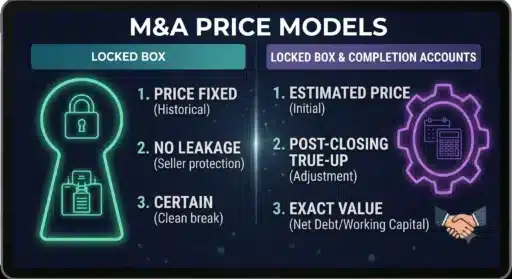
At this stage, the economic and legal terms of the contract are determined, including warranties, price adjustments and payment conditions. The experience and rigour of advisers are decisive to protect the company’s interests and avoid unnecessary risks.
Closing formalises the agreement, but it also marks the beginning of the next stage: integration. A well-managed negotiation not only achieves the best price, but also builds durable relationships and a collaborative environment afterwards.
Post-transaction integration
After signing, the most delicate phase begins: integration. A high percentage of transactions fail at this point due to a lack of cultural and operational planning.
Integration must be managed with a clear plan, effective internal communication and stable leadership. The management team plays a crucial role here: its ability to coordinate teams, maintain motivation and ensure continuity of processes is key to turning expected synergies into tangible results.
Successful integration is not improvised. It requires defining objectives, owners and timelines from the outset. When managed correctly, the new organisation consolidates its position and delivers the projected value.
Key aspects before starting an M&A transaction
Before embarking on an M&A process, the company should carry out a thorough internal review. It is essential to have up-to-date financial statements that present a true and fair view, properly documented contracts, compliance assured, and a clear corporate structure.
Equally important is the quality of the management team and that it is prepared and aligned with the strategy. The company must convey coherence, stability and professionalism to investors.
Well-organised documentation, prepared interlocutors, transparent communication and a defined strategic vision are the foundations for approaching the process successfully.
Common mistakes in M&A processes and how to avoid them
The most frequent mistakes in mergers and acquisitions tend to stem from a lack of planning and unrealistic expectations. Starting the process without shareholder consensus or without a clear strategy can block an advanced negotiation.
Another common mistake is overvaluing the business. Setting a price without analytical support or ignoring market conditions generates frustration and a loss of credibility. Valuation must be objective, data-driven and based on an honest understanding of the business’s real potential, grounded in the company’s track record, the current year, and realistic and credible projections in the business plan.
The role of the management team is also often underestimated. Divided leadership, insufficient competence or lack of commitment reduces the company’s attractiveness and creates uncertainty for buyers. By contrast, a united and competent team increases perceived value, builds confidence and ensures operational continuity after completion.
When acquiring a company, the buyer is effectively acquiring an expectation of FCF (cash flow generation). A low-quality management team can cast doubt on future cash generation capabilities and reduce the transaction’s appeal.
Finally, poor cultural integration can eliminate expected synergies. Anticipating cultural challenges, defining an integration plan and maintaining constant communication are essential steps to secure success.
The value of anticipation in an M&A process
Anticipation is the key to any successful M&A process. Preparing the company in advance makes it possible to identify risks, strengthen weak points and negotiate from a position of strength.
A company that knows its value, has its accounts in order and has a competent and committed management team can seize market opportunities with agility and confidence.
Ultimately, anticipation, planning and specialist advice transform a complex process into a genuine growth opportunity.
At Maraz Corporate Finance we help companies prepare each phase of their M&A process with rigour, experience and strategic vision, ensuring each decision contributes to creating durable value and strengthening the organisation’s future.
Javier de Rojas Roca de Togores
Partner – Maraz Corporate Finance
Frequently asked questions about preparing for an M&A process
How far in advance should I start preparing the company for an M&A transaction?
Ideally, start between one and two years before the planned transaction. That lead time makes it possible to put the accounts in order, normalise EBITDA, eliminate non-recurring expenses, professionalise the management team, reduce dependence on the owner, diversify the customer portfolio and resolve tax or legal contingencies. The better prepared the company is, the higher its value, the faster the process and the lower the risk of surprises in the buyer's due diligence. It is, in fact, the time to increase the value of the company before selling it.
What is a vendor due diligence and why is it worth doing before selling?
It is an exhaustive review of the company that the seller itself commissions on its own business, before going to market. Unlike traditional due diligence — carried out by the buyer to find risks and justify price reductions — a vendor due diligence allows the seller to detect and correct those same problems in advance. The result is that you reach the negotiation without surprises working against you, with the information under control, and with greater speed and negotiating power. Its cost is modest relative to the size of the transaction and its return is very high.
Why is the management team so important in an M&A transaction?
Because the buyer is not only acquiring assets, but the business's future capacity to generate cash, and that capacity depends largely on the team running it. Solid, cohesive and committed management conveys confidence, guarantees operational continuity after the deal and raises the perception of value. Conversely, a company that is too dependent on its owner or has weak leadership generates uncertainty and usually translates into a lower multiple, more deferred payment or demands that the seller stay on. Professionalising and giving visibility to the second line of management is one of the best investments before selling.
What is the difference between a merger and an acquisition?
In a merger, two companies integrate to form a single entity, sharing assets, teams and management structure, usually under a common strategy and with control shared. In an acquisition, one company buys all or a majority of another and takes control, imposing its strategic direction. A merger pursues balanced joint growth; an acquisition, rapid integration under clear leadership. In the Spanish middle market, the vast majority of transactions are acquisitions (purchase of shareholdings), although the specific structure — share deal or asset deal, total or partial — is defined in the deal-structuring phase.
Can I go through an M&A process without a financial adviser?
Technically yes, but it is rarely advisable. For the business owner, selling or merging their company is usually the most important transaction of their life and one they do only once; on the other side sit professional buyers who close deals frequently. That asymmetry is paid for at the negotiating table. An M&A adviser organises the process, keeps up competitive tension, defends the valuation, acts as a shield in hard negotiation and frees the owner to keep running the business. Knowing in advance the most common mistakes when selling is precisely one of the reasons why expert support makes the difference.