There is a deeply rooted habit among Spanish business owners: buying the premises where they operate —the office, the warehouse, the industrial unit. It has its emotional logic —ownership feels safe and leaves a lasting asset— but financially it hides a cost that almost never shows up in the income statement. That property is immobilised capital: money parked in bricks and mortar that generates no operating return, while the business right next to it could be earning far more.
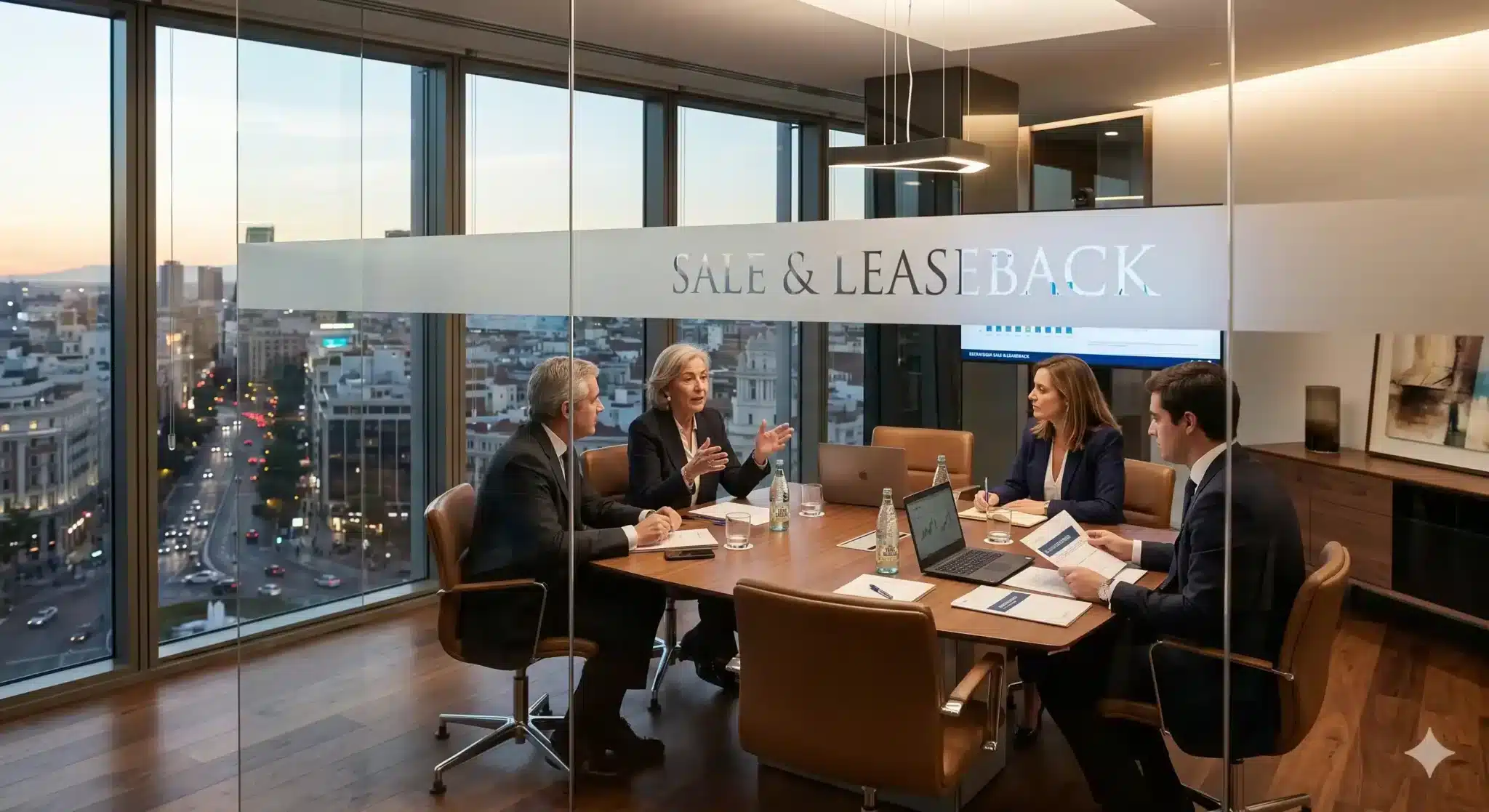
The Sale & Leaseback exists precisely to resolve that tension. It lets the family business sell the property to an investor and, in the same act, sign a long-term lease to keep using it exactly as before. The company turns an illiquid asset into cash —often close to 100% of market value— without relocating, without halting production, and, above all, without bringing in a shareholder who dilutes the family. Drawing on our experience in financial advisory for companies, this article explains how it works, its real impact on the balance sheet and returns, the risks involved, and when it is genuinely worthwhile.
How it works: the mechanism and its logic
The operation is conceptually simple, though it requires careful structuring. The owner company (seller-lessee) transfers the property to an investor (buyer-lessor) and, simultaneously, both parties sign a long-term lease. The norm is a triple net (NNN) contract, in which the tenant continues to bear property tax, insurance and maintenance, so the rent is net for the investor. Typical terms run from 10 to 20 years, with a common firm (non-cancellable) period of 7 to 10 years, rent indexed to inflation (CPI) and, occasionally, a repurchase option.
One nuance worth understanding from the outset: in a Sale & Leaseback the contract is worth as much as the building. The investor is not paying for square metres but for the rent it will collect. The price is set by capitalising that rent at a target return (the yield or cap rate): the lower the yield required —better location, more solvent tenant, longer lease— the higher the price. That is why rent, term and guarantees are negotiated at the same time as the price: they are inseparable.
Typical buyers in Spain are SOCIMIs (Spanish REITs), real estate funds, French SCPIs, family offices and specialised players. For them the appeal is clear: an asset leased at 100% from day one, with a committed long-term tenant.
Why it makes sense for the family business
An industrial, logistics or distribution company exists to produce, transport or sell; not to manage real estate. Keeping the premises in ownership ties up resources that could go to the core business —expanding capacity, strengthening working capital, acquiring a competitor, internationalising, investing in R&D or digitalisation— where returns are usually far higher than those of “being the owner”, which at best equals saving a rent whose market yield today is around 5%–6.5%.
For the owning family the argument is doubly attractive: the Sale & Leaseback provides liquidity without dilution —unlike bringing in a private equity fund— and without adding bank debt, which is especially valuable when traditional financing is expensive or constrained. It works, in fact, as an alternative financing route for the company when bank credit dries up or becomes costly. It is no coincidence that groups such as Inditex, El Corte Inglés or Mercadona have used this formula to fund expansion without borrowing.
The real engine: the return arbitrage (ROCE)
Here lies the financial heart of the operation. When a company keeps a property in ownership, the capital invested in that asset implicitly returns the real estate market rate (say, 5%–6%). But the operating business of an efficient company generates returns on capital employed that are much higher —often 15% or 20%.
Return on Capital Employed (ROCE) is calculated as operating profit (EBIT) divided by capital employed:
ROCE = EBIT / Capital Employed
Selling the property reduces the denominator (capital employed falls), and reinvesting that cash in the business strengthens the numerator (more EBIT). The result is a marked improvement in the group's ROCE: capital that was captive in a low-yielding asset is put to work in the company's growth engine. That is the essence of the operation —and also its main viability test, as we will see.
Balance sheet impact: liquidity, working capital and leverage
The cash inflow has three immediate effects. First, liquidity: a non-current asset (the property) becomes a current asset (cash), strengthening working capital and allowing the company to cancel short-term credit lines, negotiate early-payment discounts or self-fund investments without new debt.
Second, leverage. If the cash raised is used to repay mortgage debt, gross financial debt falls and the ratio most closely watched by bank risk committees improves. In groups with a stretched debt structure, this operation can be combined with a debt restructuring or refinancing to reorganise the liability side as a whole:
Leverage ratio = Net Financial Debt / EBITDA
A word of caution here, because the sales pitch “this doesn't count as debt” is only half true. Under Spanish GAAP (PGC), if the operation is classified as a finance lease, the cash received is booked as a financial liability: the debt does not disappear, it changes form. And in groups consolidating under IFRS 16, every lease generates a “debt-like” lease liability. In other words, real deleveraging only happens if the lease is classified as operating under individual Spanish GAAP, or if the cash is used to cancel debt larger than the lease liability that arises. This is not a technicality: it is the difference between the operation improving your ratios or merely disguising them.
Third, profitability: as capital employed shrinks, ROCE and ROA improve for the same profit. That said, under operating-lease GAAP the rent is an expense that reduces EBITDA; under IFRS 16, by contrast, EBITDA “improves” artificially because rent is replaced by depreciation and interest. An effect to keep firmly in mind if the company is to be valued on EBITDA multiples in a future M&A transaction: separating the operating company from the property usually clarifies the value of the business and makes it easier to sell.
The accounting key: operating vs. finance lease
The accounting treatment under Spanish GAAP determines much of the operation's outcome, and distinguishes two scenarios:
- Operating lease: if control and the majority of risks and rewards genuinely transfer to the buyer, the property leaves the balance sheet, cash comes in at the sale price, and future rent is booked as an operating expense. In this case the gain on sale is recognised.
- Finance lease: if a repurchase option or other conditions mean the seller substantially retains the risks and rewards, the operation is treated as financing. The asset stays on the balance sheet, the cash is booked against a financial liability and —importantly— no gain or loss is recognised on the sale.
That is why the design of the contract and of any repurchase options is decisive: it conditions whether the auditors validate the derecognition of the asset and, with it, the whole intended balance-sheet effect. Note that the Spanish accounting regulator (ICAC) has not transposed IFRS 16 into individual Spanish GAAP: individual Spanish accounts still distinguish operating and finance leases, unlike groups reporting under international standards.
Key tax and legal points in Spain
Capital gain in Corporate Income Tax
The sale usually generates a capital gain (the difference between price and net book value). If the operation is classified as financing, no taxable gain arises (the asset stays on the balance sheet); the Spanish tax authority has confirmed this. If it is a sale with an operating lease, the gain is taxed under Corporate Income Tax at the general 25% rate (with reduced rates for SMEs and micro-enterprises, currently being phased in).
One point not to get wrong: the old rollover relief for reinvested extraordinary gains no longer exists. It was repealed with effect from 1 January 2015. There is no longer a general mechanism to defer the gain by reinvesting it in another asset, so the tax cost of the sale must be planned from the outset and never taken for granted.
VAT, transfer tax and current uncertainty
The transfer of a second-hand property between businesses is usually VAT-exempt and subject instead to Transfer Tax (ITP), a non-recoverable regional cost. To avoid it, the parties commonly waive the VAT exemption: the operation then becomes VAT-taxed (recoverable) at 21% with the reverse charge, so the buyer self-assesses and there is no cash outlay. The residual cost is stamp duty (AJD, roughly 1.5%–2.5% depending on the region).
There is, however, an open front to watch: in late 2024 the Spanish Central Economic-Administrative Tribunal (TEAC) changed its criterion and held that leasebacks with a purchase option might not be a supply of goods but a financial loan operation for VAT purposes. The Supreme Court has yet to resolve the question. Until it does, the structure should be designed with specific tax advice covering both scenarios.
On top of this comes municipal capital gains tax (IIVTNU) on the urban land, payable by the seller, which is worth quantifying in advance.
The essential asset and the General Meeting
In a family business, the warehouse or headquarters is often the main asset on the balance sheet. Hence the importance of article 160.f of the Spanish Companies Act: the sale of an essential asset requires approval by the General Meeting, not just by the board. An asset is presumed essential when the operation exceeds 25% of the value of the assets in the last approved balance sheet. Skipping this step can taint the operation, so it must be on the calendar from the start.
The other side of the coin: risks and viability
Sale & Leaseback is not a universal solution, and presenting it without its trade-offs would be dishonest.
- Higher fixed costs and operating leverage. The company swaps a non-cash cost (depreciation) for a real cash outflow (rent). That raises fixed costs and the break-even point: in a downturn, the CPI-indexed rent becomes a rigid burden that squeezes margins.
- Loss of ownership and future appreciation. The company gives up any value the property may gain over the years, which goes to the investor.
- Renewal and relocation risk. At the end of the lease, renewing on acceptable terms may not be possible, or the business may need to relocate or downsize early, clashing with the firm lease period.
- ESG requirements. Institutional investors are increasingly demanding on sustainability: assets without certifications such as BREEAM or LEED can suffer appreciable valuation discounts, so upgrading the property before selling may require prior investment.
The acid test of viability is always the same: the operation only creates value if the reinvested capital earns more than the cost of the rent. Put differently, if the business's ROCE comfortably exceeds the yield paid to the investor. If that spread is narrow or negative, the Sale & Leaseback destroys value. And it should never be used to plug structural losses: monetising the asset to cover holes, rather than to fund growth, is the worst version of this operation.
When does it make sense?
A Sale & Leaseback is an outstanding value-creation tool provided it responds to an industrial logic and not a short-term cash emergency. It fits three profiles particularly well:
- Family businesses in succession or facing an M&A transaction, that want to separate the operating business from historical real estate —often through a holding structure— to ease the entry of partners or simplify the group's valuation.
- Growing companies with CAPEX-intensive plans that do not want to overload bank debt or dilute the family by bringing in funds.
- Industrial groups with high operating ROCE that identify the inefficiency of keeping their own capital earning market real estate rates.
At Maraz Corporate Finance we support family and mid-sized businesses throughout the process: viability analysis, independent valuation of the asset, financial-tax design of the lease and negotiation with institutional investors. The goal is for the operation to be not a liquidity patch but the genuine catalyst of a strategic plan.
Is your company's property hiding capital that could fund its next leap of growth?
We assess with you whether a Sale & Leaseback creates or destroys value in your specific case —with numbers, not hunches— and design the optimal financial and tax structure. Tell us your situation and we will analyse it together, with no obligation: contact our team here.
Javier de Rojas Roca de Togores
Partner – Maraz Corporate Finance
FAQs about Sale & Leaseback
What exactly is a Sale & Leaseback?
It is a dual operation: the company sells a property it owns to an investor and, simultaneously, signs a long-term lease with that investor to keep using it as tenant. It converts an immobilised asset into immediate liquidity without interrupting the business or having to relocate.
How much can be raised for the property?
The price is set by capitalising the agreed annual rent at a market return (yield or cap rate): the lower the yield required by the investor, the higher the price. In well-structured operations, with a solid tenant and a long lease, it is common to monetise close to 100% of the asset's market value, well above the 70%-80% typical of a mortgage.
Does a Sale & Leaseback really reduce debt?
It depends on the accounting classification. Under Spanish GAAP, if the lease is operating the asset leaves the balance sheet and the sale is recognised; if it is a finance lease, the cash is booked as a liability and there is no real deleveraging. In groups consolidating under IFRS 16 a lease liability always arises. Effective deleveraging is achieved mainly if the cash is used to cancel debt.
How is the operation taxed in Spain?
If classified as financing, no taxable gain arises. If it is a sale with an operating lease, the gain is taxed under Corporate Income Tax (general rate of 25%, with reduced rates for SMEs). Importantly, the old rollover relief for reinvested extraordinary gains has been repealed since 2015. On indirect taxation, between businesses it is common to waive the VAT exemption with the reverse charge, avoiding transfer tax.
When is a Sale & Leaseback NOT advisable?
When it is used to cover structural losses rather than to fund growth; when the capital released will not earn more than the cost of the rent; when only short, one-off liquidity is needed (a credit line is more efficient); or when the property sits in an area of strong appreciation that would be lost.
Does it need General Meeting approval?
Yes, usually. If the warehouse or headquarters is an essential asset —presumed when the operation exceeds 25% of the value of the assets in the last balance sheet— article 160.f of the Spanish Companies Act requires General Meeting approval; the board's decision alone is not enough.