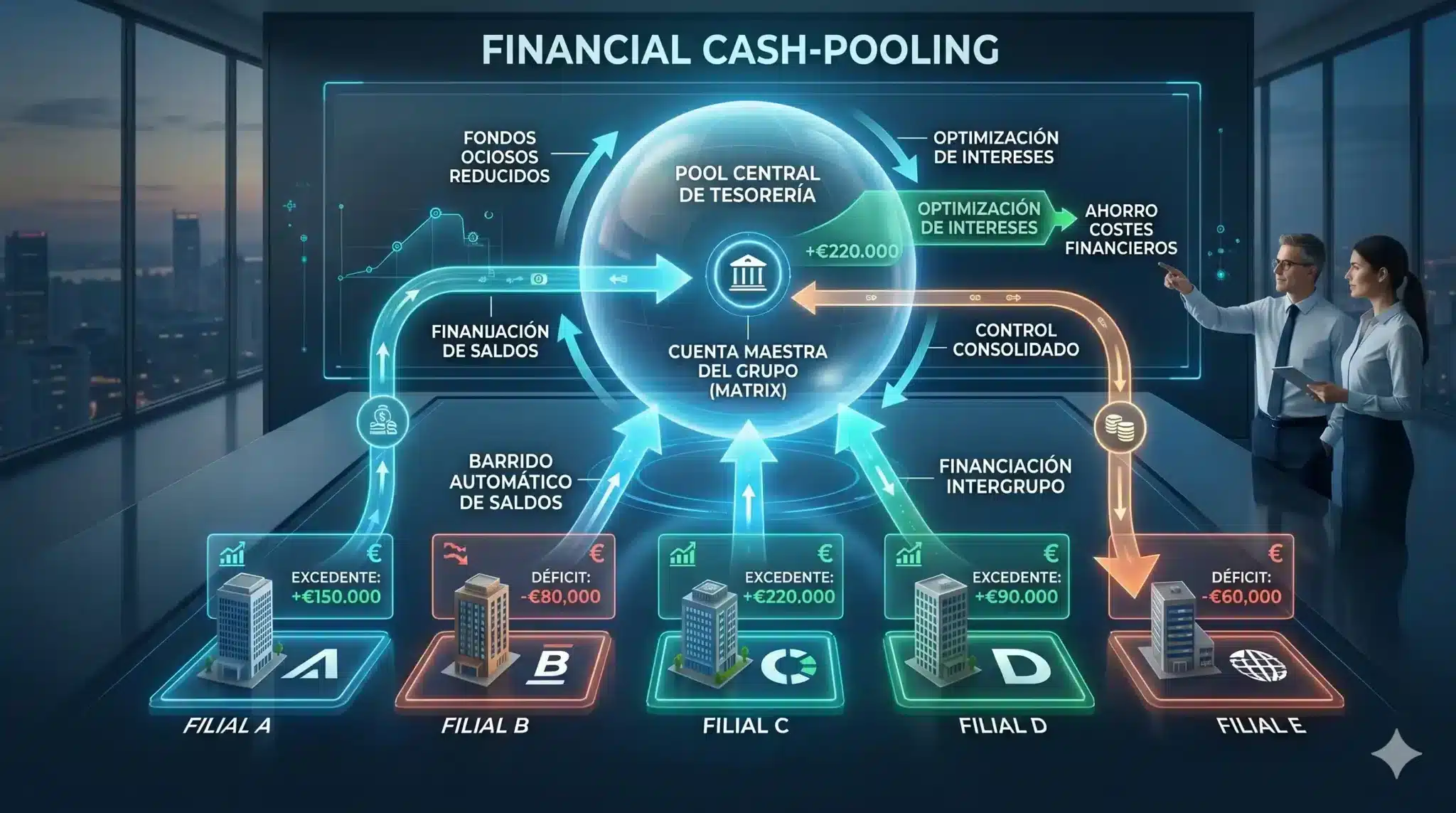
If you run a group of companies, this scene will sound familiar: one of your entities closes the month with a bank account full of idle cash, while another company in the same group is drawing down its credit line —and paying interest— just to make ends meet. Looked at as a whole, it makes no sense: the group has all the liquidity it needs, it is simply sitting in the wrong pocket. Cash pooling, or centralised treasury management, exists precisely to solve that.
It is one of the most powerful tools for gaining financial efficiency and control across a corporate group. But it is also one of those tools that, when poorly set up, can cause real headaches —especially since the Spanish Supreme Court rewrote the tax rules of the game in July 2025. In this article we explain how it works, the real benefits it brings to treasury control, what it costs, where the risks lie, and how to make it watertight in Spain.
What cash pooling is and how it works day to day
Cash pooling is, in essence, a system for the centralised management of a group's treasury. The bank accounts of the various companies stop operating as watertight compartments and start to be coordinated around a master account (also called the header or concentration account), managed by a group company —typically the parent or a treasury vehicle— acting as the pooler or pool leader.
The mechanics are simpler than they sound with an example. Picture three companies: A has +€50,000, B is at zero and C is –€20,000 overdrawn. Without cash pooling, A holds idle cash that earns almost nothing and C pays overdraft interest to the bank. With cash pooling, A's surplus automatically covers C's deficit, and the bank only sees the group's net position: +€30,000, a positive balance on which interest is earned rather than paid. In practice, the group finances itself with its own resources.
That offsetting is normally executed automatically at the close of each day. And here is the detail worth being clear about from the outset: every time money moves between companies, it generates an intra-group loan. That is not a minor technicality —it is the key to the entire tax and corporate treatment we will look at later.
The two main types: physical and notional
Not all cash pooling is the same. The first big decision is to choose between the physical concentration of balances or virtual offsetting (notional). The difference shapes the balance sheet, the risks, and even which banks you can use.
|
Criterion |
Physical cash pooling (zero / target balancing) | Notional cash pooling (virtual) |
| Mechanics | Physical, automatic sweep of balances to the master account. Peripheral accounts are left at zero (zero balancing) or at a target balance (target balancing). |
Balances stay in each account. The bank offsets positions only notionally to calculate interest on the net. |
|
Fund flows |
Real movement of money between accounts. | No physical movement of funds. |
| Legal nature | Systematically generates short-term intra-group loans. |
Does not generate direct intra-group credits; each balance stays in its account. |
|
Guarantees |
Limited, because the funds are already physically in the pooler's account. | Substantial: the bank usually requires cross-guarantees and joint liability among subsidiaries. |
| Use in Spain | The standard option for domestic groups. Fully compatible with Spanish banking. |
More restricted; in EMEA it usually requires hubs such as London, Amsterdam or Dublin, and carries regulatory uncertainty (Basel III). |
Within physical pooling there are nuances: zero balancing leaves accounts at zero each day; target balancing maintains a target balance (useful, for instance, to cover direct debits or deposits); and conditional balancing only sweeps when certain thresholds are exceeded. For more advanced groups there is also the in-house bank, where one group entity executes payments and collections on behalf of the others and even centralises FX. That already requires a serious treasury management system (TMS).
What really matters: financial control and efficiency
This is the heart of the matter, and the reason we recommend this tool to so many groups. Cash pooling is not just about saving on interest —although it does that too—; it is, above all, about regaining control over the group's liquidity and making better decisions with it.
- Centralised visibility and control. The finance function works with a single, reliable picture of the group's cash, not fifteen separate statements. That transforms the quality of decisions and lets you push subsidiaries not to hoard cash “just in case”.
- Less external financing, lower interest. By netting positions internally, the group stops borrowing outside what it already has inside. Gross bank debt falls and the spread the bank earns when one company is overdrawn and another is in surplus disappears.
- Better bargaining power with banks. A single, consolidated balance always negotiates better fees and rates than five small, scattered accounts.
- Internal financing on group terms. Companies in surplus finance those in deficit, almost always on better terms than the market would offer.
- Better cash forecasting and financial discipline. Centralising forces you to organise, report and plan ahead. Cash planning stops being an Excel file improvised every month.
This last point connects with something we see constantly in the valuation of corporate groups: the financial strength of the whole improves when the net treasury position is optimised. By reducing net financial debt, the group improves its leverage ratio (Net Financial Debt / EBITDA), a metric that any bank —and any buyer— watches closely.
And this is no cosmetic detail: improving those ratios helps avoid breaching covenants (the restrictive clauses in financing agreements). A group nearing its leverage limit can, simply by reordering its internal treasury, avoid a technical breach that would trigger accelerated repayment of its debt. Used well, cash pooling is also a risk-management tool.
The drawbacks and risks you cannot skip
It would be dishonest to sell cash pooling as a solution without trade-offs. It has them, and some are serious in the Spanish context.
- Loss of subsidiary autonomy. Each company's manager stops controlling “their” cash. It is a cultural change worth managing.
- Contagion risk. If the pool leader or a relevant subsidiary runs into trouble, it can drag the whole group down. The system's health depends on the group's collective solvency.
- Operational complexity. Accounting for each sweep as an intra-group loan, reconciling daily balances and integrating systems is not trivial. The bank's automation does not replace internal control.
- Hidden dividend (art. 273 LSC). If sweeps of balances to the parent are made unconditionally, without real interest and without a repayment plan, they can be reclassified as a hidden distribution of profits. If that pushes the subsidiary's net equity below its share capital, the transaction is unlawful and recoverable.
And the most underestimated risk in Spain: insolvency. If a subsidiary that contributes surpluses to the pool enters insolvency proceedings, its claims against the group are treated as belonging to “parties specially related to the insolvent debtor” and are classified as subordinated claims —the last to be paid. Put plainly: the insolvent subsidiary joins the back of the queue to recover the money it lent the group, and usually loses almost all of it. In addition, treasury flows carried out in the suspect period before insolvency can be clawed back. The lesson: cash pooling must never be used to drain liquidity from a subsidiary already in difficulty.
How much does it cost to set up cash pooling?
Costs fall into three blocks, and it is worth having them all on the table before deciding:
- Banking fees and connectivity. Opening and maintaining the master and peripheral accounts, sweep fees per transaction, and messaging and statement-integration services (Norma 43 / MT940) to reconcile at close.
- Legal and recurring compliance costs. Drafting the cash pooling agreement, minutes approving it at corporate-body level, the annual transfer pricing study and the documentation for Form 232 before the Spanish tax authority (AEAT).
- Technology infrastructure (TMS). Treasury software licences, integration with subsidiaries' ERPs and parameterisation consulting.
On the tools: the market ranges from simple accounting solutions for SMEs to corporate platforms with SWIFT connectivity, automated sweeps and symmetric interest calculation for large groups. The choice depends on the group's size and complexity —there is no point running an enterprise-grade system for a three-company group, or vice versa. As a rule of thumb: if the estimated annual saving in interest and fees comfortably exceeds the cost of the system and its administration, the project pays for itself.
The legal framework in Spain: what the Companies Act requires
The cash pooling agreement is an atypical contract —with no specific regulation— that combines elements of a loan, a commercial current account and an agency mandate. The Supreme Court itself has characterised it this way. That obliges directors to safeguard the legality of the flows, paying particular attention to several provisions of the Spanish Companies Act (LSC):
- Corporate approval (arts. 160 and 162 LSC). Joining the pool must be formally approved by each company's competent bodies, documenting that it is entered into in the corporate interest of the subsidiary itself, not only of the parent.
- Prohibition of financial assistance (arts. 143 and 150 LSC). No company may advance funds or provide guarantees to finance the acquisition of its own shares or those of the group. An ordinary working-capital cash pool does not breach the prohibition, but care must be taken that swept funds do not end up financing, directly or indirectly, the purchase of group shares. Breaching it renders the transaction void.
- Capital maintenance (art. 273 LSC). As noted, sweeps to the parent cannot conceal a profit distribution that leaves net equity below share capital.
This corporate fit is exactly the kind of analysis we address when studying the advantages of a holding company to structure a group: the structure must hold up legally, not just financially.
The new tax paradigm: the Supreme Court doctrine of 2025
Here is the most important change of recent years. Supreme Court Judgment 985/2025 of 15 July 2025 (ROJ STS 3721/2025, concerning the Spanish subsidiary of the Bunge group), later confirmed and consolidated by STS 489/2026 of 22 April, has rewritten the tax rules of cash pooling in Spain. It upholds the position of the AEAT's inspection and sets binding doctrine. These are its four pillars:
- They are loans, not deposits. Surpluses that subsidiaries contribute to the pool are characterised, for tax purposes, as short-term loans between related non-financial entities, not as bank deposits. This determines how comparable market rates are sought.
- Symmetric interest rates. The pooler is barred from charging a high rate to deficit subsidiaries and remunerating contributors at a marginal rate, keeping the spread. The rates applied to contributions and drawdowns must be equivalent. The leader cannot appropriate a financial intermediation margin.
- The pooler is only paid for administering. The judgment reasons that the leader performs purely administrative and coordination functions, without assuming real risks or being the original owner of the funds. Its remuneration must therefore be limited to a charge for low-value-added services, calculated on a cost-plus basis with a reduced margin —never through rate arbitrage.
- The group's rating applies, not the subsidiary's. When setting the market rate, the reference creditworthiness is not the deficit subsidiary's stand-alone rating but that of the consolidated group, because the risk is mutualised across the whole.
The Supreme Court applies a dynamic interpretation aligned with the 2022 OECD Transfer Pricing Guidelines (Chapter X on financial transactions). And the doctrine is already filtering into the administrative arena: the Central Economic-Administrative Tribunal (TEAC) resolution of 20 October 2025 reproduces the criterion, confirming that the rate must be single and symmetric because the pool leader acts as a mere intermediary without assuming differentiated risks.
Related-party transactions and mandatory documentation
All of this falls within the related-party transactions regime under article 18 of the Spanish Corporate Income Tax Act, which requires intra-group transactions to be valued at arm's length. In practice, that means keeping transfer pricing documentation: functional analysis, rate benchmarking and an assessment of the group's credit profile, all consistent with what is reported in Form 232. We develop this in detail in our guide on Enterprise Value vs Equity Value and debt-like items.
One point that greatly reduces the risk: if the group is taxed under the tax consolidation regime (a holding of at least 75%), the obligation to document internal related-party transactions disappears and there is no withholding on internal interest. For a purely domestic cash pool, electing tax consolidation is almost always the smartest decision. It is also worth remembering the article 16 LIS limit on the deductibility of financial expenses (30% of operating profit, with a minimum of one million euros deductible in any case), because pool interest counts towards it.
The grey areas the judgment left open
Rate symmetry is elegant on paper, but it creates tensions when the group, as a whole, is not balanced:
- Matched balances. When some subsidiaries' needs match others' surpluses, everything fits: the pooler charges its management fee and the balance sheet stays clean.
- Net group surplus. If the group places its surplus in an external deposit at 0.25% but must remunerate contributing subsidiaries at a symmetric rate of, say, 1.25%, a financial loss appears. The judgment does not clarify which entity should absorb it.
- Net group deficit. If the group borrows externally at 4% but can only pass on the symmetric 1.25% to subsidiaries, the leader takes a loss; and if it tries to pass on the 4%, it breaches symmetry. Another front open to future inspections.
That is why we insist: symmetry was set with multinational groups in mind, with physical pooling and a leader abroad. Its literal application to domestic or notional structures must be analysed case by case.
Cash pooling and M&A: the angle almost no one anticipates
This is the part closest to us as advisers, and where most money is lost for not having planned ahead. When a group with cash pooling sells one of its subsidiaries, the intra-group balances that subsidiary holds against the pool become a battleground during financial due diligence.
The reason is the equation that governs any transaction: Equity Value (what the seller receives) is obtained by subtracting net financial debt from Enterprise Value. And here is the problem: the buyer's advisers tend to pull intra-group debit balances into the debt perimeter, as debt-like items. If those balances generated by daily sweeps are not well documented as temporary working capital, they can translate directly into a downward adjustment to the price.
On top of that comes the Quality of Earnings analysis: the buyer will review whether the subsidiary's EBITDA has been inflated or distorted by poorly allocated treasury costs or off-market intra-group interest rates. It is exactly the kind of finding we explore in our analysis of how to interpret EV/EBITDA in M&A and valuation.
The practical recommendation: if you expect to sell a subsidiary within a 12-to-24-month horizon, disconnect it from the cash pool in an orderly way and well in advance, and settle the intra-group balances before sitting down to negotiate. It is one of the levers we work on when helping an owner prepare and increase the value of a company before a sale. The same applies in reverse: integrating a newly acquired company into the group's pool is a clear efficiency lever in a build-up strategy, always respecting the prohibition of financial assistance.
Does it make sense for your group?
Cash pooling adds more value the more these conditions hold:
- There is a parent or central treasury able to govern the system.
- There are several companies with opposite cash patterns: some generate liquidity, others consume it.
- There is seasonality or timing mismatches currently covered with expensive external financing.
It is especially useful for holdings, family groups with several operating companies, franchises and businesses with marked seasonality (retail, distribution, industry with peaks). It adds less in very small groups, with a single relevant operating company, or where implementation costs exceed the expected saving.
Action plan for CFOs and boards of directors
If you decide to move ahead, this is the order of priorities we recommend:
- Audit the interest rates in the agreement. Remove any asymmetry or pooler spread unless there is an exceptional, very well documented economic justification.
- Structure the leader's remuneration as a service agreement. Charge it as an administrative service on a cost-plus basis with a reduced margin, not through rate arbitrage.
- Index the symmetric rate to the group's consolidated rating. Not to each subsidiary's stand-alone analysis.
- Update the functional and comparability analysis. Rigorous transfer pricing documentation consistent with Form 232.
- Elect tax consolidation if you meet the requirements. It is the lever that most reduces the burden and risk in a domestic pool.
- Formalise corporate approvals. General meeting and board under arts. 160 and 162 LSC, documenting each subsidiary's corporate interest.
- Anticipate the impact on future M&A. Settle intra-group balances in advance if you expect to sell a business unit.
In summary
Cash pooling is one of those tools that separate a group that manages its treasury from one that simply endures it. Well set up, it gives you control, visibility and a financial saving that shows up in the ratios and on the bottom line. Poorly set up —or not updated after the Supreme Court doctrine of 2025— it can become a tax and corporate contingency with limitation periods of several years.
The good news is that almost all the problems are avoidable with a correct design from the outset.
Thinking about implementing or reviewing cash pooling in your group?
At Maraz Corporate Finance we have over a decade advising Spanish middle-market groups on valuation, financial structuring and M&A transactions. We design and review centralised treasury structures with an eye on both day-to-day efficiency and the value of your company the day you decide to sell —and on shielding you from the tax and corporate contingencies we have seen in this article. Tell us about your case and we will analyse it with you, with no obligation: contact our team here.
Javier de Rojas Roca de Togores
Partner – Maraz Corporate Finance
FAQs about cash pooling
What exactly is cash pooling?
It is a system for the centralised management of a corporate group's treasury. The balances of the various companies' accounts are concentrated or offset around a master account, so that the surplus of some subsidiaries covers the deficit of others. The aim is for the group to finance itself with its own liquidity rather than holding idle cash in some companies while others borrow externally.
What is the difference between physical and notional cash pooling?
In physical pooling (zero or target balancing) the money is actually moved each day to the master account, generating intra-group loans. In notional pooling the funds are not moved: the bank offsets the balances only virtually to calculate interest on the net position. Physical is the standard in Spain; notional usually requires cross-guarantees and banking hubs outside the country.
What advantages does cash pooling offer a corporate group?
Mainly control and efficiency: it gives a single view of the group's liquidity, reduces the need for external financing and interest expense, improves bargaining power with banks, and allows deficit subsidiaries to be financed internally on group terms. By reducing net financial debt, it also improves key ratios such as leverage (NFD/EBITDA) and helps avoid breaching covenants.
How is cash pooling taxed in Spain after the Supreme Court judgment?
STS 985/2025 of 15 July (and the subsequent STS 489/2026) established that pool contributions are intra-group loans —not deposits—, that debit and credit interest rates must be symmetric, that the applicable credit rating is the group's and not the subsidiary's, and that the managing company may only charge for its administrative services (cost-plus method), without appropriating a financial margin. These are related-party transactions (art. 18 LIS) requiring transfer pricing documentation.
What happens to cash pooling if a subsidiary becomes insolvent?
The claims that subsidiary holds against the group are classified as subordinated claims, as they are deemed to belong to parties specially related to the insolvent debtor. That means they are paid last and, in practice, are usually almost entirely lost. In addition, treasury movements in the period before insolvency can be clawed back. This is why cash pooling should never be used to drain liquidity from a subsidiary in difficulty.
How does cash pooling affect the sale of a group company?
The intra-group balances of the subsidiary being sold are often reclassified as debt (debt-like items) during due diligence, which can reduce the price the seller receives. The recommendation is to disconnect the subsidiary from the pool in an orderly way and settle those balances 12 to 24 months ahead of the transaction. We cover this in detail in our guide on how to increase your company's value before a sale.