Financial Assistance Prohibition
In the Spanish M&A market, particularly in the mid-sized segment, leveraged buyouts (LBOs) and management buyouts (MBOs) require a firm grasp of the legal and tax boundaries governing these transactions. Chief among them, the prohibition of financial assistance is one of the most complex and highest-risk matters: an error in structuring the guarantees or the leverage may not only frustrate the transaction, but also lead to the nullity of the financing agreements and to personal liability for the directors.
This article analyses what financial assistance is, how the leveraged merger is structured to overcome it lawfully, the shift in Supreme Court doctrine in 2025, its interaction with alternative financing, and the tax implications that condition the success of these transactions. It is a central piece of the M&A advisory and business sale advisory we provide in the Spanish middle market.
What financial assistance is and why it is prohibited
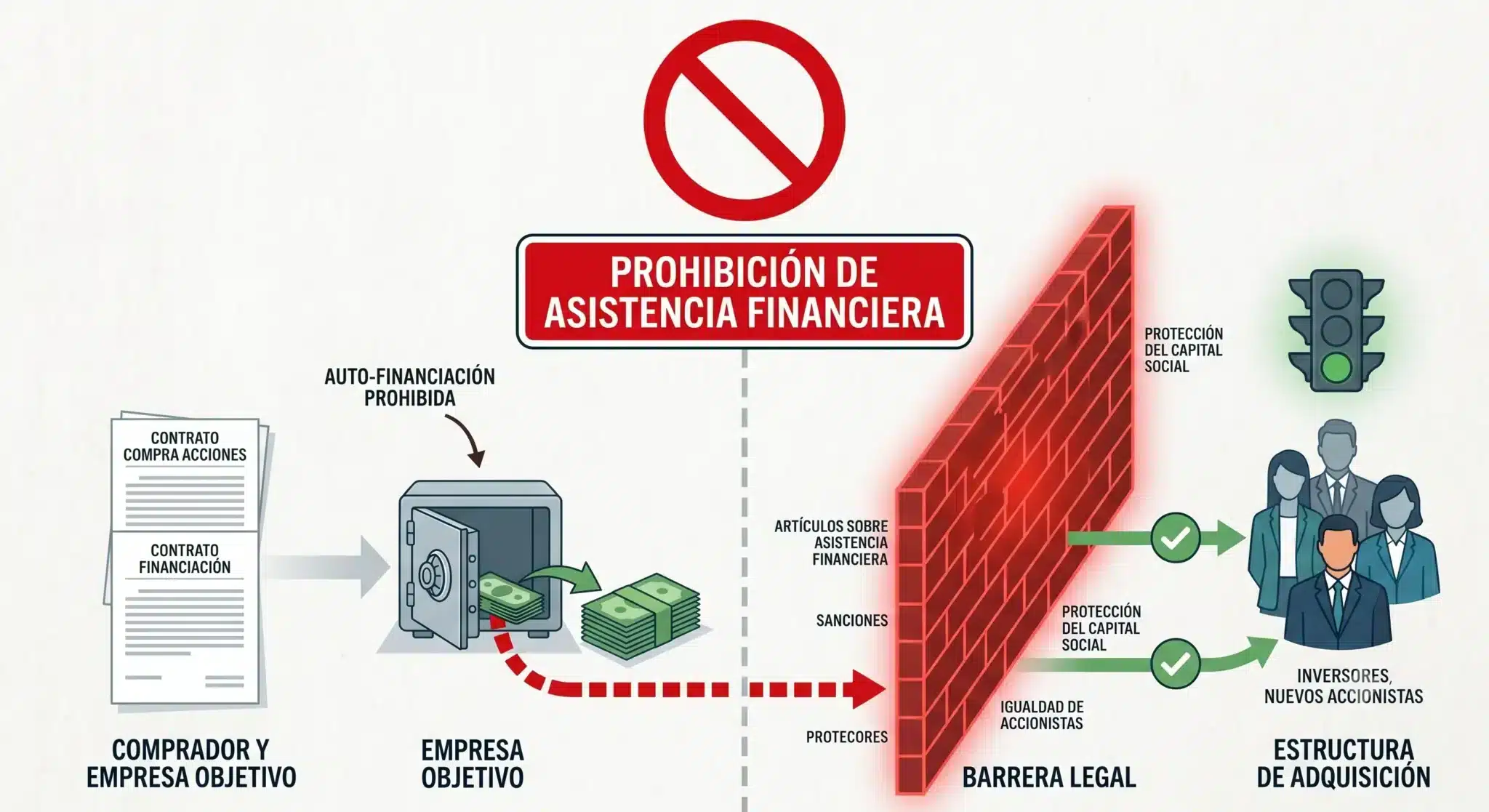
Financial assistance is the use of the balance sheet, liquidity, assets or guarantees of a company to facilitate — directly or indirectly — the acquisition of its own shares or interests (or those of its parent company) by a third party. It is a protective mechanism designed to safeguard the integrity of share capital and to protect creditors against the risk of asset stripping of the target company.
The Spanish legal system regulates it with different degrees of rigour depending on the corporate form, under the Companies Act (LSC — Ley de Sociedades de Capital). For limited liability companies (S.L.) a virtually absolute prohibition applies; for public limited companies (S.A.), a general prohibition with certain exhaustive exceptions.
|
Variable |
S.L. – Limited Liability Company (art. 143.2 LSC) | S.A. – Public Limited Company (art. 150 LSC) |
| Nature | General prohibition, without market exceptions |
General prohibition with statutory exceptions |
|
Exception for employees |
None | Permitted (facilitating employee share purchases) |
| Exception for credit institutions | Not envisaged |
Permitted in ordinary operations against distributable reserves |
|
Indirect assistance |
Prohibited (requires proof of the causal link) | Equally prohibited (interposed party) |
|
Sanction |
Nullity + fine (art. 157 LSC) |
Nullity + fine (art. 157 LSC) |
The rigidity applying to the S.L. — the predominant form among Spanish SMEs — is decisive: the prohibition not only bars the provision of funds or the granting of loans to the buyer, but also the constitution of collateral security (mortgages, pledges over assets) by the target to secure the acquirer's debt. Both provisions contain a closing clause ("nor to facilitate any type of financial assistance"), of an open-ended nature, which captures any act whose function is to finance the acquisition and which entails a real or potential cost to the company.
How an LBO/MBO is structured: the SPV and the leveraged merger
To execute a leveraged buyout, a special purpose vehicle (SPV or NewCo) is systematically interposed: a company with no operational activity of its own that receives the shareholders' equity and the acquisition debt, and uses these to acquire 100% of the target. We develop this architecture in our article on the SPV (Special Purpose Vehicle) and in the guide to the Management Buy-Out (MBO).
The problem: NewCo does not generate cash on its own, so debt service depends on the target's cash flows. The classic solution is a subsequent merger (debt pushdown) between NewCo and the target, uniting both balance sheets and transferring the acquisition debt to the operating cash flow. However, that merger raises the question of whether it constitutes deferred financial assistance, since the target's own assets end up being liable for the debt incurred to acquire it.
The leveraged merger under art. 42 of Royal Decree-Law 5/2023
The legislator, aware of the economic utility of leveraged buyouts, regulates a specific merger procedure in article 42 of Royal Decree-Law 5/2023 (successor of the former art. 35 of Law 3/2009). It is triggered where any of the merging companies has incurred debt in the previous three years to acquire control over another company participating in the transaction. It requires three documents:
- Common merger project: must set out the resources and the timeframe envisaged for the amortisation of the acquisition debt.
- Directors' report: with the economic and strategic justification for the acquisition and the merger, and an economic-financial plan.
- Independent expert's report: appointed by the Commercial Registry, on the reasonableness of the debt-amortisation projections. It is mandatory even where all shareholders unanimously approve the transaction.
The prevailing legal doctrine holds that compliance with this procedure "purges" the qualification as financial assistance: it is demonstrated, under the supervision of an expert and the Registry, that the operation is not designed to strip the company but to integrate two structures on economic grounds. A relevant point: art. 42 eliminated the requirement of the former art. 35 that the expert had to opine expressly on the existence of financial assistance, which reinforces that interpretation. Substantiating that economic logic and building the financial plan is part of the debt structuring and financing work in the transaction.
The Supreme Court turn: STS 190/2025 (Hotel El Hórreo case)
For decades, infringement of the prohibition entailed the automatic nullity of the guarantees (under art. 6.3 of the Spanish Civil Code), generating considerable uncertainty within bank credit committees, which feared losing their collateral if a court were to find concealed financial assistance. The Supreme Court Judgment 190/2025, of 6 February 2025, has reconfigured this landscape by introducing criteria of good faith and legal certainty in commercial dealings.
The case: Hotel El Hórreo S.A. granted a mortgage over a property to secure a loan advanced by a financial institution to Eurohouse Gestión de Viviendas S.L. Although the deed stated that the funds were to be used to acquire real estate, they were in fact used in their entirety to finance the acquisition of 100% of the shares in Hotel El Hórreo itself. Years later, once controlled by the purchasers, the company brought proceedings seeking the nullity of the mortgage on the ground of financial assistance. The Supreme Court dismissed the claim and upheld the security, on three pillars:
- Protection of the good-faith third party: the financial institution was unaware of the true destination of the funds. Where the creditor acts in good faith and with the required diligence, the mortgage securing a third party's loan is not null.
- Doctrine of one's own acts (venire contra factum proprium): it is abusive for those who designed and benefited from the transaction subsequently to seek to annul the security they themselves constituted, in order to release the asset without returning what was received.
- Restricted standing to sue: only corporate creditors and shareholders not involved in the management enjoy protection; not those who designed or benefited from the transaction.
This line has been reiterated by subsequent Supreme Court pronouncements in 2026. The message is clear: unlawful financial assistance remains an infringement — with administrative sanctions and potential liability of directors —, but the validity of collateral constituted in favour of good-faith financiers is protected against opportunistic claims.
This protection should not be confused with a relaxation of the rule. In the Ezentis case (STS 582/2023), the Supreme Court annulled an agreement whereby the company compensated an investor if the share price fell after a capital increase: it applied a purposive and broad interpretation, holding that any act whose function is to finance the acquisition of shares at a cost to the company falls within the prohibition. The good-faith doctrine protects a financier extraneous to the unlawful purpose; it does not legitimise financial assistance as such.
How to structure the transaction lawfully: Holding, SPV and subsequent merger
The practical question that every entrepreneur or manager asks is: if the company cannot finance its own acquisition, how then is a leveraged buyout carried out without incurring financial assistance? The answer does not lie in "circumventing" the prohibition — that would be fraud on the law and would lead to nullity —, but in
structuring the transaction so that it does not fall foul of it, channelling it through an independent vehicle and complying with the statutory procedure that "purges" the subsequent merger. This is the standard market approach, step by step:
Step 1 — Incorporation of the vehicle (SPV / NewCo) and, where applicable, the holding company
The purchasers (a management team in an MBO, a fund, an industrial investor) incorporate a new company — the NewCo or SPV — with no operational activity. They contribute their equity to this company, which in turn contracts the acquisition debt with banks or alternative financiers. The legal key: it is the NewCo — not the target — that borrows and stands as debtor. The target's assets are not touched at this point. Where it is also desirable to plan the shareholders' wealth or a future divestment, a holding company is placed above the NewCo, opening the door to the art. 21 CITA exemption which we discuss below.
Step 2 — Acquisition of the target by NewCo
NewCo acquires 100% (or a controlling majority) of the shares in the target company. The guarantees required by the financiers at this stage fall on the shares of NewCo itself and on the target's shares acquired (share pledge) — not on the target's operating assets. This nuance is essential: pledging the shares being acquired is lawful; mortgaging the target's real estate or pledging its accounts to secure the purchaser's debt would constitute prohibited financial assistance.
Step 3 — Subsequent merger (debt pushdown) in compliance with art. 42 RD-Law 5/2023
Once acquired, NewCo and the target merge. On the merging of the balance sheets, the acquisition debt is combined with the operating cash flow of the business, which repays it. As this merger takes place having contracted debt in the previous three years to take control, the reinforced procedure of art. 42 must be followed: a merger project setting out the debt-amortisation plan, a directors' report with the economic justification, and an independent expert's report from an expert appointed by the Commercial Registry.
Once that path is completed — and the economic logic of the transaction has been demonstrated, showing that it does not seek to strip the company —, the merger is validly consummated and the taint of financial assistance is neutralised.
Step 4 — Debt repayment out of the business's cash flow and deleveraging
Following the merger, the operating cash flows of the business service the debt. Tax planning then comes into play: for the interest to be deductible, the amortisation schedule under art. 16.5 of the Spanish Corporate Income Tax Act (LIS) must be respected (reducing the debt by ≈12.5% per annum for 8 years, down to 30% of the acquisition price), which should be agreed in the financing contract itself from the outset.
Represented schematically, the flow is: Investors/managers (equity) + Banks (debt) → NewCo/SPV → acquires 100% of the Target → merger of NewCo + Target (art. 42) → the business's cash flow repays the debt.
The role of the holding: tax neutrality and future divestment
Placing a holding company above the structure offers three advantages that go beyond the acquisition itself: it enables the group's tax consolidation (offsetting results to optimise the cash servicing the debt); it enables the 95% exemption of art. 21 CITA in a future disposal of the participation (effective tax rate of 1.25%); and it facilitates the presentation of a "clean company" by separating non-strategic assets before divestment. We develop this in the article on the holding company.
Each of these steps — design of the vehicle, structuring of the debt and its guarantees, execution of the merger and tax planning — requires fine coordination between the legal, financial and tax spheres. This is precisely the integrated M&A advisory that we provide at Maraz, together with financing structuring.
Alternative financing and guarantees: friction points
In current transactions, traditional bank financing coexists with alternative instruments that provide the flexibility required by the middle market. All of them must be analysed in light of the prohibition:
|
Instrument |
Cost / return | Key features |
| Mezzanine debt | ~14%–20% + equity kicker |
Hybrid subordinated to senior debt; completes the structure without significantly diluting the shareholder |
|
Venture debt |
High rate + warrants (low dilution) | For technology companies with a track record; runway without significant dilution |
| ENISA (profit-participating loan) | Euribor + spread + variable tranche |
Without personal guarantees, but with a change-of-control clause |
|
SGR guarantee |
Subsidised fees |
Unlocks bank financing; requires being a member of the Mutual Guarantee Society (SGR) |
Two cautionary notes are particularly relevant:
Guarantees over the target. The alternative financier, like the bank, will seek collateral: pledges over customer receivables or accounts, mortgages over assets. If those guarantees are granted by the target over its own property to secure the acquirer's debt, and are constituted before a merger purged by art. 42, the operation directly falls into nullity for financial assistance. The Spanish legal system, moreover, does not admit the Anglo-Saxon floating charge over all assets: each guarantee must be formalised individually.
Change-of-control clause in ENISA loans. ENISA lines are very useful for strengthening working capital, but they incorporate accelerated maturity clauses or penalty clauses if the majority of control of the borrower changes. In every due diligence of an acquisition, these loans must be reviewed: if ENISA's prior consent is not managed, the transaction may trigger accelerated and unforeseen loan repayment.
Tax matters: Deductibility of the acquisition interest
The viability of an LBO/MBO does not depend solely on the cash flow, but also on the harnessing of the tax shield of the debt interest. The Spanish Corporate Income Tax Act (LIS) introduces two limits that should be modelled from the design stage of the transaction.
General limit — art. 16.1 LIS
Net financial expenses are deductible up to 30% of the operating profit for the tax year, with a floor of €1,000,000 which is always deductible. Operating profit is calculated with specific adjustments to the earnings from operations (adding back depreciation and certain impairments, and dividends from participations of at least 5%).
LBO-specific firewall — art. 16.5 LIS
(Correction relative to the draft, which numbered this article as 16.4.) To prevent the NewCo's debt from being offset, via merger, against the target's profits, art. 16.5 LIS provides that the financial expenses of the acquisition debt are deductible up to 30% of the operating profit of the acquiring entity itself, without including the profit of any company that merges with it in the 4 years subsequent to the acquisition.
This limit does not apply if the acquisition debt does not exceed 70% of the price; and ceases to apply in the following years if the debt is reduced, from the acquisition, at least in the proportional part corresponding to each of the 8 subsequent years, until it reaches 30% of the purchase price.
In practice, this compels the parties to agree in the financing contract an amortisation of the principal of approximately 12.5% per annum. Incorporating this repayment requirement into the bank negotiation — part of the financing structuring — is what safeguards the deduction of financial expenses following the merger.
Optimisation through the holding — art. 21 LIS
Setting up a holding company before the transaction is the most robust strategy for reconciling tax neutrality, risk separation and future divestment. It enables recourse to tax consolidation (offsetting the holding's expenses against the subsidiaries' profits to service the debt) and, above all, application of the art. 21 LIS exemption: capital gains from the disposal of participations of at least 5% enjoy a 95% exemption, which reduces the effective tax rate to 1.25% (compared with the general 25% rate, or PIT rates that may exceed 30%). We develop this in the article on the holding company.
The holding also enables presenting a "clean company": separating non-strategic real-estate assets or excess cash before sale. Since the buyer applies multiples on recurring EBITDA, a clean balance sheet maximises price — something worth quantifying with a professional business valuation.
What happens if Financial Assistance prohibition is infringed
The sanction is twofold and independent. On the civil plane, the financial assistance or guarantee transaction is null and void (under art. 6.3 of the Civil Code), although — as the Supreme Court has clarified — that nullity does not always extend to the share acquisition transaction, nor does it prejudice the good-faith financier. On the administrative plane, art. 157 LSC provides for a fine of up to the nominal value of the shares or interests acquired, for which the directors of the infringing company are liable (the CNMV having jurisdiction in respect of S.A.s, and the Ministry of Economy in respect of S.L.s).
The cost of an error here is high: the transaction may be tainted and the directors exposed. That is why it is advisable to design the structure from the outset with expert transaction advisory, coordinating the legal, tax and cash-flow modelling aspects.
Conclusion: from Financial Assistance Prohibition to transaction engineering
The prohibition of financial assistance has ceased to be an insurmountable wall and has become a challenge of legal, financial and tax engineering. The leveraged merger procedure of art. 42 of RD-Law 5/2023, together with the protection of the good-faith financier consolidated by STS 190/2025, shapes an environment in which strategic leverage and legal certainty in commercial dealings can coexist.
However, the success of an LBO, an MBO or a restructuring in the middle market requires an integrated view: legal structure, cash-flow modelling in service of the debt and tax planning of capital gains. A careless analysis of the target's balance sheet, a badly constituted guarantee, an ignored change-of-control clause or an amortisation schedule that breaches art. 16.5 LIS may give rise to serious contingencies.
At Maraz Corporate Finance, from Alicante, we accompany entrepreneurs, management teams and investors throughout the entire journey: valuation, due diligence, financing structuring and design of the M&A transaction. If you are considering a leveraged transaction or the reorganisation of your group, contact our team for a tailored diagnostic.
Javier de Rojas Roca de Togores
Partner – Maraz Corporate Finance
FAQs on Financial Assistance Prohibition
What exactly is prohibited financial assistance?
It is any act by which a company uses its balance sheet, liquidity, assets or guarantees to facilitate a third party's acquisition of its own shares or interests (or those of its parent): loans to the buyer, advances, or guarantees by the company over the acquisition debt. It is prohibited by arts. 143.2 LSC (S.L.s) and 150 LSC (S.A.s) to protect share capital and creditors. It is a critical point in any leveraged M&A transaction.
How can a company's own cash then be used to finance its acquisition?
Through a NewCo (SPV) that acquires the target and a subsequent leveraged merger (debt pushdown) which complies with the procedure of art. 42 of RD-Law 5/2023: merger project, directors' report and independent expert's report. Once that path is completed, doctrine considers that the prohibition is "purged". Designing that financing structure is one of the keys to the transaction.
If the prohibition is infringed, is the transaction null?
The financial assistance transaction or guarantee is null and void (art. 6.3 CC), and the directors may be sanctioned by a fine (art. 157 LSC). However, STS 190/2025 has clarified that a guarantee in favour of a good-faith financier who was unaware of the unlawful purpose is not null, and that whoever designed the transaction cannot subsequently seek its nullity. The nullity of the financial assistance, moreover, does not always drag with it the sale of the interests.
What tax risks does a poorly structured LBO carry?
The main risk is losing the deduction of the interest on the acquisition debt. Art. 16.5 LIS limits that deduction and requires the debt to be reduced proportionally over 8 years (≈12.5% per annum) down to 30% of the price, and it also disregards the operating profit of the merged company during the 4 subsequent years. It must be modelled from the design stage, within the financing structuring.
Why review ENISA loans before acquiring a company?
Because ENISA profit-participating loans incorporate change-of-control clauses: if the majority of the borrower's capital changes, ENISA may declare accelerated maturity with a penalty. If its prior consent is not obtained, the acquisition may trigger accelerated loan repayment. Detecting this is one of the objectives of the financial due diligence prior to the transaction.