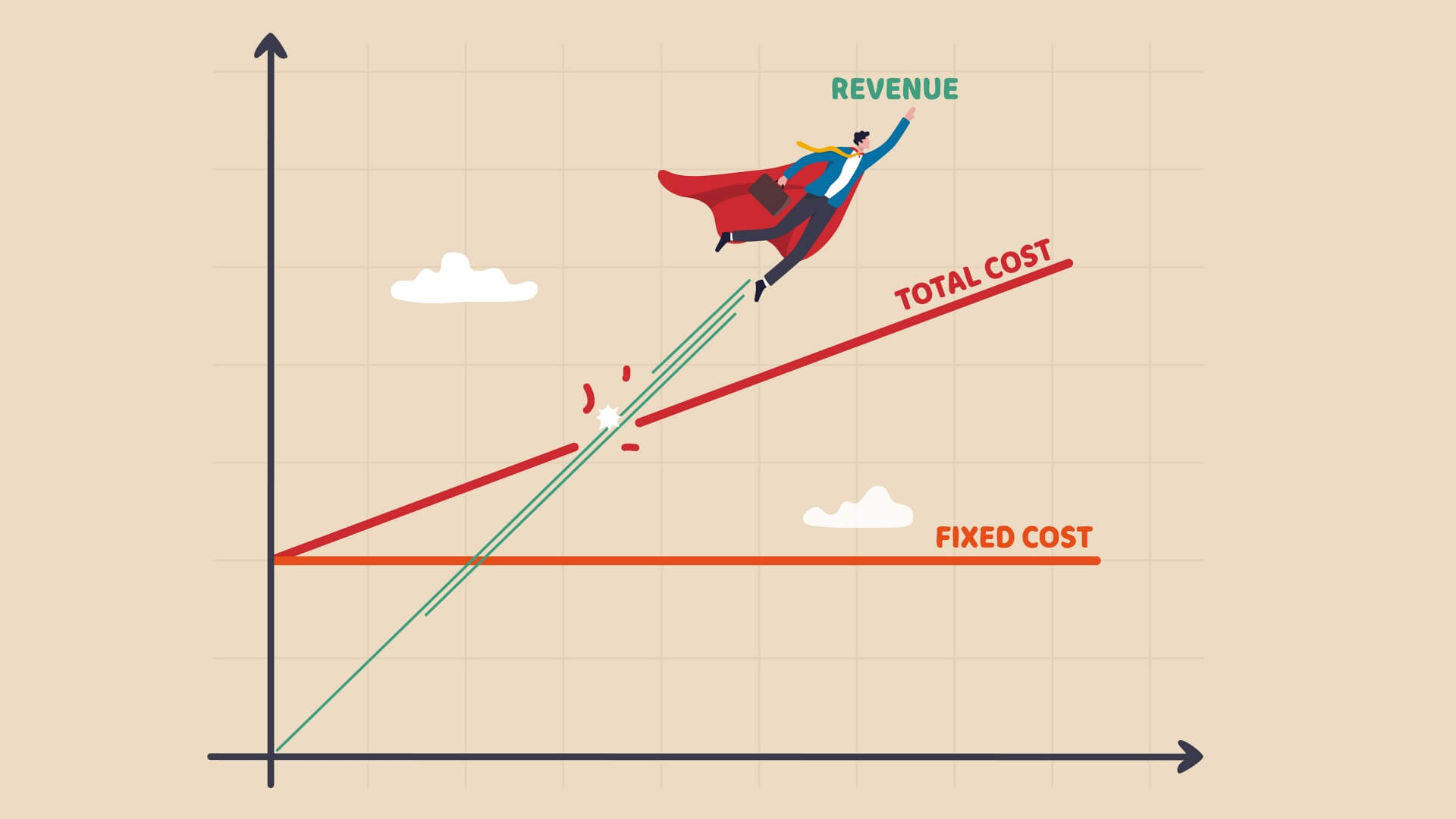
What is the break-even point?
The break-even point (also called the break-even threshold or profitability threshold) is the level of sales at which revenue equals total costs, resulting in zero profit. At that point the company neither makes nor loses money; beyond it, every additional sale begins to generate profit. Understanding the break-even point is fundamental to analysing the financial viability of a business, setting prices and planning sales targets.
The break-even point is calculated by finding the volume of sales needed to cover all of the company's fixed and variable costs. In mathematical terms, the classic formula in units is:
Break-even point (units) = Fixed costs / (Unit selling price − Unit variable cost)
The difference in the denominator is the unit contribution margin, i.e. the amount each unit sold contributes towards covering fixed costs.
Example: if a company has fixed costs of €10,000, a unit price of €50 and a variable cost of €30, then its contribution margin is €20 and the break-even point would be 500 units sold: 10,000 / (50 − 30).
In other words, it needs to sell 500 units for revenue to cover its total costs exactly.
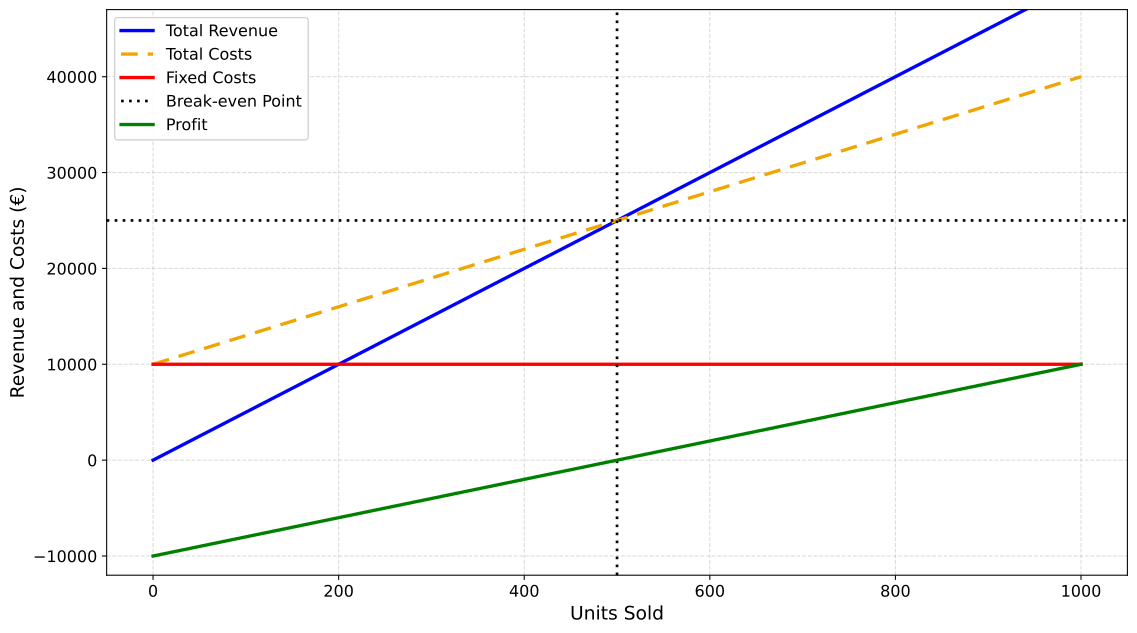
Break-even point chart
Explanation:
-
- A typical break-even chart:
-
-
- - The red line represents total
fixed costs (which remain constant)
-
-
-
- - The orange line reflects
total costs (the sum of fixed and variable costs, rising with each unit produced)
-
-
-
- - and the blue line shows
total revenue generated by sales
-
-
-
- . The
break-even point is where the revenue line (blue) intersects the total cost line (orange), indicating the level of sales at which revenue equals costs.
-
-
- To the left of that point there are losses (costs exceed revenue) and to the right there are profits.
A lower break-even point is preferable, since it means the company needs to sell fewer units to cover its costs.
Once the break-even point is reached, all fixed costs are covered; from then on, each additional sale generates a profit equal to the unit contribution margin, since it only has to cover its own variable cost.
It is important to note that the break-even point is a relative value: it must be interpreted in context. It is usually compared with expected sales or production capacity to assess the viability of the business.
For example, if the break-even point exceeds the company's maximum sales capacity or seems unattainable given market demand, the project would be financially unviable. Conversely, a break-even point below (or in line with) projected sales indicates a more comfortable position for generating profit. Integrating this threshold into management control and periodic reporting is one of the typical functions of a fractional CFO.
Note: Besides being calculated in units, the break-even point can be expressed in sales value. This is obtained by multiplying the break-even units by the unit price.
Let's compare two cases: a software company with high fixed costs and a distribution company with low fixed costs
A software company with high fixed costs
Imagine a software development company that invests heavily in its product. Fixed costs (mainly developers' salaries, servers, licences, etc.) are very high relative to its sales, while the variable costs of selling each additional licence are very low. This is a typical situation in software or SaaS models, where "a SaaS company may have high initial fixed costs due to software development, but lower variable costs as it scales".
The financial implications are significant. Because of its high fixed costs, the break-even point in this business is quite high, which increases risk: a lot of sales are needed to avoid losses.
If actual demand turns out lower than expected, the company would face significant losses, since fixed costs "weigh" even if target sales are not achieved. This situation reflects high operating leverage: with so many fixed costs, variations in sales have an enormous effect on the result. Indeed, when a company has very high fixed costs, its break-even point rises and it becomes more sensitive to changes in sales volume.
On the other hand, once the break-even point is passed, this type of company can scale its profits quickly. Each additional licence sold beyond the profitability threshold will generate a significant incremental profit. This potential for high profits beyond break-even is characteristic of software businesses with high fixed costs: heavy upfront spending, but also a high margin on each additional sale. In short, it is a "high risk, high reward" model: they require significant volume to avoid losing money, but once the threshold is passed, most of the revenue turns into pure profit.
This dynamic explains why valuing these businesses requires specific methods, as we see in how to value a start-up.
A distribution company with low fixed costs
Now consider a distribution company (for example, a retail shop or a distributor of physical products) that operates with a very different cost structure. In this case, fixed costs are low, since the business may only have to pay the rent on premises, a few basic salaries and utilities. Most of its costs are tied to the goods it sells, i.e. variable costs (buying the product from the wholesaler, delivery fees, etc.). In other words, this company has relatively little fixed expense to cover each month, but each individual sale leaves a smaller margin, because it has to pay the cost of the goods sold.
Low fixed costs make the barrier to avoiding losses lower, since the company does not carry much structure to finance. Indeed, "when a company has low fixed costs and many variable costs, it is easier to adjust production and costs in line with changes in supply and demand". This means that if sales fall, this company can reduce its inventory purchases (lowering variable costs) and hold up better, keeping its costs aligned with demand. There is greater flexibility to adapt to adverse market conditions.
On the other hand, the disadvantage of this model is that unit profits are smaller. Even after passing the break-even point, each additional sale contributes only a small incremental profit. To generate large profits, a lot of volume must be sold.
Note that, although this company's break-even point is lower and quicker to reach, its profit growth is slower compared with the software case. In thin-margin distribution businesses, profitability depends on constantly moving a large number of units.
Break-even comparison: software vs distribution
The two examples above illustrate how each sector's cost structure influences its break-even point and its profitability dynamics. In general terms, the software sector tends to have a cost structure with a high fixed proportion, which means it needs a significant volume of sales (or a critical mass of users) to amortise those initial costs. For example, many software start-ups operate at a loss in their early years until they reach enough users to cover the sunk costs of development. By contrast, the distribution/retail sector operates with light structures, able to reach break-even with fewer sales and adjust quickly if the market fluctuates.
This does not mean that one is "better" than the other, but that they have different risk-return profiles: the software company bets on recovering its investment many times over later (once the threshold is passed, each sale contributes a lot to profit), while the distribution company seeks stability by selling volume at modest margins.
Understanding the operating leverage of each model is key to designing the business plan and strategy.
Strategies for lowering the break-even point and improving profitability
Lowering the break-even point is a desirable objective, since it allows profitability to be reached sooner and reduces the risk of losses. To achieve it, various cost- and price-focused strategies can be applied.
In essence, the break-even point will fall if we increase the contribution margin per unit (either by raising prices or lowering variable costs) and/or if we reduce total fixed costs. Some specific strategies:
-
-
- Reduce fixed costs: Cutting fixed expenses directly lowers the numerator of the break-even formula. The company can renegotiate leases or contracts to pay less, drop non-essential fixed expenses, or outsource certain activities to convert fixed costs into variable ones (for example, outsourcing logistics instead of owning a fleet). It also pays to optimise the use of resources: eliminate waste, save energy and generally make the structure more efficient to lower recurring fixed expenses.
- Reduce variable costs: Improving the contribution margin means attacking the variable cost per unit. You can negotiate lower prices with suppliers, look for cheaper raw materials or make production processes more efficient so as to use less input per unit.
- Increase the selling price (gross margin): If the market allows it, raising prices increases the margin per unit and lowers the break-even point. This strategy should be used with caution, considering demand elasticity and competition.
- Improve the product/service mix towards higher-margin items – for example, adding premium lines whose unit price (and margin) is higher. Likewise, improving the value proposition or quality can justify a higher price, increasing the contribution margin without losing sales.
- Increase sales volume (and exploit economies of scale): Although strictly speaking selling more does not "move" the break-even point mathematically, in practice it allows fixed costs to be covered sooner and brings profits forward. Marketing and sales strategies can help achieve higher volume: investing in advertising, promotions or market expansion to win more customers.
- Use cross-selling or upselling with existing customers to raise the average revenue per customer. Higher volume spread over the same fixed cost structure reduces the fixed cost per unit produced, improving profitability. In some cases, growing in volume also makes it possible to negotiate better unit costs (economies of scale), tying in with the reduction of variable costs mentioned above.
- Other tactics include optimising inventory management (avoiding losses through obsolescence) and reducing shrinkage or waste in production. Every reduction in unit variable cost increases the unit margin and therefore reduces the volume of sales needed to cover fixed costs.
-
In practice, a combination of these strategies is usually the way to lower the break-even point: cut fixed expenses, improve processes and launch campaigns to sell more. The result is a lower break-even point, greater financial security (a better margin of safety) and more headroom to invest in growth or withstand sales downturns. Designing and executing this margin-improvement and efficiency plan is precisely the job of fractional financial management.
External factors that affect the break-even point
A company's break-even point is not static; it can be affected by various external factors in the economic and market environment.
Some of the most important are:
-
-
- Inflation and input costs: Inflation can raise both variable costs (raw materials, supplies) and fixed costs (rents, salaries, utilities). If selling prices do not rise in step, the contribution margin shrinks and the break-even point rises, since more sales will be needed to cover higher costs. For example, a rise in the cost of raw materials that cannot be fully passed on to the price means a smaller denominator (price − variable cost), raising the sales threshold needed to break even. Companies must monitor their costs and adjust prices or seek efficiencies to counter inflation.
- Changes in market demand: A general fall in demand for the company's products or services does not alter the calculated break-even point itself (which is theoretical), but it does make it harder to reach in reality. If the market contracts, the company may no longer manage to sell that minimum volume, falling below break-even and incurring losses. In such cases, it is sometimes necessary to restructure the company to lower the break-even point to a level compatible with the new demand (for example, by reducing fixed costs through closing premises, cutting staff, etc.). Conversely, a boom in demand makes it easy to exceed the break-even point comfortably, allowing the company to earn profits even with sub-optimal cost structures.
- Competition and market prices: The entry of new competitors or aggressive pricing strategies in the sector may force the company to lower its selling prices or incur more marketing expense to maintain its market share. Both affect the break-even point negatively: lower prices reduce the contribution margin per unit, raising the volume needed to break even; and higher commercial expenses mean higher fixed costs. Competitive pressure can thus shift the break-even point to a higher level of sales.
- Regulation and government factors: Changes in taxes, new employment or environmental regulations, tariffs, etc., can introduce additional costs for the company. An increase in taxes or social security charges raises fixed costs (e.g. more spending on legal compliance) and variable costs (e.g. a higher cost per unit if tariffs on imported inputs rise), affecting the break-even point in a similar way to inflation. On the other hand, government subsidies or incentives could reduce costs and lower the break-even point.
- General economic conditions and sector trends: The economy as a whole has an influence. In times of recession, as well as falling demand, there may be overcapacity and a need to lower break-even points in order to survive (many companies renegotiate leases or cut staff in a crisis). By contrast, in expansionary cycles companies can tolerate higher break-even points in expectation of growing sales. Likewise, technological or consumer trends can make a business model obsolete and require changes to the cost structure.
-
When falling demand or inflation lead the company to operate persistently near or below its break-even point, it is advisable to act early: we address this in business crisis and restructuring options, and if the problem is debt, in restructuring and refinancing.
Conclusions on the break-even point
Break-even analysis combines accounting and strategic aspects to provide a clear sales threshold that separates loss from profit.
The break-even point is a vital tool in financial planning. Knowing and managing it allows managers to take informed decisions: if a project requires sales that are too high to be profitable, perhaps it should be reconsidered; if the company is getting dangerously close to its break-even point, it is advisable to reduce costs or boost revenue to recover a margin of safety. A healthy business will always seek to keep its break-even point as low as possible and well below its actual sales, thereby securing a cushion that guarantees viability and profits in a competitive, changing environment.
If you are looking at how to improve your company's management and profitability, at Maraz Corporate Finance we help you as a fractional CFO to implement the cost control, margin analysis and management reporting that keep the break-even point under control. And if you need to finance growth or rebalance the structure, we support you in raising financing.
Javier de Rojas Roca de Togores
Partner - Maraz Corporate Finance
Frequently asked questions about the break-even point
How is a company's break-even point calculated?
Total fixed costs are divided by the unit contribution margin (unit selling price minus unit variable cost). The result is the number of units that must be sold to cover all costs. Multiplying those units by the price gives the break-even point in sales value.
What is the difference between break-even point, break-even threshold and profitability threshold?
None: they are three names for the same concept. They all refer to the level of sales at which revenue equals total costs and profit is zero.
Why does a software company have a higher break-even point than a distribution company?
Because its cost structure has a high proportion of fixed costs (development, servers, technical salaries) and a low variable cost per unit. That raises the sales threshold required and the operating leverage, but it also allows profits to scale very quickly once it is exceeded. This dynamic shapes its valuation as a start-up.
How can I lower my company's break-even point?
By increasing the contribution margin (raising prices or reducing variable costs) or reducing fixed costs (renegotiating contracts, converting fixed costs into variable ones, eliminating non-essential expenses). Improving the mix towards higher-margin products also helps. A fractional CFO can design and execute that margin-improvement and cost-control plan.
What happens if my company operates below the break-even point?
It means it is incurring losses: costs exceed revenue. If it is temporary, it can be absorbed; if it persists, you have to act quickly by lowering the break-even point (reducing fixed costs) or boosting revenue. When the situation becomes chronic, it is worth considering the restructuring options before the problem gets worse.