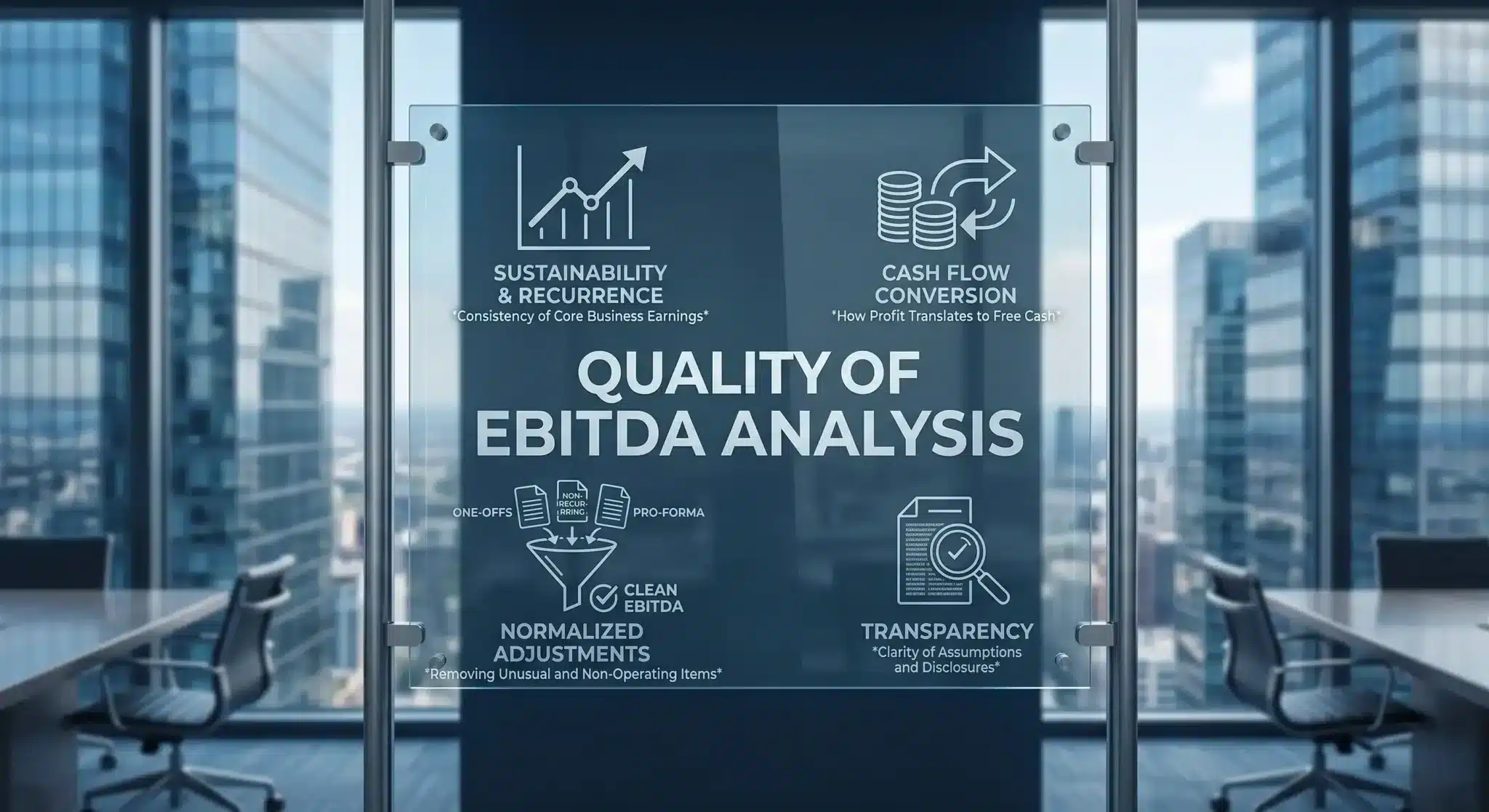
Quality of Earnings:
When a buyer says they are paying "seven times EBITDA", what they are really buying is not the EBITDA shown in the statutory accounts, but a cleansed version of it: the earnings the business can generate on a recurring, sustainable and transferable basis under new ownership. The gap between the two figures is rarely small, and it is precisely in that margin that much of a deal's price is decided. The analysis that measures that gap has its own name in M&A parlance: Quality of Earnings (QoE), and it is the technical core of any financial due diligence.
The profit and loss account—whether prepared under Spanish GAAP (Plan General de Contabilidad) or under international standards (IFRS)—is designed to meet tax and statutory obligations, not to reflect a business's recurring cash-generating capacity. That is why reported EBITDA is only an accounting starting point. The work of Quality of Earnings consists of clearing away the "noise"—both accounting and operational—to isolate normalised EBITDA, which is what truly matters in a transaction.
In this article we explain, from practice, what that analysis involves, which families of adjustments are applied, how the boundary between expense and investment can distort earnings, why an EBITDA adjustment rarely travels alone (it drags working capital and net debt with it), and how all of it comes together in a full worked example. It is a technical subject, but the underlying logic is simple, and it is worth understanding for any owner considering the sale—or purchase—of a company.
What Quality of Earnings is—and why it exists
Accounting has one job: to reflect a company's activity faithfully and in an orderly way within a regulatory framework. But accounting was never designed to answer the question a buyer asks: "how much recurring money will this business make next year, once I am the owner and the current owner's idiosyncrasies have gone?" Answering that question requires reinterpreting the numbers, not merely verifying them. That reinterpretation is the Quality of Earnings analysis.
It is worth distinguishing it from an audit, with which it is often confused. An audit verifies that the accounts give a true and fair view under the applicable standard, looking backwards with a compliance mindset. The earnings-quality analysis, by contrast, challenges those same accounts with a transaction mindset: it cares less about whether they are "correctly prepared" than about whether they are repeatable. A company can have perfectly audited accounts and still have very poor-quality EBITDA. We develop that difference in our article on Financial Due Diligence vs Financial Audit.
The starting point is always the same: most middle-market SMEs are valued by applying a multiple to EBITDA. If that EBITDA is the base to which the multiple is applied, the critical question is not "what is the multiple?" but "which EBITDA do we apply it to?" An adjustment of €500,000 in earnings, at a multiple of eight, moves the price by four million. That is why the most valuable work in a due diligence lies not in arguing over the multiple, but in building the figure to which it is applied with rigour.
From reported EBITDA to normalised EBITDA: The Bridge
The aim of the analysis is to build what the industry calls the EBITDA bridge: a table that, starting from the EBITDA reported in the accounts, adds and subtracts justified adjustments until it reaches normalised EBITDA—the figure that reflects the recurring profitability of the business. Every adjustment must be documented and defensible before the counterparty; an adjustment that cannot be supported with evidence is an adjustment that will collapse in negotiation.
Conceptually, the bridge links five broad families of adjustments to reported EBITDA: non-recurring items, adjustments to market value, accounting cut-off (accruals) corrections, the boundary between expense and investment (OPEX vs CAPEX), and pro-forma adjustments. The result is normalised or run-rate EBITDA: the best estimate of what the business generates on a sustainable basis. Let us look at each family.
The five families of adjustments
1. Non-recurring items (one-off)
Costs or income that occurred during the period but are not part of day-to-day operations: a lawsuit already settled, severance from closing a business line, the fees of the sell-side advisers themselves (deal fees), a fine, an insurance claim. These are added back to EBITDA (add-backs). The reverse also applies: a one-off gain—the sale of a property, a one-time grant—must be subtracted. One important nuance that tends to spark debate: not every redundancy is "non-recurring". If the company incurs severance every year through its normal staff turnover, that cost is recurring and cannot be added back. The analyst checks the historical rate before accepting the adjustment.
2. Adjustments to market value (arm's length)
Particularly relevant in the family business, where many costs do not reflect market conditions. The classic case is the owner-manager's remuneration: if the founder is paid €50,000 but the role would require hiring a director at €180,000, a negative adjustment of €130,000 applies, because that is the real cost of running the business without them.
Conversely, if they are paid well above market, the excess is added back. The same logic applies to rents paid on premises owned by the shareholder's own property company, to purchases from related parties, and to management fees charged by a parent that may disappear after the sale. This adjustment overlaps with a sensitive tax area, that of transfer pricing, whose contingencies should be reviewed in parallel.
3. Cut-off and accruals
Timing distortions arising from breaches of the accruals principle: sales booked in one period that relate to deliveries in the previous one, supplier invoices not recorded at year-end, volume rebates on sales or purchases settled in a different year from the one that generated the entitlement, or bad-debt provisions artificially reversed at year-end to inflate the result. These are fine adjustments that surface only when the detail is analysed month by month.
4. The OPEX vs CAPEX boundary: the subtlest adjustment
This is one of the quietest mechanisms for overstating EBITDA quality, and it deserves a pause. EBITDA is a measure that sits before depreciation and amortisation. Therefore, any expense shifted from the income statement to the balance sheet—capitalised as an asset rather than charged as a cost of the period—increases EBITDA euro for euro. A conventional expense reduces EBITDA; that same amount, once capitalised, no longer reduces it, because its impact is deferred via depreciation in later years (and depreciation sits "below" EBITDA).
Two areas concentrate the risk. First, the capitalisation of R&D and software development: it is common for a technology company to capitalise its developers' salaries on the argument that they create an intangible asset. If due diligence shows that much of that time is spent on maintenance or bug-fixing—current expense, not investment—that amount must be reclassified as expense and subtracted from EBITDA. Second, machinery maintenance: if routine repairs have been booked as "asset improvements" (CAPEX) to dilute their impact over ten years of depreciation, they are reclassified as expense of the period. In both cases, reported EBITDA falls.
5. Pro-forma and run-rate adjustments
These reflect the annualised impact of changes that occurred mid-year. If the company signed a recurring contract in July worth a million in annual margin, the accounts for the year show only six months: the pro-forma adjustment adds the rest to reflect future capacity. The same logic, in reverse, applies to closing a loss-making unit (its revenue and costs are removed) or, positively, to an acquisition completed in October (the nine prior months are incorporated to homogenise the base). It is one of the most technical adjustments and where unjustified optimism most easily creeps in, so it demands contracts and evidence on the table.
Revenue Quality: What the earnings are made of
Normalising EBITDA answers "how much does the company really make?" But a serious analysis goes one step further and asks "what are those earnings made of?" Two companies with identical normalised EBITDA can deserve very different valuations depending on the quality of the revenue that sustains them.
- Customer concentration. EBITDA sustained by a single customer accounting for 40% of gross margin, with no long-term contract, is far more fragile—and worth less—than the same earnings spread across hundreds of customers. It is a latent deal breaker.
- Price-volume mix. One must discern whether sales are growing through more units sold or only through price increases. If growth comes solely from price while volume falls, the competitive position is deteriorating and the recurrence of EBITDA is at risk.
- Recurrence and churn. In subscription or recurring-service models, the analyst reviews the cancellation rate (churn), customer lifetime value and the health of deferred revenue collected in advance. And they watch for artificial sales pushed at quarter-end with aggressive discounts that mortgage future margin.
- Revenue recognition and cut-off. Cross-checking delivery-note dates against invoice dates reveals whether earnings have been "pulled forward" to hit targets. A spike in billing in the last month of the year—the classic year-end hockey stick—is always a signal to investigate.
An adjustment never travels alone: EBITDA, Working Capital and Net Debt
Here is one of the ideas that separate a superficial analysis from a professional one. An EBITDA adjustment is not an isolated exercise in the income statement: it almost always has a symmetrical counterpart in working capital or in net debt. And it is in that connection that significant figures are won or lost in negotiation.
An example makes it clear. Suppose due diligence discovers that the company has not provisioned €200,000 of invoices from a customer that has entered insolvency. The finding hits on three fronts at once:
- On EBITDA: a negative adjustment of €200,000 is made for the unrecognised bad-debt expense.
- On working capital: that receivable leaves the balance sheet, reducing real working capital at closing. If the contract sets a target working-capital level, the seller will have to contribute cash to make up the shortfall.
- On price: at a multiple of eight, that €200,000 of lower EBITDA takes €1.6 million off Enterprise Value; and, in addition, the working-capital adjustment prevents the buyer from inheriting a bad debt after closing.
That is why the earnings-quality analysis cannot be separated from the analysis of working capital and why it matters, nor from the conversion of EBITDA into cash. High EBITDA achieved at the expense of skimping on maintenance capex, or by stretching supplier payments, is not good EBITDA: it is a deferred problem.
How it is done: From the general ledger to the EBITDA bridge
A rigorous earnings-quality analysis does not settle for the trial balances presented by management. It follows an orderly sequence in three layers.
First, extracting the detail. Work is done on the complete General Ledger, entry by entry, not on aggregated summaries. Data analytics is used to process thousands of entries in search of unusual patterns that a monthly balance hides.
Second, the monthly analysis of the last 24 to 36 months. Breaking EBITDA down month by month reveals what the annual figure conceals: billing spikes in the final month of the year, anomalous jumps in gross margin that point to inventory or cost-allocation errors, and overheads that do not follow the logic of the business.
Third, building the EBITDA bridge: the reconciliation table that starts from accounting EBITDA and incorporates each add-back and each deduction until it reaches normalised EBITDA. It is the deliverable that synthesises the whole exercise and on which the price is negotiated.
Worked Example: How an analysis moves 3 million
Let us illustrate the scale with a hypothetical case. "Industrial Solutions, S.L." is an industrial-sector company put up for sale with the following starting figures:
- Turnover (year T): €25,000,000
- Reported (accounting) EBITDA: €4,200,000 (margin of 16.8%)
- Multiple agreed in the letter of intent: 7.5x
- Indicative Enterprise Value: 4,200,000 × 7.5 = €31,500,000
After reviewing the General Ledger, the contracts, the payroll and the accounting policies, the due diligence team identifies six adjustments:
|
Item / Adjustment |
Type | Impact (€) |
| Reported (accounting) EBITDA | Starting point |
4,200,000 |
|
Director's salary to market value |
Market | −150,000 |
| R&D reclassification (CAPEX to OPEX) | Capitalisation |
−300,000 |
|
Expense cut-off (accruals) |
Accruals | +80,000 |
| Severance from line closure | Non-recurring |
+120,000 |
|
Unaccrued supplier rebate |
Accruals | −100,000 |
| Below-market related-party rent | Market |
−50,000 |
|
Normalised EBITDA |
Final figure |
3,800,000 |
The result: the EBITDA on which the deal should really be negotiated is €3,800,000, 9.5% below the reported figure. Applying the same 7.5x multiple, Enterprise Value falls from €31,500,000 to €28,500,000. In other words, the earnings-quality analysis has revealed a price adjustment of three million euros in the buyer's favour. Without that analysis, the buyer would have overpaid that amount and, on top of it, inherited an understated cost structure (the director who must be hired, the R&D that is really an expense).
Note a detail that lends credibility to the work: of the six adjustments, two add and four subtract. An honest analysis does not seek only to inflate or only to cut; it seeks the real figure, and that is why it includes adjustments that pull in both directions. That, moreover, is the difference between a report the counterparty accepts and one that falls apart in the first meeting.
Buyer and Seller: Two uses of the same analysis
How the analysis is approached depends on which side of the table you sit.
From the seller's side, it is increasingly common to commission one's own analysis before going to market, within a Vendor Due Diligence.
It has three concrete advantages: it allows the buyer's objections to be anticipated by identifying the weak points of EBITDA before they find them; it allows every legitimate add-back to be captured and documented—extraordinary costs of the year, temporary licences, one-off severance—so they are correctly added to the base to which the multiple is applied; and it allows the pace of the process to be controlled, preventing the buyer, during the exclusivity phase, from using last-minute findings to renegotiate downwards (so-called price chipping). We develop this in our article on the advantages of Vendor Due Diligence.
From the buyer's side, the use is the mirror image: to protect the capital and ensure that the flows projected in the model are real. The buyer will challenge with scepticism each add-back proposed by the seller and will demand documentary evidence of its non-recurring nature. But the findings do not only adjust the price: they feed into the representations and warranties of the purchase agreement and into the post-closing adjustment mechanisms. And, above all, the buyer will want to know how much of that normalised EBITDA truly converts into free cash after covering recurring capex and working-capital needs.
From Normalised EBITDA to the seller's cheque
Reaching normalised EBITDA is not the end of the road. That EBITDA, multiplied by the sector multiple, yields the Enterprise Value (the value of the business). But what the seller receives at the notary is the Equity Value (the value of their shares), and between the two sit net financial debt, the working-capital adjustment and debt-like items.
Confusing the two concepts is the most expensive and frequent error in a deal; we explain it in how to interpret the EV/EBITDA multiple. And the multiple applied is not universal: it varies widely by activity, as we set out in our analysis of EBITDA multiples by sector. The earnings-quality analysis sits at the first link of that whole chain, which is why it conditions everything that follows.
Conclusion about Quality of Earnings
Quality of Earnings is, ultimately, an exercise in honesty about the numbers: separating the recurring from the exceptional, the operational from the personal, the sustainable from the window-dressed, and distinguishing expense from investment. It is neither a formality nor a box-ticking exercise, but the analysis with the greatest impact on price—because it acts on the very base to which the multiple is applied, and because each adjustment propagates into working capital and net debt. As the worked example shows, a rigorous analysis can move a company's value by several million euros.
That is why it should be approached with method and with a transaction mindset, not an accounting one. At Maraz Corporate Finance we integrate the earnings-quality analysis into our Financial Due Diligence work and our M&A transaction advisory, both on the buy side and the sell side. Because valuing a company well starts with understanding what its earnings are truly made of.
Javier de Rojas Roca de Togores
Partner - Maraz Corporate Finance
FAQs - Quality of Earnings
What is the difference between accounting EBITDA and normalised EBITDA?
Accounting EBITDA is the figure shown in the statutory accounts under the applicable standard. Normalised EBITDA strips that EBITDA of everything that is neither recurring nor transferable to the buyer: owner remuneration off market, personal expenses, extraordinary items, related-party transactions and improperly capitalised costs. In a Spanish SME the gap is typically between 15% and 25%.
Why does capitalising expenses affect EBITDA?
Because EBITDA is calculated before depreciation and amortisation. If an expense that should hit the income statement is capitalised as a balance-sheet asset, it stops reducing EBITDA and its impact is deferred via depreciation, which sits below EBITDA. That is why capitalising R&D salaries or machinery repairs inflates EBITDA euro for euro, and the earnings-quality analysis reclassifies it as expense.
How much can an EBITDA adjustment affect the price?
A great deal, because it is multiplied by the multiple. At a multiple of eight, a €500,000 adjustment moves Enterprise Value by four million. In the worked example in this article, six adjustments netting −€400,000 of EBITDA reduce Enterprise Value by three million at a 7.5x multiple.
Does an EBITDA adjustment affect only the income statement?
No. It almost always has a counterpart in working capital or net debt. For example, an unprovisioned bad debt adjusts EBITDA downwards and, at the same time, reduces real working capital, obliging the seller to make it up at closing. That is why the earnings-quality analysis is studied alongside working capital and net debt.
Who should commission the analysis, the buyer or the seller?
Both use it. The buyer, to avoid paying for unreal earnings and to feed the findings into the contract's warranties. The seller, ideally before going to market, to document their legitimate add-backs, avoid surprises and control the pace of the process. Commissioning it before selling, within a Vendor Due Diligence, is one of the decisions that best protects the price.
What signs point to low-quality EBITDA?
High customer concentration, growth based solely on price increases with falling volume, margins that improve just before the sale, year-end billing spikes, aggressively capitalised expenses and high EBITDA sustained at the expense of not investing in maintenance capex. All point to earnings that are less solid and repeatable than they appear.