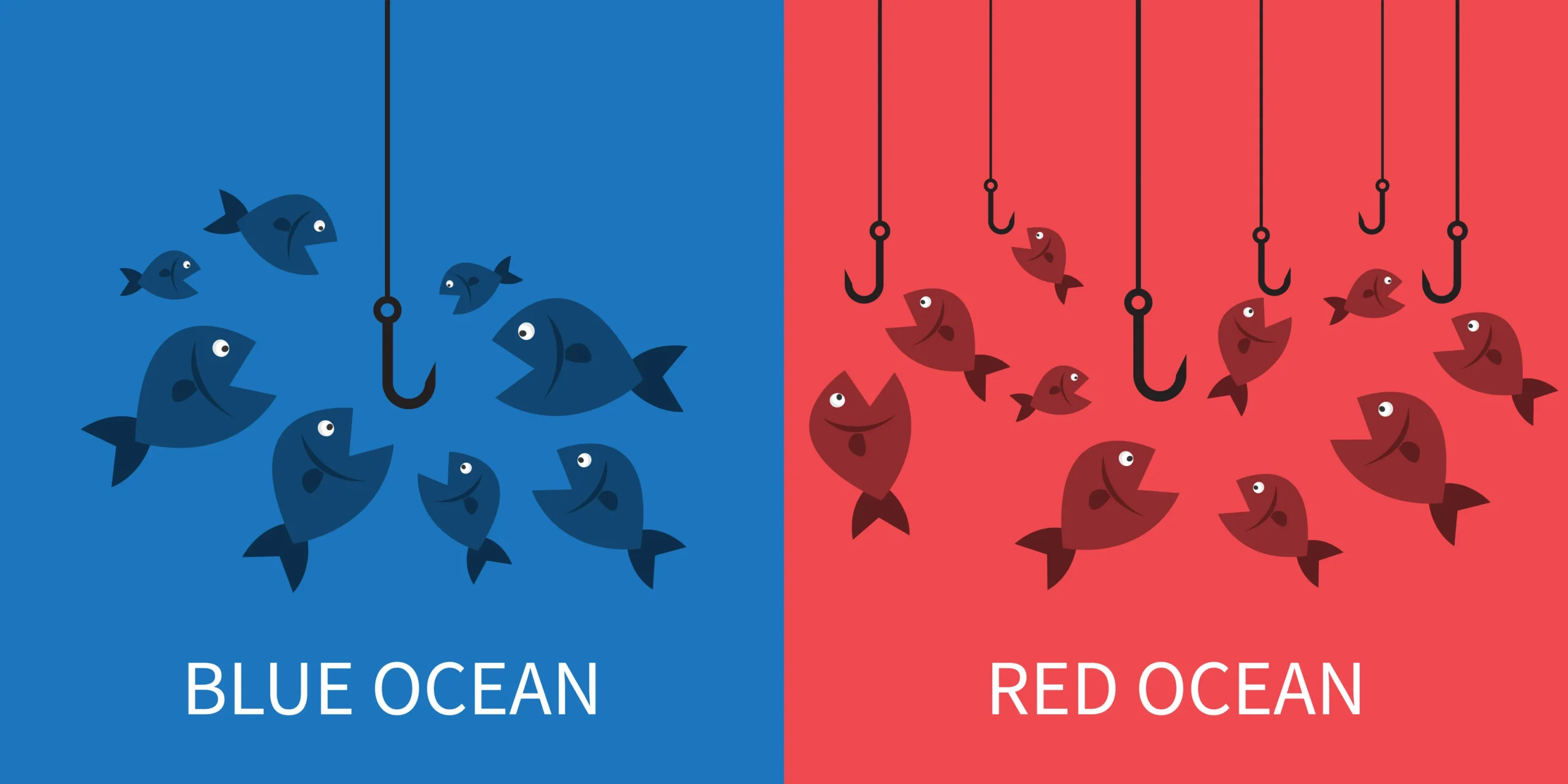
Blue Ocean Strategy in mature industries
In most business schools, when competitive strategy is discussed, two broad paths are usually presented:
- Compete on price (cost leadership)
- Compete through differentiation
In young or growing industries, both options can coexist reasonably well. But in mature industries, many companies end up trapped in the first: they try to defend volume and share through ever-increasing discounts, while cutting costs to protect margin. That is how the typical red ocean forms: very similar companies, with similar products and services, competing for the same customers… with very little room to grow profitably.
This problem has intensified in a digital environment. Today, for many customers, the first filter is opening several browser tabs: suppliers’ websites, online catalogues, comparison sites and marketplaces. In a matter of minutes they can see who is the cheapest in the market. If your website and your commercial narrative only talk about price and technical specifications, you are inviting the customer to treat you like a commodity.
Against this backdrop, blue ocean strategy proposes a different logic: not choosing between “price” or “a little bit of differentiation”, but creating your own market space where direct comparison matters less and the value proposition is difficult to reduce to a price list.
1. The vicious price cycle in mature industries
In a mature industry, several factors tend to coincide:
- Excess capacity and pressure to utilise it
- Products and services perceived as very similar (undifferentiated)
- Highly informed customers with easy access to online information
- Increasing real-time price transparency thanks to websites and comparison tools
In that context, the dynamic repeats itself:
- A competitor cuts price to win a key contract
- Others respond with discounts to avoid losing volume
- The product is perceived as even more undifferentiated
- The customer assumes they can always push a bit more on price and choose the supplier most willing to lower it
The result is a value-destruction spiral: more activity, more revenue, but less cash generation and increasingly strained leverage. From a corporate finance perspective, it is a poor combination: margin pressure and a constant need to refinance or support a debt structure with declining returns.
At the same time, there is often an underlying issue: the company has not genuinely worked on its value proposition, nor compared it rigorously against competitors, nor translated it into a consistent commercial argument. There is a vague sense of what others do, but there is no structured tracking of:
- What specifications they offer
- What service levels they guarantee
- What contractual terms have become standard
- What they communicate on their website and in sales materials
- Without that competitive mirror, it is easy to fall into the feeling that “we all do the same” and that the only lever left is price
2. What blue ocean strategy adds
Blue ocean strategy is not a slogan; it is a shift in approach:
- Stop fighting for millimetres in a saturated market
- Build a proposition that solves the customer’s problem in a different way
- And do so with a cost structure that remains competitive
Three ideas capture it well:
- Create new value, not just cosmetic features
- Differentiate with controlled costs: the goal is not to be the most expensive, but to offer a combination of attributes the customer values more than a simple discount
- Look at non-customers and alternative uses, rather than limiting yourself to the “usual” segment
This is not the preserve of tech start-ups. Transport, packaging, industrial maintenance, B2B services and logistics businesses have opened blue oceans by redefining:
- What problem they solve, precisely
- What service they wrap around the product
- And how they charge (payment model, contract structure, subscription, performance-based pricing, etc.)
3. Value proposition and competition: looking in the right mirror
In many companies, the value proposition is little more than generic corporate copy. It lacks concreteness: what problem do I solve better than others, how does that impact the customer’s P&L, and what proof do I have to defend it?
Here, competitor monitoring is essential—properly understood:
- It is not enough to receive “filtered quotes” from time to time
- You need a basic system to collect and organise information about key rivals
For example:
- What specifications do they provide as standard for each product type?
- What service levels, or response times, do they guarantee contractually?
- What flexibility (financing, lead times, terms and conditions) are they building into proposals?
- What central message do they convey on their website and in commercial materials?
With that snapshot, you can compare your product and service specifications against something objective and, from there:
- Identify where you are better
- Accept where you are indistinguishable from competitors
- Decide where it is worth investing to move ahead
The next step is to reformulate the value proposition with that evidence: what you offer, what the customer gains, and why it makes sense to pay for it even if someone cheaper exists.
That value proposition cannot stay in internal documents; it must become:
- Simple comparison sheets
- Quantified examples of savings or improvement
- Real use cases
- Messaging that matches what the customer sees on the website
4. CRM and commercial intelligence: data that helps you move beyond price
A good CRM tool, used properly, is the heart of commercial intelligence. The problem is that it often remains just an address book: customer contact details, a record of who was visited and when, and little else.
The difference comes from disciplined CRM use to record:
- Opportunities, proposals and prices offered
- Discounts applied
- Outcome of each deal (won/lost)
- Reasons for losing: price, specifications, service, lead times, terms, reference to a specific competitor
- Market signals brought back by the sales team (new competitor services, changes on competitors’ websites, customer reactions)
Over time, the CRM can answer highly relevant questions:
- What type of customer values which attribute?
- Where does price competitiveness break down?
- Which competitor beats us most often—and with what?
- Which offer changes improve win rate?
In an environment where it is so easy to go online and see who is the cheapest, structured commercial intelligence is probably the best defence against price wars. It lets you refine the value proposition, adjust commercial policy and steer R&D with data—not intuition.
5. Sales force: selection and training as a strategic lever
None of this works if the sales force is not properly selected, aligned and equipped.
In mature industries, a salesperson who simply “turns quotes around” and negotiates discounts is not enough. The required profile looks more like a practical consultant than a mere seller:
- Understands the customer’s business beyond the purchase order
- Can translate the value proposition into economic impact
- Is able to genuinely listen to what is happening in the market
- And feels comfortable defending the value proposition of the product or service against the ease of selling on price
Hence the importance of:
Selection of the sales force:
- Look for profiles that combine technical understanding, business perspective and relationship skills. (A “cheap” salesperson can be very expensive: evaluate on cost–benefit, not salary cost alone.)
- Assess with cases: role plays where they must explain a value proposition versus a cheaper competitor and handle objections
Ongoing training:
- Sufficient technical knowledge of product and service
- Mastery of the value narrative and competitive comparisons
- A basic financial toolkit: margin, TCO, payback, impact on the customer’s P&L
- Using the CRM as a daily working tool (not bureaucracy)
In practice, the sales team is both the radar detecting market changes and the voice that must explain to customers why the company is no longer playing only on price.
6. R&D and applied innovation: reinventing what you offer
Blue ocean strategy is not just a commercial story. Without R&D and applied innovation, it remains theory. In many companies, product development is limited to incremental versions or tweaks requested by a major customer. That rarely creates a blue ocean.
The approach that works starts with the customer’s problem: production downtime, energy consumption, changeover times, regulatory risk, lack of real-time data, difficulty integrating systems from different suppliers.
From there, R&D should focus on redesigning product and service around those problems, incorporating:
- New functionalities
- Sensors and accompanying software
- More stable processes
- “Turnkey” solutions with partner ecosystems
And, crucially, rethinking the business model:
- Pay-per-use
- Performance contracts
- Product + service bundles
- Digital platforms for customer relationship management
The combination of product, service, data, digital experience (including the website) and pricing model is what can create a true blue ocean in a mature industry. Again, the CRM closes the loop: it measures customer reaction, conversion on new propositions, objections that arise and adjustments the market is asking for.
7. A roadmap to stop competing only on price
For a company that feels “customers only buy from us on price”, the shift requires a multi-stage process:
- Strategic–financial diagnosis: analyse profitability by product, customer and channel; cost structure; price sensitivity; dependence on key accounts; investment needs and financing capacity. This is very similar to an Independent Business Review (IBR), but focused on future viability and the ability to sustain a reasonable, sustainable debt structure.
- Listen to the market methodically: systematise information from customers and non-customers—objections, loss reasons, competitor references, perception of service, price sensitivity. Capture it in the CRM so it can be analysed, not just discussed in meetings.
- Redesign the value proposition: based on that diagnosis, redefine the problem you solve, the value you deliver and how you prove it. Explicitly compare your specifications and service against competitors. Turn that into commercial narratives, quantified cases and messaging consistent with what is communicated online.
- Align operations, CRM and sales: adjust internal processes and cost structure to the new proposition. Implement (or professionalise) CRM as a management tool, and redesign sales selection, training and incentives so they drive value-selling, not just volume.
- Measure in financial terms: translate the strategy into margin improvement, revenue quality, recurrence, customer diversification and risk profile. That is what banks, funds and industrial partners will look at when assessing model resilience.
8. How Maraz Corporate Finance can help
The transition to a blue ocean is not only a marketing or product matter. It directly impacts:
- Company valuation
- Risk profile
- The ability to sustain a given debt structure
A company that has successfully redefined its value proposition, defends it well in the market and uses its CRM as a commercial intelligence system typically shows better margins, higher growth and higher-quality revenues.
At Maraz Corporate Finance, we support industrial and service businesses in mature sectors that want to make this leap: moving from competing only on price to building a differentiated, profitable and financeable business model. We can help you:
- Run a strategic–financial diagnosis similar to an IBR, focused on future cash generation and debt-structure sustainability;
- Redefine, together with your management and sales teams, your value proposition and blue ocean strategy;
- Integrate that vision with CRM use and commercial intelligence;
- Translate all of this into financial models and a narrative that banks, investors and industrial partners understand.
If your sector seems condemned to price wars but you sense your business can play a different game, let’s talk.
Finding uncontested market space requires a structured analysis of your industry and capabilities, which is the starting point of Maraz's strategy consulting work with mid-market companies.
Analyst - Maraz Corporate Finance
Frequently asked questions about blue ocean strategy
What is blue ocean strategy?
It is a strategic approach that consists of ceasing to compete in a saturated market (the "red ocean"), where all rivals offer similar products and the battle is fought on price, in order to create a market space of your own where direct comparison is less relevant. It is not about choosing between being the cheapest or differentiating a little, but about redefining which problem is solved and how, offering a combination of attributes that the customer values more than a simple discount, with a cost structure that remains competitive.
Can blue ocean strategy be applied in a mature or industrial sector?
Yes, and in fact that is where it adds the most value. It is not the preserve of technology start-ups: companies in transport, packaging, industrial maintenance, logistics or B2B services have opened blue oceans by redefining exactly which problem they solve, which service they wrap around the product and how they charge (pay-per-use, performance contracts, subscription, product + service bundles). The key in mature sectors is to stop competing only on price by strengthening the value proposition and the business model.
How do I stop competing only on price in my company?
Through a multi-stage process: a strategic and financial diagnosis (profitability by product, customer and channel; price sensitivity; cost structure); listening to the market methodically (objections, reasons for lost deals, references to competitors, captured in the CRM); redesigning the value proposition on that evidence, comparing it explicitly with the competition; aligning operations, CRM and the sales force with the new proposition; and measuring everything in financial terms (margin, recurrence, quality of revenue). The goal is to sell value, not volume.
What role does the CRM play in a differentiation strategy?
A well-used CRM is the heart of commercial intelligence. It must not remain a contact list: it should record opportunities, prices offered, discounts, the outcome of each deal and, above all, the reasons for lost deals and the market signals brought in by the sales team. Over time, those data answer key questions (which customer values which attribute, where price competitiveness breaks down, which competitor beats us and with which weapons), making it possible to refine the value proposition and steer R&D with data rather than intuition. It is the best defence against a price war.
How does ceasing to compete on price affect company value?
Very directly and positively. A company that has successfully redefined its value proposition usually shows better margins, more growth and, above all, higher quality and recurrence of revenue, as well as less dependence on large customers. All of this reduces its risk profile and improves its capacity to carry debt, factors that translate directly into a higher valuation. It is exactly what banks, funds and industrial partners look at when they assess the robustness of the business model ahead of a financing or a corporate transaction.